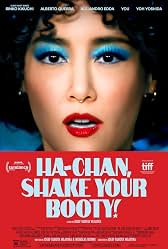

“Ha-Chan, Shake Your Booty!” (2026) starts with married couple, Haru (Rinko Kikuchi) and Luis (Alejandro Edda), living a perfect life in Tokyo, which includes competing as amateurs in ballroom dancing. When Haru loses her partner in life and dance to death, she is unable to function until her family forces her to return to Hozumi Dance Academy and is instantly attracted to Fedir (Alberto Guerra), the most recent dance instructor. Though the attraction is mutual, returning to life is messy and complicated. Does Haru need to grieve more before regaining her footing? Whatever you expect, don’t. If you are familiar with the narrative stylings of “Ally McBeal,” imagine that surreal style for the ballroom dancing set. It is not for pearl clutchers because while there is no nudity, there is profanity and sexual situations under unconventional circumstances.
There are some elements of “Ha-Chan, Shake Your Booty!” which may confuse you, so here is a quick tutorial. Adding “-chan” to a person’s name is an affectionate way to shorten someone’s name and make it cute. In Japan, the wife gets to decide the legal status of a dead body if no other person is designated. Some ordinary cabs in Tokyo are black, and the drivers wear white gloves. Using one does not denote wealth. In Japanese culture, seeing a black bird, which could be a crow or a raven, symbolizes the bridge between the human and spiritual realm or carrying someone’s soul. If a person is not cremated, the dead person’s soul may not transition peacefully into the afterlife and becomes a wandering ghost instead of an ancestor spirit. The smoke carries the person’s spirit into the afterlife.
Kikuchi is perfection in her portrayal of Haru. Haru remains sympathetic even when she does questionable things. Edda and Kikuchi’s chemistry in the opening is so convincing that it sets the stage for the rest of the story and will convince moviegoers that they were utterly in love. Director and cowriter Josef Kubota Wladyka’s composition of their scenes and the camera movement which follows her movement and highlights where she directs her attention reflect their importance to each other and their interests. “Ha-Chan, Shake Your Booty!” depicts Haru’s emotional reality, not objective reality, and fantasy dance sequences often reflect how she feels about the situation. When Haru and Luis share the frame, and the camera is still, it reflects the stability of their relationship. Set decorator Maya Tanaka makes their home into a cozy, peaceful paradise, and it also transforms in Luis’ physical absence.
Haru’s sister, Yuki (Yoh Yoshida), and the irreverent and divorced Hiromi (You), who flew from New York to Tokyo in with her son, Danny (Tom Harwood), ground Haru instead of allowing her to isolate and mourn indefinitely. Thanks to their intervention, she resumes leaving her house and socializing. Wladyka usually centers Haru in between them, and it is like a visual representation of the spectrum of Japanese women, especially regarding adopting other cultural norms to individuate their personal appearance and reflects their personality. The straight haired, even haircut, conventionally dressed Yuki is married to Eri (Yuka Mannami), and they have a daughter, Mila (Keren Louis). Hiromi’s hair is multicolored, unevenly cut, a younger way of styling herself. She is the Samantha of the group, and if she had a different demeanor, her comparing divorce with death would be incredibly callous. Both of them use tough love to handle their loved one, but their unconditional acceptance regardless of Haru’s actions and encouragement for Haru to live fully makes their dynamic riveting, which may explain why it is harder to get invested in Haru’s relationship with Fedir because it means less screentime for these three. (Side note: I thought they were all sisters, but a lot of reviews classify Hiromi as a cousin).
Haru has a type: Latin men. Dance is her gateway drug to romantic relationships. Luis was from Mexico, and Fedir never specifies his national origin, but he speaks Spanish. If the emotion was not so sincere, and if the men reacted differently, the issue of cultural appreciation versus appropriation and/or fetishization would come up, but I’ll defer to reviewers who share Luis and/or Fedir’s ethnic background. The story is divided into chapters and “La Catrina” seems to signal that Haru has more than appreciation for Mexican culture when Haru dresses as an iconic symbol of the Day of the Dead. José Guadalupe created the image as satire of a Mexican vendor rejecting indigenous for European roots. Diego Rivera later renamed from “La Calvera Garbancera” to the feminine form of the Spanish word for dandy, catrin. It is unclear whether Huynh and Wladyka are aware of the history, which puts a different spin on Haru’s cultural syncretism and preference for Latin culture, but for most of the general public, the association with the holiday may be separated from the lesson of death knowing no social status. The Aztec goddess of death and queen of the underworld, Mictecacihuartl, who protects dead bones, may have influenced Catrina’s creation. This figure is not a horror figure though her appearance kicks off the chaos in the second half of “Ha-Chan, Shake Your Booty!”
I watch horror movies for fun, but my horror movies are awkward social situations that are clearly going to crash and burn. It would be a spoiler to discuss the details, but Fedir is completely honest while all his students are busy objectifying him. Haru starts slow on a parasocial level before making her move in real life, but she approaches the relationship with dishonesty, including to herself regarding what she wants. While the early developments are conventional and sweet, it is also hard to suspend disbelief that Luis never catches on to the truth. Here are two teasers: he goes to her house without catching her in one lie, which means that he is not observant, and works at a place that she is so into that the people from the studio actually go to her birthday parties so how do they not casually mention salient details about her. Normally movies make guys into villains, especially one with an unconventional approach to relationships, but “Ha-Chan, Shake Your Booty!” makes him the sober, moral barometer regarding Haru’s ascent from grief. It was also a nice touch for the dialogue to indicate the amount of time that passed between their interactions because it was not always obvious.
Wladyka and cowriter Nicholas Huynh craft an absolutely unhinged trajectory to the end, and the biggest surprise is how often you may find yourself audibly gasping in shock and surprise. Just when you think the madness has stopped, it has not, and things get worse. It is an actual relief when Haru is prevented from doing anything else. It is the one moment where you may begin to wonder whether all the fantasy sequences actually indicated that Haru may not be all there and need help, but no, she is just a mess and her attraction irrationally morphs into jealousy and anger that Fedir is not Luis, and grief untouched every aspect of his happiness. While she directs none of those emotions towards him, it does appear in unhealthy, unacceptable ways in reaction to completely predictable circumstances. While the consequences are serious, it does not appear so severe that it derails the mood of “Ha-Chan, Shake Your Booty!”
Ultimately, the goal of “Ha-Chan, Shake Your Booty!” is not about Haru getting a replacement relationship but for Ha-Chan to let go of Luis and feel joy without guilt or minimizing grief. It is a character study without prose dumps, and Wladyka shows does not tell. His mother, a professional ballroom dancer, inspired this story. To be frank, it was obvious that most of the cast were not professional dancers because the dance sequences were not perfect, but they were expressive and reflective of the characters’ and scenes’ moods. They are still a joy to watch.
“Ha-Chan, Shake Your Booty!” felt like the most unique and consistently enjoyable and riveting film released today. Though some were frustrated that it was so expressionistic thanks to the everyone’s excellent work in front and behind the camera, including the earnest attempt at dancing from the actors without experience doing their best, prioritizing showing how the protagonist feels over biographical details worked. It is also the lesson of dancing, and now the lesson of this film. It is all about feeling.