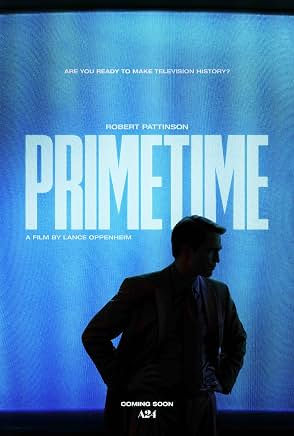

“Primetime” (2026) is an ugly film, inside and out (compliment), to portray three characters as potentially worse than the people that they ensnared. The movie profiles three fictionalized characters involved in the production of a segment from Dateline NBC, aka Dateline, a network television news magazine-reality television hybrid. Just as in real-life, the segment spins off into its own television series, “To Catch a Predator,” where a vigilante group lures unsuspecting adults, who behave like pedophiles, into sexually soliciting children, but are actually adults while the results get videotaped and packaged into entertainment. Robert Pattinson plays the host, Chris Hansen, like a lizard who found the sun and does not see the cold front moving in. Hansen’s producer, Andie Bender (Merritt Wever), is his producer, a soft voiced, people whisperer lulling people into throwing themselves against the rocks for her success. Dan Plumb (Skyler Gisondo, who resembles Jackie Chan) is an actor who just wants to do his job and get his SAG card but gets more than he bargained for when he becomes one of the decoys who lure in unsuspecting potential predators. Who is the real predator? Sorry, no xenomorphs here, just moral monsters. Writer Ajon Singh adapts Luke Dittrich’s Esquire article, “Tonight on Dateline This Man Will Die,” which sits behind a paywall and was published on September 1, 2007. The director Lance Oppenheim’s inspiration originates in his wife’s movie wrap congratulations gift of a Cameo congratulations video from Hansen who then pitched his movie ideas. It is Oppenheim’s first foray into fiction after being a documentarian.
Disclaimer: I cannot believe that I never watched “To Catch a Predator” because my mom loved “Dateline” and reality shows. I kept substituting Keith Morrison (great voice) for Chris Hansen, and nope, not the same. On the other hand, I did watch “Lost” (regrets, I have a few, think “Game of Thrones” last season). If you are looking for a blow-by-blow of how the movie measures up to reality, go to the spoiler section for a cursory examination, but if you want a more thorough comparison, prepare to watch “Predators” (2025), a documentary about the television series, immediately after “Primetime.” I would not recognize Hansen if my life depended on it so Pattinson could dye his hair blue and talk in a falsetto, and he would clear my bar of expectations.
“Tenet” (2020), “The Batman” (2022) and “Mickey 17” (2025) dragged me kicking and screaming to the Pattinson fan club, but I’m here, and “The Drama” (2026) and “The Odyssey” (2026) kept me firmly sat. His work as Hansen is unctuous like a man at a peep show getting ready to leap through the glass and attack his shadow self, which is perched writhing on the chair in the center of the room. Hansen comes off as a complete weirdo, a combo of fame whore, inflated ego and bottomless neediness that cannot even get quenched with the forced adulation of his young sons. It is a rise and fall story, but the rise is modest, and the fall is almost invisible if not non-existent other than to signal to the audience that the monster whom he hunts is actually himself. In one scene, he makes a great Lady MacBeth meets Pilate as he compulsively washes his hands after a predator touches him. He feels no guilt about his job, but fiercely frames himself as a father and protector, however, he is a father who does not actually parent. Anna Faris as his first wife, Mary, moves around the house as if she is married to Bluebeard and trying to survive without making waves.
If “Primetime” is worth watching, it is a chance to see Wever get more than a few minutes onscreen. People have described Melanie Lynskey’s take on feminine menace in “The Last of Us” and “Yellowjackets” as revolutionary, and the only way to destroy misogyny is to see women as full human beings and recognize that they are not a monolith of goodness, but as capable as men of being soulless. Wever is mesmerizing as Andie, a practical woman more reptilian and controlled than Hansen. Andie knows exactly what she is doing and enjoys it. She would unhinge her jaw and swallow everyone whole if it meant an ounce more credibility at 30 Rockerfeller. Wever shares a scene with Jessica Hecht that is practically Shakespearean. When I discovered that the only woman producer, Marsha Bartel, who was assigned to “To Catch a Predator” in March 2006 actually raised ethical concerns and allegedly suffered retaliation, my fun was spoiled. It is not a refreshing take on accurate villainy, but the same old trope of ambitious women as monsters. Ugh, come on. It is also possible that the motivation was more benign and did not want the movie to be a sausage fest.
Gisondo is the heart of “Primetime.” In a world that congratulates boys and men who are survivors of sexual violence as if it was a testament to their prowess, Gisondo’s take on Dan reveals how something can be harmful even if the external world behaves as if abuse benefits him. Dan’s immediate reaction is authentic, and he only adjusts after taking emotional cues from others. In many ways, he becomes the groomed and abused child that he plays on TV. Dan is constantly sexually assaulted and expected to exult afterwards. Dan is woefully unprepared at every turn: no informed consent, no clear expectations or instructions, few examples of how to perform his job, and no vocational calling for the work. He is at sea, and the dynamic between Dan and Chris is demented as a substitute father and son relationship even though they are both grown men.
Unlike the central three characters, implicitly Del (Phoebe Bridgers), another decoy actor, is a true believer who is in it for protecting kids, not increasing her fame or gaining power in television. In one scene, when she discovers inappropriate merch marketing the show, she takes a moral stand. In one hallway scene, the group walks in one direction while she walks in another with a meaningful look directed at Dan. Morality is not flashy, is generally a solitary exercise and swims against the tide. The trajectory of all three characters reflects a commitment to the work regardless or because of the moral implications. All of them had an opportunity to get out of their predicament if they found it untenable, but they double down. Implicitly, the final scene shows one character’s reward, and it seems paltry and anti-climactic compared to what they imagined. Is the exchange fair: what they gave up versus what they received? It is success as failure. Note who is missing from the scene if you watch it. Side note, I’m here for the Eric Rahill renaissance and all the casting directors who associate him with working out, being hot and encouraging in “Primetime” and “Maddie’s Secret” (2025).
Cinematographer David Bolen stylized the aesthetic and tone of “Primetime” to resemble the texture of watching analog television complete with lines, over exposed light, saturated colors and overall, an ugly, harsh, unflattering light. The color tone is often yellow or green raking a jaundiced eye to literal levels. The color of a scene can change even if the location or composition does not because it reflects the emotional temperature of the scene. Editor Daniel Garber’s work verges on surreal but occasionally feels like using a remote control to see what else is on the air waves during the time slot. As someone who lived in this era, the assessment of the tone of television was accurate. It is an ugly film, and the judgment is in the visuals, not the dialogue. Its most controversial aspect may be framing the vigilantes as even more pervy than the predators, who are not excused, but humanized though only a skosh. Even the full-frontal male nudity is harsh and shocking. It is an overall risky move to explore the nuance of hunting pedophiles, which has not been done so deftly since “Snowtown” (2011).
By highlighting the logistics of such an operation, “Primetime” interrogates the unholy syncretism between law enforcement, vigilantes and private corporation interests. The lines get blurred and amplifies the office politics for power into unforeseeable clashes. Perverted-Justice cofounder Xavier Von Erck (Matthew Maher) competes with Andie, who ultimately sways Murphy, Texas police chief Cortland Gunn (Bokeem Woodbine), to reinforcing her image as the decisionmaker.
If you are going to see “Primetime” because you are a fan of Chris Hansen or “To Catch a Predator,” you may want to slow your roll and reconsider whether it is for you since quite a bit of creative liberty is taken. If you are an artsy fartsy film lover who is interested in how visuals can show, not tell the story, then it is a must see. The only problem is that it may alienate the scores of people who would be interested in this story because of its complex message and experimental, expressionistic style.
S
P
O
I
L
E
R
S
Hansen did win an Emmy, but it was for covering child slave labor in India, not disappearances and murders. “To Catch a Predator” did appear opposite “Lost,” started on November 11, 2004 and ended December 28, 2007. Dan Schrack is the only decoy named Dan and only has a couple of acting credits according to IMDb. David Corvo was the producer. The November 5, 2006 raid on the DA’s house occurred during the day, and Billy Myrick was the Murphy, Texas police chief, and is not Black like Woodbine. After “To Catch a Predator” ended, “What Would You Do?” premiered on February 26, 2008. Around June 2011, the National Enquirer did cover a four-month affair with Kristyn Caddell, a Florida television reporter, but it occurred after “To Catch a Predator” ended. Hansen got divorced from his first wife in 2020 after she filed on June 5, 2018.