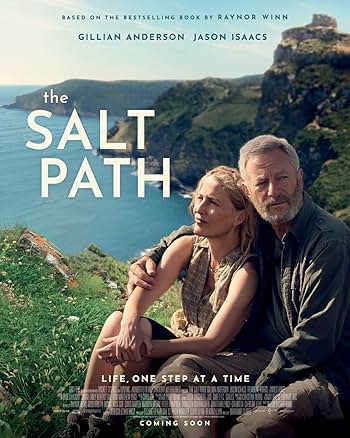

“The Salt Path” (2024) is based on Raynor Winn’s 2018 memoir, which details events that transpired in 2013. Disclaimer: On July 5, 2025, journalist Chloe Hadjimatheou published an article in The Observer debunking the book, and on December 12, 2025, the journalist hosted a documentary, “The Salt Path Scandal,” which I did not know before seeing the movie, and likely would not have affected my decision because I was there for Gillian Anderson, who plays the controversial author. I have not read the article or seen the documentary. A couple, Raynor (Anderson), nicknamed Ray and formerly Sally Ann Walker, and Moth, formerly Timothy, Winn (Jason Isaacs), lose their house, and Moth finally receives a diagnosis (CBD) explaining why he has been in pain for five years. Paddy Dillon’s. guidebook, “The South West Coast Path,” inspires them to walk the entire length of the path so they can have time to decide what to do after losing everything. What is home? Even if you are in it for the acting and because it is easier and cheaper than walking the path yourself, it will still feel a bit long and lacks connective tissue. Do not try this at home.
Anderson is a person who exudes confidence so seeing her play Ray so organically is a revelation. Ray starts as a frightened woman withdrawing into herself who gradually begins to put her shoulders back to better enjoy the sun and the fresh air throughout the journey. She is convincing as the devoted wife willing to bear the physical and invisible burdens of the relationship as the realistic partner. Still even while the make-up department tries to make it seem as if the sun bleached out or reddened Anderson’s skin, she still looks way better than anyone else would under similar circumstances.
Ralph Fiennes was supposed to play Moth, which would have made this movie a must-see film, but he chose “Conclave” (2024) over “The Salt Path,” and he made the right choice if only because Isaacs really wanted the role. Isaacs is an underrated character actor who somehow looks even better as Moth than he normally does cleanshaven. He looks like Alec Baldwin during his glory days after the glow of youth left. Moth basically starts with a visible limp and a sword of Damocles poised over his head. He is a bit annoying with his impractical optimism and minimizing of their position. Also, in the early part of the movie, he makes life needlessly harder when he does not contribute at the same rate as his capacity. There is a point in the movie when the partners function like a relay race, and he takes over doing the heavy lifting, which includes reading Seamus Healey’s translation of “Beowulf” out loud in public to collect money. It is very inspirational though it sounds ridiculous in a vacuum.
In reductive terms, “The Salt Path” is a journey about a couple getting their groove back and returning to their normative gendered roles through taking a sabbatical, spending time in nature, and divesting from material desires. While watching it, it is lovely to see the couple rekindle their relationship and revel in spending time with each other unless you are made of stone, but it is also glaringly obvious that the details of the origin story lacks details, especially during their only argument as they blame each other for losing their home. Ray blames Moth for entering an investment that they did not need. What was the investment? Dunno. He blames her for not submitting the letter earlier. Um, did they have a lawyer? Is she a lawyer? Why are they angry at the guy? What did he do? My kingdom for subtitles. Also how did they afford a house when they seem to only be able to perform hard labor and earn little? Sure Polly (Hermione Norris) is a friend who is willing to help, but how do they know each other, and why does she trust them? The holes in the story are as large as the path. Is it essential? No, but the idea that their first impulse is to walk instead of get a job, find a place to live then see how little money that they have screams that there is more going on that did not make it to the screen. If you are worried about being triggered, normally content about people being homeless is sufficient to ruin a good time, but the red flags actually helped because it meant there was a possibility that they were not actually homeless and maybe everything was exaggerated. It does explain why there are no closing credit photos of the present day couple.
If writer Rebecca Lenkiewicz had not leaned on the couple needing to be blameless to receive the audience’s empathy, the story would have worked better because if they are at fault, being homeless and hungry then finding your footing and rediscovering love still makes for a strong comeback. A redemption story is just as good. Lenkiewicz’s more recent films, “She Said” (2024) and “Hot Milk” (2025), are stronger than her other films, “Ida” (2013) and “Colette” (2018). “The Salt Path” falls somewhere in the middle so govern yourself accordingly and consider yourself warned. Her use of repetition in scenes, men walking their dogs and rebuking them and people on the path mistaking Moth for a famous poet, has a pleasant symmetry. The last act is the most interesting because they are just living an ordinary life, so the audience finally has an opportunity to contrast their walking selves compared to when they are clawing their way back to normalcy.
Compared to Lenkiewicz, director Marianne Elliott fares better in her directorial debut. It is a great tourism film. The main reason to see “The Salt Path” on the big screen is to experience the South West Path. It felt as if “Couture” (2025) possibly borrowed some moves from Elliott, specifically using a line on the hospital floor paralleled with following seashells on the beginning of the path. Showing which mile they were at felt unnecessary and not detailed enough without a reminder of the total amount of miles, which was six hundred and thirty miles. The schmaltz mostly works because she understands that the movie’s best ingredients should be centered.
During the majority of “The Salt Path,” the narrative toggles between the present and flashes back to explain how they ended up in this predicament with the exception of the opening. Lenkiewicz and Elliott did not have to open in media res with a chaotic moment. It did not create suspense but felt anti-climactic once the entire scene was shown. Tone-wise, the use of the same scene at different points in the story is so different and frankly feels like a bait and switch. “The Salt Path” is not the kind of movie that needs a cliff hanger (dad joke: you will get it). While the flashbacks were a fine way to structure the narrative, beginning with a “how we got here” opening did not work.
If the real couple “The Salt Path” walked the path, it was not necessary to make them aggrieved saints. If it was not for the talented cast or the film’s ability to capture the beauty along the path, this movie would not need to be watched in a theater.