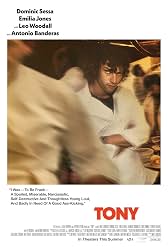

A couple of chapters titled “Food Is Sex” and “Food Is Pain” in “Kitchen Confidential: Adventures in the Culinary Underbelly” inspired “Tony” (2026), an estate authorized biopic about the struggle for Anthony Bourdain’s soul during his young adult days in Provincetown, Massachusetts, which was thankfully and blissfully shot on location complete with a cameo from Bourdain’s best friend. Set in 1975, with aspirations of becoming a writer without writing, Tony (Dominic Sessa) leaves New Jersey and heads to P-town to pursue Nancy (Emilia Jones), a college classmate whom he had a crush on when they went to high school together. When he runs out of money, Chef (Antonio Banderas) takes pity on him and allows him to work at his restaurant and sleep on his hammock. Tony begins to appreciate cooking but has a hard time letting go of shrouding himself in lies to bolster his public image. Will he be honest with himself and what kind of life he wants, or will he keep pretending to be someone he is not while acting as if he does not care? This story may be more fanfic than fact, but the film captures the conception of a person whom we never knew but loved so we can share a magical cinematic communion between the living and the dead. “Tony” feels true to the spirit, nostalgia and beauty of a past that never was and gives us permission to remember him again.
My mom and I did not enjoy many of the same things, but she thought Bourdain was hot and was fine with watching all his television series where he globetrotted and took us with him. I could get with that program because I faithfully owned and read all his books, which I gave away to an even bigger fan. So I feel a bit proprietary over Bourdain’s memory, and theoretically Sessa does not fit the bill. No one does. “Tow” (2025) made me concerned that Sessa was a one hit wonder, but he is perfect here, and he shoulders the big responsibility of becoming a man that many can still recall. More experienced actors have faltered under a lighter burden. Director and cowriter Matt Johnson (still need to see “BlackBerry”) is brilliant to start “Tony” in the dark and hearing Sessa’s voice before showing him. Sessa channels the voice, cowriters Todd Bartels, Lou Howe, Johnson and Matthew Miller nail the dialogue. Sessa sounds like Bourdain, which makes it that much easier to immediately suspend disbelief and believe that you somehow jumped in a time machine and are fortunate enough to see Tony discover the joys of cooking.
Except of course, it is not true. If it has been awhile since you read the book, it is familiar enough that you can go with it but feels just off kilter enough that you may find yourself suppressing the urge to read and come back. May I suggest not doing so, going with the flow, reading then going to the theaters again and appreciate all the little notes that you missed the first time. The charm of “Tony” is the rhythm and routine of discovering the pleasure and joys of a life that he never knew was an option but turns out to be key to unlocking his true self. Then when there is a change in the quotidian practice, the shift pulls you in even closer. Tony is like an audience surrogate drawing us into an unfamiliar world and asking himself if he fits then the routine gradually makes room for him; thus, the change, but these steps are initially gradual then monumental. Every day is the same until it is not then it is like discovering a whole new world at your doorstep. The ensemble cast brings that world to life, and it feels viscerally real though it is so clearly staged.
As Sal, Leo Woodall is pivotal to the first act of “Tony.” Woodall is becoming one of my favorite actors. God really gave with both hands when He made Woodall: hot and a perfect actor. Sal is everything that Tony pretends to be, and Tony imitates Sal, the good and the bad. Woodall makes this insensitive, amoral, libidinous, sensuous man into the stuff of legends and almost aspirational in his insouciant approach to life. He is the path that Tony is heading: a life of fun bullshit until the bill comes due. Anyone who grew up in the Eighties shivers during his scenes of carefree sex and drugs, especially when he administers the latter intravenously. The movie frames Tony as more inexperienced and less self-assured than he was, so he eyes Sal’s actions nervously checking to see if Chef disapproves so that he can act accordingly.
“Tony” becomes a movie where cooking saves Tony and gradually transforms him into Anthony Bourdain thanks to Chef’s ministrations. To be clear, Bourdain had the opposite experience and out of spite for all the mean cool kids in the kitchen, Bourdain decided to prove them wrong and prove that he could be the best. Banderas is like a fantasy of the great chef preferring to live a humble life using the freshest ingredients while embracing a slower life filled with community drawn to food. Imagine adoring food so much that you spend your free time making condiments, and it seems romantic. While Chef may shake his head at the dissolute behavior of his employees, he draws the line at taking the Lord’s name in vain. Chef is like a fisher of men baptizing Tony until he becomes disciplined enough to appreciate the work. Banderas has still got it, and he is completely believable as the man who shows the way to Tony.
The entire cast is remarkable for making their characters feel recognizable. Cinematographer Michael Bauman captures the magic of summer in a coastal town, and part of the pleasure of watching “Tony” is visiting an eternal summer of perfection without responsibilities or bills. Editors Curt Lobb and Robert Upchurch even make a routine of washing dishes, shucking oysters and puking seem idyllic.
It feels as if the filmmakers considered making an everyman story with a twist ending that this person is famous and *gasp* Anthony Bourdain except then it would not make as much money except for people committed to the cast and/or the A24 brand. So the marketing makes it obvious, and the opening quote is a quote from the book, but if a movie goer arrives a little late, his last name is never uttered until the final scene. On the other hand, it thematically makes sense because at that point, he decides what kind of man he will be and becomes Anthony Bourdain.
“Tony” is the most religious secular movie about saving a man’s soul and setting him on the right path. The good news is that Anthony Bourdain got everything that he wanted and became a writer and a chef. The movie keeps it light and gives no clues about the battles that he fought and could not win despite being unique and special, but there is a poignant portion periodically devoted to the distance that he feels from his challenging mother as he realizes how much he emulates her and finds annoying. It is preemptive grief about the simultaneous love and annoyance of the other that is within you.