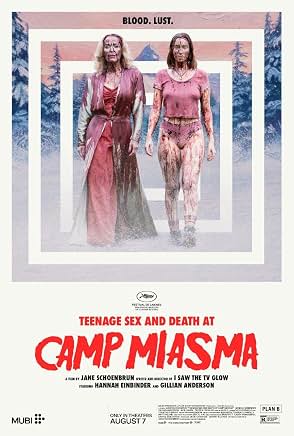

“Teenage Sex and Death at Camp Miasma” (2026) is Jane Schoenbrun’s latest greatest film. Director Kris Williams (Hannah Einbinder) is making a remake, sequel of the latest “Camp Miasma” film, a fictional slasher franchise with Little Death (Jack Haven) as the killer who shares some similarities with Jason from the “Friday the 13th” franchise. Kris heads to the Pacific Northwest to Camp Tivoli where the original movie was filmed and the actor who played the former first final girl, Billy Pressley (Gillian Anderson), lives. Their approach to art and filmmaking is very different. Will Kris be willing to step out of her comfort zone and embrace Billy’s visceral approach thus connect fully with herself and the world on a physical level? While scores of unsexy movies try too hard to extol the virtues of a sexual awakening while playing it safe, Schoenbrun easily brushes them aside to make a surreal yet relatable movie about how love of (exploitive) horror movies and sexual awakening can help people to evolve into their true selves.
“Teenage Sex and Death at Camp Miasma” is not subtle but still manages to be so literal that it may leave moviegoers scratching their head wondering what they just watched. It starts in winter with Kris encased in winter clothes then as the movie unfolds, the ice thaws, and Kris shed some layers. At the outset, Kris enthusiastically allows work to define her and connects to her body through the pleasures of eating concession food, mostly synthetic fare, the tactile pleasure and physicality of film like the solidity of the film projector, the sound of it playing and the visual pleasure of watching movies. For her, it is almost orgiastic, but her connection to other people is awkward, delayed and full of omissions. While embracing her queerness (she is polyamorous), she still cannot fully enjoy the world as a being of “flesh and fluid,” only as a head. Einbinder as the Schoenbrun surrogate makes a heavy lift seem light, easy and organic as she goes through an onscreen evolution which prioritizes the human experience over success. Einbinder proves that a meeker, less flamboyant character can hold her own if the part is written and acted well.
Schoenbrun understands that the familiarity of pop culture is the universal language that ties together some heady concepts that would be otherwise foreign to some moviegoers thus why she wrote a role with Anderson in mind. Anderson has had a chokehold on audiences since “The X-Files,” but once the series receded into television history, she managed to appeal to numerous demographics either by going full British costume drama having grown up in London since she was two years old or acting like a complete weirdo in the NBC series “Hannibal.” Anderson can add Billy to her list of iconic roles. Wilde was the best part of “I Want Your Sex” (2026), but the film did not give her enough room to show all the facets of her character. Anderson fills in the gaps between the young version of her character (Amanda Fix) and how she became the artist living alone who makes the same painting repeatedly in so many different incarnations akin to the compulsion to remake well-worn movies. While alive, the same moment can be experienced differently because of the change in time, place and personhood.
Billy shows her eccentricity when she plates KFC on an elegant, old fashioned dinner platter, but is self-aware enough to realize the impression that she makes and uses it to play harmless pranks on Kris. Billy is at a different stage in her life but does not wield her experience as if she is a superior. Instead, she is an unexpected soulmate who gently coaxes Kris into embodiment and impart the lessons that she learned which she believes will help Kris enjoy her body. It has the effect of transporting Kris into another way of filmmaking compared to the contemporary soulless approach.
“Teenage Sex and Death at Camp Miasma” offers terrific satire into the moviemaking business. While Schoenbrun loves film, the dialogue is teeming with ridicule over the people that Kris must work with to realize her movie. Instead of focusing on their conversation, her agent (Sarah Sherman) multitasks and plays squash with her teammate (William Vaughan) jokingly saying, “Hail Satan.” A zoom call with four studio execs is perhaps the most pitch perfect depiction of corporate speak with the unflappable Tracy (Jess McLeod), the senior exec, Jeffrey (Dylan Baker), the aspiring exec (co-producer Willy McGee), and the assistant with the movie trivia knowledge (Louise Weard). The intersection of artist with funding results in a culture clash. Kris also holds suppressed contempt for her partner, Mari (Jasmin Savoy Brown), without articulating her lack of desire to hang out with Mari’s guy, bisexual, Golden retriever energy Thor (Aren Buchholz). The denouement brilliantly uses horror as a wish fulfillment of clearing the deck of all these annoyances to get to the relationship that matters, which in turn leads to making the film that she wants, not a commercialized property for profit.
The name of the killer, Little Death, is a euphemism for orgasm. The killer symbolizes the ultimate freedom, a person who abandons any gender norms, embraces all fluidity, functions as an avenger against transphobes or anyone who is a tension point in someone’s life and is the essence of physical existence, all desire and action, not mired in paralysis and thought. Little Death becomes a God figure in this world. How many times have you heard that God has no gender and about His wrath? Honestly it is a provocative impossible to ignore depiction of incarnation. Also, the idea of a creator who allows Their beings to play and be creators, i.e. filmmakers, offers a fresh twist on the idea of Eden and being naked and unashamed. The idea of ascension, resurrection and baptism get taken to unexpected incarnations. “Teenage Sex and Death at Camp Miasma” is very subversive, and the apocalyptic cry, “He has the Final Cut,” is hilarious. Very apocalyptic. Nice.
“Teenage Sex and Death at Camp Miasma” is also one of the best-looking films of the year as Schoenbrun toggles between using 35 mm film to create the fictional franchise before returning to the present with matte landscapes that evoke a fantasy real world that makes it easier to believe when the couple enter the liminal space of the present and film. The geysers of blood against an unreal verdant, arboreal background sets the tone of an organic ornateness that complements the garish, synthetic colors of candy wrappers. Every living space whether a hotel or Billy’s home features the aesthetic of a movie theater. It is interesting how Kris and Billy begin to feel as if they are in the film as the light bleeds to the right side of the frame when they watch the first movie. It was also delightful how Kris cannot resist inserting technical talk (“split diopter”) into the viewing experience, and Billy does not want to be disturbed even though she lived it and has probably seen her movie countless times.
The standout comedic character in the movie within the movie is Eva Victor’s DJ Ella Giastic, a hyper feminine person with a punk mohawk who likes to nudge/hit people to make sure that her jokes land. “Teenage Sex and Death at Camp Miasma” is a movie with a sense of style and humor that accomplishes so much that other movies aspire and boast about but is nothing but vacuous image.