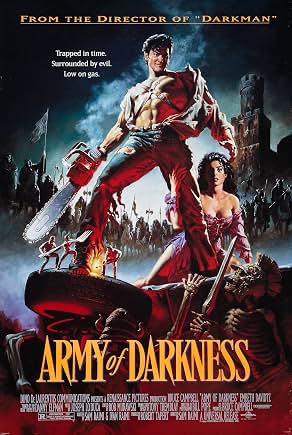

“Army of Darkness” (1992) is the third feature in the “Evil Dead” franchise, which currently consists of six movies, four graphic novels, a ton of comics, a television series and a partridge in a pear tree. It expanded a proof-of-concept short film “Within the Woods” (1978). It was not intended as a reboot to the franchise, but to resume at the end of the second film, “Evil Dead II” (1987), originally titled “Evil Dead 2: Dead by Dawn.” Ash (Bruce Campbell) gets sucked into the year 1300 after using the Necronomicon Ex-Mortis. Will he prioritize himself or help the people of that era fight the Deadites before going home? While the third film is not a fave and a complete departure in tone, location and stakes from the prior films, it still contains elements of cowriter and director Sam Raimi’s later films and is a cult hit for many.
“Army of Darkness” continues the trend started in “Evil Dead II” of changing huge swaths in its recap of what happened in the prior movie. There is no mention of Ash and his girlfriend, Linda (Bridget Fonda, the third actor to play her and she has zero lines), attending Michigan State University. The cabin’s original occupants are not even referenced so no credit is given to the professor and his family for opening the portal. The events of “The Evil Dead” (1981) are so far in the rearview window that they do not really exist. This Ash does not have any personal ties to anyone in his dimension except to his profession.
This time around, Ash reads the opening narration, which is very similar to the second film, but he is a blue-collar hero, a worker in housewares at S-Mart and is fully macho. It feels as if Raimi and Campbell realized how much easier it was to make a movie with primarily Campbell and let the other characters mill around, which is weird because “Army of Darkness” has the largest cast compared to the prior ones and multiple locations, but it is still very much the Ash show. Campbell is a physical genius, and if Jim Carrey ever claimed that Campbell inspired his work, it would not be a surprise, but it does feel like a waste to go to that much effort to expand a universe but essentially make the same film as the second. There are no other characters who can be interpreted as on the same level of importance in the story as there were in the first two movies.
During 1300 AD, Ash finds himself caught between two warring factions, Arthur (Marcus Gilbert) versus Henry the Red (Richard Grove) with most of the action unfolding in the prior’s camp. Arthur’s people mistake Ash for being on Henry’s side. This entire conflict is occurring despite the Deadites threat. To survive, Ash must defuse the situation, which is easier once he proves his fighting skill against the Deadites, and a Wiseman (Ian Abercrombie) helps him. After losing her brother in the war against Henry, Sheila (Embeth Davidtz) is just as eager as everyone else for Ash to die but becomes his love interest after he proves himself. Love interest is generous because this Ash is a love ‘em and leave ‘em kind of guy, not the man from the first two movies who were broken up over their girlfriend’s death.
This iteration of Ash has the emotional depth of a kiddie pool, recycles commercial slogans in dialogue as his personal thoughts and does not care about details even if they could save his life. Ash feels less like himself than ever before and seems to be more like a personification of an era and a sensibility. The action in “Army of Darkness” leans more towards humor in the vein of “The Three Stooges.” Instead of a disembodied hand acting like a mischievous child, a shattered mirror divides into smaller, multiple versions of Ash, and it becomes like a scene out of “Gulliver’s Travels” (1726) with the Lilliputians tying down Ash instead of Gulliver. That work was supposed to be satire so was Raimi making a similar move with a less obvious message?
In the first film, the most effective man is not the sensitive man who sides with the most vulnerable woman and has a feminine side. In the second film, the most effective man is the one allied with the academic woman over the locals who believe thoughtless action is the right route. This Ash is more like the locals in the second film: cavalier and careless except for the style. His ignorance and bombastic style are his assets. If he is a king, it is not in the traditional regent meaning, but like Elvis, the king of aura. “Army of Darkness” has a lot of style.
“Army of Darkness” features the outlandish, unrealistic fighting style that would be adored in “Xena: The Warrior Princess.” Lots of battle cries, back flips, acrobatics that look fake from people who do not seem as if they could execute those moves. So why did that action style appeal to more people in the television series over the third movie? The latter is really over the top and honestly looks goofier because it depicts demonic activity and is not frightening. Though challenging, Ash’s victory feels like a foregone conclusion. Initially as a woman, Xena fighting against a man or an entire army was a shock and a pleasant surprise. Ash fighting the dead begins to feel monotonous, and his interactions with the locals of that era fall short in terms of hilarity compared to a movie like “Monty Python and the Holy Grail” (1975).
Raimi and others involved with “The Evil Dead” express regret over the tree rape scene, which feels graphic but within the context of the story, is treated sensitively. There is a rape and pillage scene in “Army of Darkness,” which is played for laughs and titillation, specifically it gives the movie an excuse to show busty women, and one woman appears to have her top ripped off so the audience gets to enjoy bare breasts and sexualized imagery. The head of the dead army is very similar in attitude and appearance to Ash so while the attention is unwanted, he is not played as bad as much as entitled like Ash to women’s attention. The aesthetic of the first three movies has always been bodice ripper with Campbell also objectified and becoming more buff over time. Rape is framed as a liberating act that helps living women find sexual expressiveness as a Deadite, not a traumatic experience. “I may be bad, but I feel good.” The women in this film verge on two dimensional, and men adhere to gender norms in a way that the previous installments did not.
“Army of Darkness” is the final movie in the franchise made in the twentieth century. It set the stage for Raimi’s “Doctor Strange in the Multiverse of Madness” (2022) with better financing and technology to bring his vision to life and frankly a better story. While everyone loves Campbell, the franchise started to get self-indulgent and became more sizzle than steak or scares and even with more resources and people, showed that they then hit the wall in terms of creativity for Ash and the Deadites.