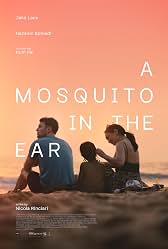

“A Mosquito in the Ear” (2026) adapts Andrea Ferraris’ 2021 Italian graphic novel, which is based on his life around 2002 when he and his wife, Daniela Mastrorilli, adopted their daughter, who is now twenty-four years old. The onscreen version changes the couple’s nationality from Italian to American. Daniela (Nazanin Boniadi, who was born in Iran) and Andrew (Jake Lacy) travel from San Francisco to Goa, India to meet Sarvari (Ruhi Pal), the girl that they adopt from the orphanage, but when they leave the grounds, she understandably freaks out. Will they ever be a family? This film is unintentionally an argument against international adoptions, especially if the Catholic Church is involved, even though everyone seems well intentioned.
Andrew and Daniela are introduced as an elated, united team mutually excited about the adoption, but as “A Mosquito in the Ear” unfolds, it is not long before they start to fray under the strain of being new parents and the ethnic and gender differences begin to function as obstacles. If you come to this movie unfamiliar with the story, it is not initially obvious that Andrew is supposed to be the protagonist, which is telling because he gradually must get acclimated to taking a back seat in the family dynamic without sulking. It is kind of funny to see Lacy in this movie considering that he also had a lead supporting role in the most positive movies about abortion, “Obvious Child” (2014). Lacy is the go-to actor if you are looking for a regular guy with some hidden software for being a supportive partner upgrades to get his character through tough times that would\ expose the worse side of most men. He has solid chemistry with Boniadi.
Daniela is more enthusiastic about being a mother and becomes impatient with how Andrew leans on her while being a supportive partner and feels as if he increases the burden when he adds to her workload. If you watch “A Mosquito in the Ear” without knowing anything about Boniadi, based on some of the dialogue and her appearance, it would be easy to mistakenly believe that she is Indian American, which would explain why sometimes insensitively Andrew expects that she can just understand their daughter even though neither he nor his wife speak Hindi. Daniela is not depicted as perfect. She gets impatient with Andrew when he has some human moments even when he does what she says, but the fact that he needs a break on the first night, and she has to tough it out when she has the same level of experience in child rearing makes her frustration palatable. Boniadi does make her character seem a little uptight, but because it is so easy for people to demonize moms, it is a miracle that she manages to make her character relatable until the eleventh hour.
Pal is in her acting debut. Child actors in movies have a lot of pitfalls to avoid from being too stagey or being so annoying that it is easier to forget that they are supposed to be playing kids. If you are an English-speaking viewer, then there is less of an ability to critique line delivery because Sarvari does not speak English in the movie. Pal has a physically rigorous performance complete with a dining incident that will give nightmares to anyone who watches it. She projects all her character’s emotions on to her face so even when the viewers do not understand what she is saying, no translation is needed. “A Mosquito in the Ear” puts moviegoers in the parents’ position and at least in the screener that I had, there was almost no translation of what Sarvari was saying in Hindi so it is more likely to empathize with the parents’ plight. This creative choice betrays the filmmakers’ intent. They think that the target audience is adult, likely parents, and spend less time considering that they are not considering a potential audience of adoptees who relate to the child character, especially her refusal to leave the only home that she knows. She is the real hero of the story, and if the movie begins to pick up momentum in the denouement, it is because the story begins to treat her as a character, not an accessory.
In his feature debut, cowriter and director Nicola Rincari makes a colorful film that reflects India’s beauty. While he may have made a faithful adaptation and should be praised for reflecting the challenges of adoption, the actors must do a lot of heavy lifting to make this process seem normal, not traumatic for all involved. Considering the evolving discourse on adoption, a filmmaker’s duty is not only to be faithful to the letter of a story, but the spirit of the story while translating its sensibilities so the audience can understand it today. The few changes further complicate an already complex story and risk framing Andrew as more negative with the cultural, nationality and interethnic differences in the onscreen marriage versus the offscreen couple. It was already a cynical move to make them American so more money could be made, but adding texture requires knowledgeable writers who are equipped to handle intersectionality. It is a misstep, not grievous, but it could have spelled disaster.
Rincari seems to be oblivious to the global controversies surrounding children, adoption practices, abuse and global treatment of indigenous people in relation to the Catholic Church. He kind of assumes that nun equals good, and Micky Singh, who plays Sister Aruna, brings enough innate credibility to the character to make her not seem as if she is engaging in child trafficking for profit, but that character is still shady. All the people who work at the orphanage are depicted as people who care for the children, and the children reciprocate, but when “A Mosquito in the Ear” shows their transition practices, it does not matter how many times women chastise Andrew, he is right. The process is just toss the kid at some adults who cannot communicate with the child and hightail it out of the country before anyone realizes how messed up it is. The default is that the child will adjust to the parents, not vice versa. There is no language or length of stay requirement for the parents. The only standard is that sick kids go to wealthier Westerners, and healthy kids get to stay home. Um! So also, an ableist adoption practice albeit practical. Also, Sarvari is understandably scared of Andrew because she is not familiar with men, and she does not even realize these two are supposed to be her parents because no one told her. While Andrew’s pain at being eyed with suspicion, even from his wife, or ignored is visceral and fair, it is nothing compared to Sarvari’s wise skepticism, especially considering her vulnerable societal status.
“A Mosquito in the Ear” sticks the landing and stay for the closing credits, which includes actual footage from Ferraris’ and Mastrorilli’s trip and likely animation from the source material. The best adaptations reject the limitations of reality and are supposed to fix the deficiencies of life through acknowledgment or shifting focus and devoting more attention to subjects that were present but not fleshed out. It is better to fix past problems than repeat them.