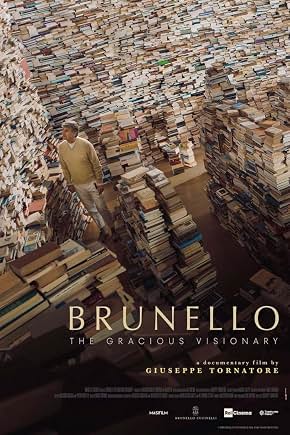

“Brunello: The Gracious Visionary” (2025) is a biographical docudrama about Brunello Cucinelli, an Italian who rose from being a peasant to creating an internationally known luxury brand. It also happens to be Giuseppe Tornatore’s most recent film. Though beautifully shot, anyone unfamiliar with Cucinelli will find it challenging to exercise patience to wait and find out who he is and why they should care. Even fashion lovers will have to wait for more than half the runtime to glean any germane information. People who just want to be sold a rags to riches fairy tale mostly set on the Italian countryside may get more bang for their buck if they see it as a cheaper alternative to going to Italy. Otherwise, the beautiful, but boring docudrama feels like an indulgent vanity project so Cucinelli can relive the past.
Have you had the experience when an older person in the winter of their life has told everyone their stories and are largely ignored? (I’m older people.) They are thrilled to get a new audience who will listen to them, but the reception will vary depending on the quality of the storytelling, the person, and the content of their story. Theoretically Cucinelli should be interesting, especially to Americans who dream of becoming self-made men with an embarrassment of riches. Instead, the narrative meanders through a nostalgic, hagiographic, barely structured tale with almost no momentum except wondering when will “Brunello: The Gracious Visionary” reveal why Cucinelli has a movie devoted to him. The first hour is about his childhood on the countryside in a sharecropping family, and poverty has never been so idealized. Subsequently, a half hour is devoted to his dissolute gambling days at a bar, which explains the periodic flash of him shuffling an ancient dark set of cards. It is spun as wholesome. Are they also selling a bridge? The final quarter is a whirlwind of success complete with renovating castles, towns and establishing the Universal Library of Solomeo that does not appear to have a Dewey decimal system and requires deft Jenga skills to borrow a book if it is really available to the public with ceiling high piles of books instead of shelves. It makes for an amazing set to interview Cucinelli with not a single patron in sight. Check out the movie poster if you are curious.
If “Brunello: The Gracious Visionary” does not feel like a real biography, it is because even the bad times sound good in a flat, press release take on rustic romanticism kind of way. In one tale during his salad days at the start of his business, Cucinelli regales the camera with tales of braggadocios claims of success within earshot of prospective buyers. It often feels like Tornatore is similarly obliging with a cinematic reprise of this way to drum up business. Cucinelli tells a story then Tornatore recreates the tales as if it is a drama with actors playing the role. Good news: you get two movies for the price of one. Bad news: you get two boring movies for the price of one.
Occasionally Cucinelli will walk through the area where the drama is unfolding, and the actors are earning their paycheck. While Cucinelli does not come off as anything but smooth and relaxed, not needy or attention seeking, the actual ensuing movie feels as if he constantly needs to be the center of attention, and it could not be a movie because then he would not be onscreen for most of it. What is with the trend of recreating the past while the present person observes: “A Big Bold Beautiful Journey” (2025), “Eternity” (2025) and “Disclosure Day” (2026)? Each iteration loses emotional impact with each subsequent movie. When he starts combing goats to make cashmere, sure he has the experience to do it, but even the most naïve moviegoer will probably side-eye this “spontaneous” act before the cameras.
“Brunello: The Gracious Visionary” lays on the praise really thick. It is most disconcerting when people tell stories about his childhood, i.e. they do not have a first-hand account, which Cucinelli probably told them, but Tornatore needs to break up the monotony of just Cucinelli talking for two hours. There is a huge assumption that the audience will recognize the interviewees. Dear reader, other than American viewers recognizing Oprah, who is described as “global media leader” and likely needed no caption, and actor Patrick Dempsey (random) and Chinese viewers recognizing actor Liu Tao, who apparently had her character regularly decked out in his clothes in a popular television series titled “A Man For All Seasons” according to the docudrama, you will not.
When his family members appear on screen, only the name (his wife, Federica Benda Cucinelli) or their business title may appear if they are women (his daughters, Vice President Cucinelli SPA Carolina and Camilla Cucinelli), but if they are men (cousin Walter Cucinelli, brother Giovannino Cucinelli), they get a name and relationship status. It is really weird and rack your brain to recall if you have ever seen that detail in a documentary before. Some childhood friends such as Paolo Parretta, Pino Roma can confidently share first-hand accounts about the past.
Most of the other interviewees are related to Cucinelli’s business: Head of Men’s Style Enzo Biagiotti, CEO Cucinelli SPA Ricardo Stefanelli, CEO Cucinelli SPA Luca Lisandroni, investor & board member Ramin Arani, Co-Head of Men’s Creative Team Alessio Piastrelli, Head of Women’s Creative Team Tiziana Pierangeli, Creative Team Women Giovanna Manfredi, President Cucinelli USA Massimo Caronna, Senior Tailor Damiano Labricciosa, personal interpreter Chiara Serafin, solicitor’s son Alessandro Mattii, artisan-sculptor Stefano Giannoni, employees Michaela Sgombra, Maria Grazia Funari and Patrizia Miseria. Other people’s relationship to the titular subject is left as a mystery: architect Massimo De Vico Fallani, President & CEO F1 Stefano Domenicalo, Rector of the University of Perugia Maurizio Oliviero, entrepreneur Gianluca Vacchi, Ade s.r.l. owner David Dottarelli, Prime Minister Mario Draghi, and LinkedIn & Manas AI cofounder Reid Hoffman. Some interviewees require no context and are obviously relevant: Esquire Creative Director Nick Sullivan, former GQ Global Editorial Director Will Welch, and Vogue China Founding Editor Angelica Cheung. One Catholic Church official, Father Cassian Folsom Order of Saint Benedict, sings his praises, but another deceased member is constantly referenced.
If “Brunello: The Gracious Visionary” is an infomercial or a vanity project, it is not for Cucinelli’s business, but for Cucinelli as a humanitarian, renaissance man who wants to style himself like the twentieth century nouveau riche, not the tech bro oligarchs’ selfish excess. He gets points for caring how he appears to the public. Also, he has a sense of style and is the king of neutral colors though he got success because of his bold approach in dying cashmere and marketing cashmere clothes to women. The aesthetic of the entire film feels in lock step with his company’s branding.
If “Brunello: The Gracious Visionary” was not intended to be an informercial or a vanity project, then let’s be charitable and return to the idea of a person reflecting on their life, but instead of busting out a bunch of dusty photo albums, they can afford to hire the renowned director of “Cinema Paradiso” (1988) who does not mind making a film to replenish the coffers. It is honest and respectable work that looks terrific even if all the coffee in the world will only help a skosh.