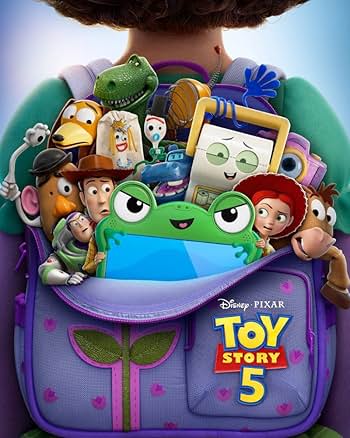

Bonnie (Scarlett Spears) is finding it hard to make friends because kids do not play anymore. Instead, they stare at their devices. Her parents (Lori Alan and Jay Hernandez) decide to get Lilypad (Greta Lee) to help her, but it only winds up making everybody unhappy. Will Jessie (Joan Cusack) find a way to face her past to find solutions to the futuristic problems? “Toy Story 5” (2026) is the best in the franchise with a pleasing balancing act between the toy and human characters. It is optimistic without pulling punches or being unrealistic.
“Toy Story 5” juggles a lot of balls without dropping one. There is a new sheriff in town, and sometime between “Toy Story 4” and now, Dolly (Bonnie Hunt) willingly ceded leadership of Bonnie’s room to Jessie, and unbeknownst to the toys, that room is an oasis in a vast wasteland of discarded toys. Visually achieving the zenith in animating this installment are codirectors and cowriters McKenna Harris in their feature debut and Andrew Stanton, one of the original writers of “Toy Story” (1995), in his first time directing a “Toy Story” film. Playtime is distinguished with pastel chalk like animation while the real-world scenes occasionally feel live action during the opening and one of the post credit scenes. It is not often that the story and the visuals are on the same level, and both are perfect.
“Toy Story 5” starts with a lot of division: tech versus toys, children who act like children versus mean children who mimic adults, Buzz (Tim Allen) versus Woody (Tom Hanks) vying for the deputy spot, stuck in trauma versus healing and taking one more chance. Young and old moviegoers will equally resonate with the question of what is an authentic relationship? Jessie is still wondering if all that time that she spent with Emily was nothing though it felt real. Bonnie can make friends easily online, but in real life, there is no connection, and she feels worse after hanging out in the margins of the group. There is also the idea of giving up entirely because it would be too painful to go through that cycle again. This doubt is like a virus that perpetuates alienation as a formerly open person retreats into themselves thus unintentionally making another open person feel similarly and destroying any potential for creating community of likeminded individuals. The emotional stakes in this installment are high, and considering the proliferation of friendship coaches for adults, moviegoers of all ages are guaranteed to relate to these dynamics. Harris and Stanton never take the easy way out and only blame technology for this heartbreak. It has always existed, and it just takes different forms. They also explore the phenomenon of how Jessie internalizes a systemic problem, which is a very American dynamic: to pathologize the person, not see a pattern playing out across all segments of society.
The goal of “Toy Story 5” is to find a sweet spot and not demonize anyone but celebrate everyone’s gifts and come together to find a solution instead of sitting in shame and alone. If you cause a problem, you fix it. Adults need to see this movie and learn this lesson. It is the first installment where the rehabilitation of characters who seemed villainous works because they are shown as three-dimensional characters like the toys though they function differently. There are numerous clusters of groups that slowly converge: the new inhabitants of Jessie’s first home, the ones who live in Bonnie’s home, a troupe of Buzz Lightyear toys and Woody’s new family of lost toys.
If you are worried that Buzz and Woody taking a back seat will not work, do not. “Toy Story 5” is the first time that Buzz’s mutability was not treated as a negative, but a fact that gradually turns positive and becomes an asset. Woody’s age is played for laughs instead of treated as a nonissue which may lead to ire from some fans since he has a paunch and a bald spot. He seems to suffer no long-term issues with the removal of his voice box. Most of the familiar toy characters are present, but not pivotal except for Bullseye who stays beside Jessie for most of the film, which makes sense considering that the film has a horse.
The new supporting characters who played essential roles are Smarty Pants (Conan O’Brien), a device that trains kids to go to the bathroom, Snappy (Shelby Rabara), a digital camera for kids, and Atlas (Craig Robinson), a GPS in the shape of a hippo. Their kid is Blaze (Mykal-Michelle Harris), who has succeeded in finding the balance between tech and toys, but also has problems finding other children who meet her friendship expectations. There is some foreboding that if she keeps getting disappointed, she could wind up like Bonnie and sink into herself. Blaze and several other characters are the first Black people appearing in a “Toy Story” film complete with the girls wearing bonnets when they go to sleep. Of course, because the bar is in hell, it could mean that a bunch of people will complain that Black people exist in a movie where toys can think, talk and move.
“Toy Story” and “Toy Story 2” are uncontroversial picks as the best in the bunch, and they are very focused movies with a clear trajectory. “Toy Story 3” (2020) and “Toy Story 4” were good movies, but they felt more like action adventure with humans almost irrelevant and the acting equivalent of wallpaper. The toys have often played out midlife anxieties that take place at home or in work, but the last two movies felt more like a cash grab to keep things going instead of emotionally wrenching works about a particular type of crisis. “Toy Story 5” is the first one which brings the pain, but at the end, it does not leave its audience wallowing in it and barely able to recover. I actually audibly laughed out loud numerous times. It also has a lot going on at once without feeling scattered or like the animated cinematic equivalent of a perpetual motion machine.
“Toy Story 5” is also the first in the franchise that feels complete but not over, and as if there is room for a quality sequel. It also is exciting because having the human beings more integrated into the plot opens the franchise up to fresher storylines, including showing parents parent well instead of being careless and making the toys’ lives more difficult. It is also refreshing to finally have a movie about technology that introduces nuance into the room. It criticizes and compliments technology equally. A lot of movies try to “both sides” an argument and wind up diminishing good and elevating evil, but Harris and Stanton found the perfect balance without falling into that trap. Now if they could apply those skills to all the hot button issues of the world, it would be a better place. Chop chop!