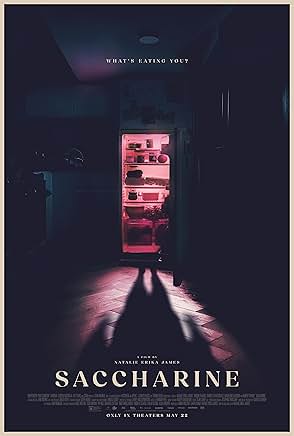

Hana Hitching (Midori Francis), a first-year medical student, binge eats. When she gets her first patient, a cadaver donated to science that a fellow student cruelly nicknamed Big Bertha (Anna Adams), she develops an unusual relationship to the corpse. “Saccharine” (2026) shows the danger when Hana decides to merge her taboo eating disorder with an alternative, unauthorized diet plan and her professional ambitions. Is writer and director Natalie Erika James’ third feature a little too long or does she just have such a deft way of turning her movie into an uncomfortable but brilliant entry in the body horror catalogue? It is a bit of autofiction with Hana as James’ onscreen surrogate.
Let’s get something out of the way. Francis used prosthetics to seem heavier than she is, but they made her seem deformed, not bigger than she is. Another character seemed distractingly and immediately fake in their fat suit and not in a horror way. It is a lot to ask an actor to gain then lose weight for a role because not everyone is Leying Du, and if that happened, it may cause the very problems that “Saccharine” is warning against. I did not have this problem with “The Whale” (2022) though I did engage with the discourse surrounding that movie but contrasting Hana’s appearance with another actor who is not thin, Danielle Macdonald, who plays Hana’s best friend, Josie, Josie looks healthy, glowing and normal because she is. To be fair, it may be integral to the story that Hana looks ashen and dull even before she starts her diet, but it was distracting even if it was intentional.
As “Saccharine” unfolds, James gradually shows more about Hana’s background starting with her same sex attraction to Alanya (Madeleine Madden), a psych major running a twelve-week challenge. Josie asks, “Have you figured out if you want to be with her or be her?” This question is redundant because the imagery of the montages already gets the audience there immediately. Editor Sean Lahiff and the sound design mix and link the ecstasic sighs and sounds of eating, sex and exercise. So sex and eating are ways to consume another person, and in horror, each have always been elements leading to the sexiness of death, but ultimately alienating nature and inherent loneliness of destroying who you desire and love. See vampires. Outside of the cadaver or anatomy lab hangs a photograph of an intact beautiful corpse except with her abdominal skin flayed and insides exposed lying amidst a lavish looking setting, which is a reference to Clemente Susini’s “Venerina” (1782), which translates to Little Venus, a life-sized wax model which had artistic and educational value and was intended to eliminate the need for human dissection. Such models were known as Slashed Beauties or Dissected Graces so even in death, a woman is still required to be beautiful. Hana’s profession’s relationship to bodies combined with the link to sex and food are inherently problematic considering that an euphemism for oral sex is eating, death is a source of beauty and desire, and the diet is not vegetarian.
On Hana’s birthday, Hana, Josie and Nikki (uncredited actor) go to a club, and a hot chick approaches Hana, but not to hit on her. It turns out Melissa (Annie Shapiro) was a high school friend, but she did not recognize her because Melissa lost weight thanks to a pill that is not government approved, but the catch is that it is expensive, so Hana decides to reverse engineer its contents. It is human ash. So she starts to take bits of Bertha, create it then take Bertha pills. “Saccharine” feels like a mashup of “Raw” (2016), “Flatliners” (1990), “Thinner” (1996) meets “Dr. Jekyll and Mr. Hyde” or some mad scientist storyline, especially when she begins to pass out. The story is some kind of mashup between a possession film and instead of a haunted house, a haunted body. The cannibalistic aspect is incrementally developed, and the mythology is understated, but rich if you have a familiarity with Buddhism or Taoism.
Hana is half Japanese, and her mom, Kimie (Showko Showfukutei), practices ancestor veneration and has an altar to offer fruits and vegetables to their ancestors, likely Hana’s maternal grandparents. If such offerings are not maintained, it is seen as disrespectful. A failure to remember to give offerings will weaken the spiritual connection. Sharing a meal creates a bond between the living and dead and may promote protection. If a living person eats the offering, they will absorb the spiritual essence of the recipient. So, what does that have to do with Hana and Bertha? Hana already engaged in disordered eating, but the connection to Bertha exacerbates it. The more that Hana eats, the bigger Bertha gets and the less Hana weighs. Bertha’s physicality is felt in the real world. Hana’s disrespect of Bertha through using her as a treatment instead of a person creates a connection between them, but Bertha’s presence looks rapey though it was not remotely sexual. Bertha appears nude, hovers over Hana and lies on Hana until their bodies begin to merge thus leaving Hana immobile and paralyzed so very similar to a succubus. Also, Bertha rejects Hana’s attempt to eat healthier and has an insatiable appetite, which rises to the mental health condition of pica, eating things that are not food. Hana’s apartment building’s trash chute gets paralleled with her esophagus as she throws garbage into her body.
This hunger is reminiscent of the supernatural legend of the hungry ghost, who has a small mouth and a distended belly, which is an image of hell through dissatisfaction. When Kimie asks Hana to care for the altar, she jokes, “We do not want to attract any hungry ghosts,” but that has already happened. Bertha’s actions in life do not align with her treatment of Hana in death. Here is where “Saccharine” falls short on the mythology though it is possible based on the last act that Bertha is not the lynchpin to this phenomenon, and Bertha is just the physical manifestation of Hana’s mental issues or projection of her feelings about being fat, but actually has nothing to do with Bertha’s actual spirit if it exist. If it is purely psychological horror, it sticks the landing as a horror movie. Before she started ingesting her, Hana saw herself in Bertha despite the complete lack of physical resemblance simply because they shared the same nail polish.
Body dysmorphia is depicted in a counterintuitive way. In Eastern mysticism, a convex mirror is supposed to be the opposite of a traditionally shaped mirror, which can act like a portal to the spirit world, and push away negative energy. It is unclear why James’ reverses the mirrors’ function here other than it is cool, but it could be the idea that because Hana does not see herself accurately, the convex mirror would have the opposite effect on her. The first act includes a plethora of social media images that reinforces her negative mind set.
“Saccharine” does give short shrift to the friendships. Josie is basically a footnote, taken for granted and does not play a pivotal role until the end. It is a bit of an exaggeration, but Hana spends as much time with Melissa as Hana based on screentime. It was frustrating that the idea was never bandied around that ingesting one person’s ashes is the reason that Hana experienced side effects, but Melissa did not. If you do not mind entering the mindset of a person living an unhealthy, dysfunctional life, then definitely check out James’ latest disturbing film.