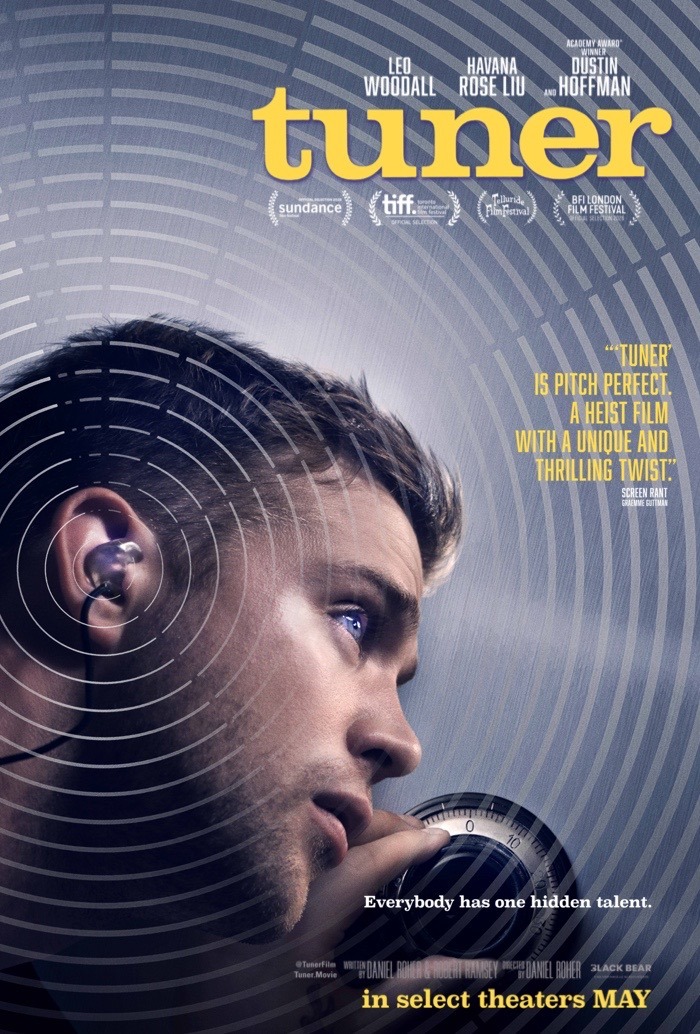

“Tuner” (2026) stars Leo Woodall as Niki White, a piano tuner who spends his days with his boss and father figure, Henry Horowitz (Dustin Hoffman). While working, he meets Ruthie (Havana Rose Liu, “Lurker”), a driven composer, and their common interest in music draws them together. When Henry gets sick and starts racking up medical bills, he decides to use his gift of perfect pitch, the ability to identify musical notes perfectly, and his curse of hyperacusis, being allergic to loud noises, to break into safes for Uri (Lior Raz) while maintaining Harry’s business. Of course, things go south. How will Niki pay for his transgressions and what is he willing to do for love? Director and cowriter Daniel Roher’s first scripted feature is an entertaining and energetic ride, but somewhat predictable as if the Hays Code was breathing down Roher and cowriter Robert Ramsey’s necks. You will not mind because it is such a pleasure to watch a talented, charismatic, interesting ensemble cast work together.
Why are some actors just compelling to watch even when they are not speaking or interacting with anyone? Even without the dramatic plot, people would watch Woodall just to watch Niki tune pianos and live. He was a compelling supporting character in a small role in “Nuremberg” (2025) and given a starring role, Woodall proves that he can shoulder any task regardless of size. He has crazy chemistry with any actor or inanimate object. He is also attractive and not in a pretty boy way, but a thick, meaty way. Niki is the gifted, wounded man who still gets coded as childlike because his primary relationship is with a father surrogate who knew his father. It is giving orphan energy. “Tuner” twists itself into pretzels to allow Niki to do bad things without being a bad guy.
Editor Greg O’Bryant does a lot of heavy lifting to keep the audience invested in Niki and “Tuner.” There are so many rapid cuts that the movie resembles a jazzy tune of montages as O’Bryant mixes shots of the most gorgeous city skyline on Earth, Niki’s work routine and after work activities. When the pace slows down for interaction and dialogue, it is not boring, but a rest. Silence and pauses are just as important in music and movies as the action. The scenes without the rapid cuts are about establishing characters, relationships and dynamics and are pleasurable to watch so it is easy to not immediately notice how predictable this story is with a few unexpected twists.
Hoffman mostly plays an active role in the opening of the movie, but he may get you to shed a few tears in his last speaking scene. Henry is like a stamp of approval to signal that Niki is a good boy, and their banter is a joy to hear. Henry has the gift of gab, which helps Niki snag a second chance to impress Ruthie. Liu is perfect as Ruthie, a high strung, ambitious perfectionist in an endearing way. In the wrong hands, Ruthie could be annoying or turned into a villain, but Liu keeps her grounded as someone recognizable to other strivers who believe that life gets in the way of a perfectly good work routine. It is also easy to imagine Ruthie as the star of her own movie and Niki as the villain if “Tuner” had different goals and was shot from her perspective without the benefit of having Niki’s side. Niki could be seen as trying to sabotage Ruthie’s work out of silent resentment over feeling as if he should have her life and keeping her at his level. It is a tight rope that the film navigates well, but it also may signal a strange phenomenon of making the straight, cis male into a minority and an underdog that everyone can cheer on thus keeping minorities as supporting characters who revolve around him, but because they dominate the landscape, it is less obvious. Side note: observation is not criticism. If “Tuner” is doing it, it is doing it well, and other movies could learn from them.
Is Niki a Gentile or Jewish? Based on his last name and appearance, the prior, but that could mean nothing. There is an idea that Niki may be a Gentile living in worlds that he would not ordinarily belong to if it was not for his disability and class through profession, not taste. Harry and his wife, Marla (Tovah Feldshuh) are his American Jewish parent substitutes. New York is a diverse city, and Harry’s work in jazz opens the door to other minorities (side note: Herbie Hancock looks like Jeff Goldblum). They work for the wealthy before crossing paths with recent immigrants who have a family business, Stern Sentinel Security. Uri is friendly and the boss. Benny (Nissan Sakira) loves his dog, Stacey, and watching videos of dogs on his phone. Yoni (Gil Cohen) seems more suitable for the role. The Sterns also present as warm and welcoming, but the nature of their work, betraying the trust that their employers put in them, suggests otherwise. This trio of actors act as if they are a family unit, and Raz’s ability to shift mood from sinister to affable on a dime nails the approach to the role. Please try to notice their first encounter with Niki before they know about his gift and just consider him a blue-collar worker. It is a great example of believe the first impression and portends how their professional relationship will devolve.
The safe cracking work seems safe and voluntary with victimless crimes, but things change when Niki becomes the victim as Uri feels entitled to Niki’s services. “Tuner” feels as if it is making a veiled political statement here that Niki lacks the discernment to distinguish between safety and danger because of a shared adopted culture and the underdog origins of immigrants. It feels as if the filmmakers are taking a circuitous route to address problems within the Jewish community which Roher is a part of. Even the Horowitz family cannot tell that the Sterns are a threat. Like “Marty Supreme” (2025), the Holocaust becomes the backstory of the film. The issue of the Holocaust occasionally comes up with the Sterns, who use toxic masculinity to survive or the spectre of domestic colonialism: prioritizing making money over morality, a ruthless approach to hierarchy, an extraction mindset, human rights violations, a disregard for human life and suffering as an over course correction approach to “Never Again.” The only antidote told is another reference to the Holocaust, which the denouement revolves around.
Of course, Niki is the main character so having the audience care about his safety over anyone else is understandable, but “Tuner” starts playing fast and loose with details, especially a heist involving crypto, and there is at least one implied murder that no one seemed troubled over. It is a movie with huge consequences while still becoming a happy ending that almost completely counters the negative side effects of violating the law while granting one wish to Niki for being a good boy.
Side note: is “Tuner” an elaborate commercial for donuts? I’m not being funny. Count the number of scenes where someone mentions or has a donut. Rolex makes sense because a heist is part of the process, but donuts?!?