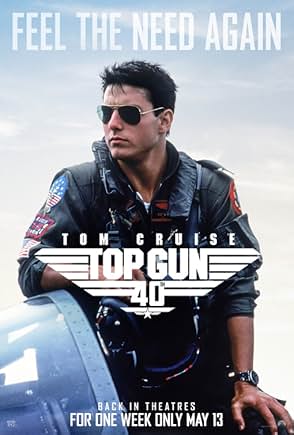

It is the fortieth anniversary of “Top Gun” (1986), which adapts Ehud Yonay’s California Magazine article, “Top Guns” (May 1983). With Paramount re-releasing it in theaters as a double feature with “Top Gun: Maverick” (2022), six years later, the bill has come due to see both films in the theaters as a double feature. I refused to see the latter because I did not feel like rewatching the prior or giving my money to a man who owns a Hawaiian island and may be considered a god so while critics raved about the sequel, I remained stubborn until now when the conditions are exactly what I requested. Pete “Maverick” Mitchell and his best friend, Nick “Goose” Bradshaw (Anthony Edwards), get into Naval Fighter Weapons School and learn how to engage in aerial combat (sung to “Mortal Kombat,” the techno version, of course). Upon arrival, Maverick immediately competes with Ice Man (Val Kilmer) to prove that he is the best, can shoot down the instructors, and snag Charlie (Kelly McGinnis), but will his rule breaking ways hurt others? Will he realize how serious his job is, and does he have what it takes not to wash out?
“Top Gun” always felt like a glorified informercial to improve military recruitment, and forty years later, to discover that happened is wild. It now feels like a reprise of WWII dogfight and air combat movies without the glory of a clear-cut war where the bad and good guys are openly fighting. Though the enemy is never explicitly named during the film, it is obvious to this Cold War baby that the red star on the enemy’s oxygen mask signals that they are supposed to be Soviets, but they do not talk. The final sequence was intended to involve North Korea but was scrubbed for obvious reasons. It feels like propaganda, but it also feels like a sports movie with slightly higher stakes, a manhood ritual complete with mysteries about legacy, fathers and father-figures. Instead of God, fallen comrades become spiritual guides. All existence revolves around fighter pilot life. The real sexuality is in the opening when in unison, the men turn to look at planes taking off and landing, which is likely why there were no love scenes in the original cut. The good news is that because of the huge incident that changes Maverick’s demeanor, the fighter jet canopy was redesigned and likely saved actual people’s lives.
Is the acting good? It is period appropriate for the Eighties, but it does not hold up forty years later; however, it may be prudent to blame the dialogue, not the actors. Reading reviews from that era, it did not exactly hold up then, but it was wildly popular. I did not see it in the theaters and part of me questions whether I ever saw the entire movie when it aired on network television complete with tons of commercial interruptions or just enough to talk about it as if I did. It was not my kind of movie for that era because it was not horror or comedy. On the Cruise meter, he is on the threshold of snapping his fingers to making a blockbuster: in between baby Cruise when he was a fetus powerhouse without the box office validation to movie magic Cruise. In the Eighties, having a brunette instead of a blonde male play the hot shot was diversity. It is also the movie responsible for Cruise’s adrenalin addiction. He learned how to ride a motorcycle and got the flying bug thanks to “Top Gun.” It would have an impact on the entire trajectory of Cruise’s career and thus movies and movie theaters for decades to come. So technically “Top Gun” saved movie theaters.
McGillis walked a fine line between the plausibility of a love interest and teacher as the one woman not dressed super feminine in dresses and showing lots of skin but still scorching in her professional wear or her tomboy jaunts. The use of shop talk to cultivate romance would fit in well with the drama of a porno’s idea of a hot teacher soliciting their pupil for information. Edwards is so lively as Goose, and I remember the surreal realization that Edwards was the same actor who played Dr. Green in “ER.” Kilmer as Ice, the responsible hotshot foil to Maverick, made the beach volleyball sequence work. If “Top Gun” was shot now, there was more chemistry between Maverick and Ice Man with all the glances, smiling and closeness. If the existing film was played as a silent film, it would not look like hostility but attraction. Charlie who? Meg Ryan just rolls up in a supporting role as Goose’s wife before becoming America’s sweetheart in a string of hit rom coms. Tom Skerritt and Michael Ironside as the elder statesmen fit the bill perfectly. “Top Gun” has a lot of heavy hitters in blink and miss them roles: Tim Robbins and Adrian Pasdar in his feature debut.
A lot of the situations would not work today. It was made long before the 1991 Tailhook scandal so a guy walking into the women’s bathroom to flirt with the hottest woman in the cast would not fly. Also, at least on the books, the military frowns on adultery, and that bar scene implies that Maverick is trying to hook up Goose even though he is married with a son. The running prankster coffee gag played on Air Boss Johnson (Duke Stroud) would be seen as more than silly antics with air traffic controllers more stressed than usual, but the one thing that seems to avoid getting reprimands is no helmet on a motorcycle.
What does work forever is the soundtrack, which is how “Top Gun” made an indelible impression on me. That soundtrack is still a banger, especially Berlin’s “Take My Breath Away,” Loverboy’s “Heaven In Your Eyes,” and Kenny Loggins’ “Danger Zone.” Though not a part of the original soundtrack, Deniece Williams’ “Let’s Hear It For The Boy” (1984) plays in the background of one scene. Even the songs that sound dated function like a time machine and perfectly encapsulate the era’s vibes: Cheap Trick’s “Mighty Wings,” Kenny Loggins’ “Playing With the Boys,” Teena Marie’s “Lead Me On,” Miami Sound Machine’s “Hot Summer Night” (and that woman singer is none other than Gloria Estefan), and Marieta Waters’ “Destination Unknown.” Harold Faltermeyer’s complete score was never released, but his work with Steve Stevens’ “Top Gun Anthem,” which plays in the opening, does appear on the soundtrack with another song and is played at the beginning of “Top Gun: Maverick” still evoking the same vibe without sounding dated though Faltermeyer used a polyphonic 16 bit stereo Synclavier Digital Music System, which is a kind of synthesizer.
“Top Gun” will never be my kind of movie but is the perfect product of its times for people who only think of existence as a world of the senses consisting of what you can see, hear and feel. It exists for people who want to live vicariously through Maverick without having any of his attributes, which includes walking a fine line between valid, necessary risk taking and sober sense of responsibility as the best and only one able to save others.