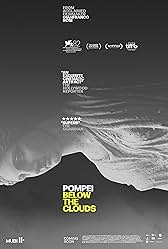

“Pompei: Below the Clouds” (2025) is a black and white documentary set in Naples from writer and director Gianfranco Rosi. Without narration, a structured narrative or identifying captions, the film captures snippets of life under one of the most historically famous active volcanoes. If you want to be informed, then this film would not suit your tastes, but if you enjoy experimental films, have time to give it your complete attention without interruptions, are not easily distracted, keep your phone far away and prepare to enjoy this undeniably visually stunning film. Only being able to see it on the small screen feels like a cardinal sin.
What is the difference between Pompei and Pompeii? In 79 AD, Mount Vesuvius destroyed Pompeii, the ancient Roman city. Pompei is the city that currently exists near the ruins of Pompeii. Without any identifying information, Rosi shows local and Japanese archaeologists, students and professionals, firemen, investigators, an after school program with students and one older man to answer all their questions on any topic, worshippers, Syrian sailors bringing grain from the war zone in the Ukraine, employees at an emergency call center, and tourists theorizing about the petrified bodies’ relationships while living. Rosi does not always show who is speaking whether the voice comes from a phone or a person near the camera. When it is a theory, at one point, he debunks it and plays the audio from a prerecorded tour offering scientific facts. All these people are telling stories with varying levels of accuracy, but even the most accurate tool cannot tell all.
The spaces explored are inside and outside public transportation, in tunnels, at archaeological digs, museum basements, phone banks, store fronts and interiors, inside ships, grain storage facilities, ruins, dark rooms developing photographs of antiquities, a church, beaches and the ocean. There are longshots of the city during the day and night. Periodically, Rosi cuts to the interior of a movie theater showing clips from different movies, including “The Last Days of Pompeii” (1953) and “Journey to Italy” (1954) starring Ingrid Bergman with her husband, Roberto Rosselini, in the director chair. As “Pompei: Below the Clouds” approaches the end, it is easy to confuse the negatives of the dark room with the moving pictures captured at night on black and white film. The way that stories are illustrated, i.e. the medium and choice of subject, affects how we digest the story or what we associate it with. After all, Rosi does not show everything in Naples. He shows spaces that are open to the public, i.e. either permitted, limited or vulnerable, but private spaces are excluded except for the audio that seeps from them.
“Pompei: Below the Clouds” reflects how the events of 79 AD still play an active role in quotidian life, particularly how people may have panicked at every tremor, but unlike today, did not have an expert who can reassure them with scientific facts offered on walls of monitors that the volcano is not going to blow and raze their town. It is human connection and solace through technology. There are of course more regular calls such as domestic violence, getting locked out of their home, reporting arsonists, or needing help after an accident. The volcano is responsible for the content on the radio, the profession of residents and out of towners from the University of Tokyo’s Villa Augustea Archaeological Mission. The mystery and unknowability of the past is at the heart of most present-day interactions, including the Prosecutor and investigators trying to solve the theft of ancient frescoes. There is a compulsion to relate to past when it surrounds you, and Naples is more than just its association with Vesuvius. When the present demands urgency and immediate attention, the past fades into the background.
So, what is the connection to the scenes involving grain? “Pompei: Below the Clouds” feels as if it is about death and loss and how people approach such complex subjects sideways. One student at the afterschool program just watches cooking videos on his phone and asks the man about the difference between grain and corn. They take for granted that it will always be available. A Japanese archaeologist discusses twenty-two years of digging and finally achieving results before segueing to the concept of grain as a cause for war that ease of international commerce eliminates to feed empire, which cannot feed itself. It is not obvious why he brings up the subject of grain? Is it routine or for the cameras? How much is performing for the camera or reality? After all, the Syrian sailors seem to talk normally while working out at the gym, but there is a camera there. Because these groups are speaking in other languages, it is impossible to discern whether the affect is organic and natural or sounds wooden and performative.
At any rate, whether staged or authentic, the topic of grain connects all three groups in the present to the past since it was a staple then too, but it also connects the peaceful locals and the Japanese team to the Syrians and Ukrainians, who experience war not as a concept or an artifact, but as a part of daily life. The locals are unconcerned with the war in the Ukraine though some of the phone calls reference a war without specifying which one, but the sailors’ radio is not tuned to a program discussing the volcano or local crime, but global news and the death of fellow Syrian sailors while working in the Ukraine. Everything and everyone are connected in ways that the filmed people are oblivious to, but Rosi captures the association even with the juxtaposition of a still shot of a mound of grain and the volcano. There are different ways that death comes for large groups of people: through nature and men’s actions.
While “Pompei: Below the Clouds” is a gorgeous film, watching it anywhere except a movie theater feels like an exercise in futility. If it is already challenging to capture the surreal and transcendent nature of a volcano and clouds through film, reducing it to a smaller scope feels akin to blasphemy or stupidity. It is a testament to Rosi’s eye that even if you equate the poetic imagery and accompanying audio to a soporific, you still may try to hang on. For the most part, it is still possible to see the nighttime or dark underground shots on a smaller screen in black and white film, which is impressive and is usually a common stumbling block for anyone watching a movie at home. Images lose definition under certain conditions. Again, it is not the way that it was intended and will likely be frustrating, but it works.
Even if you have no poetry in your heart and abstraction angers you, “Pompei: Below the Clouds” may absorb you for awhile. If you are expecting a straightforward documentary about volcanoes, Rosi makes Werner Herzog seem like a commercial filmmaker. If you find yourself in over your head, still try to finish it. Try to think of it as foreigners’ version of reality television without prizes like “Cops” without the spectacle interspersed with a few other genres if PBS had to take over programming for all the networks.