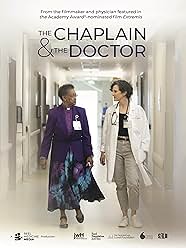

Set in Oakland, California’s The Wilma Chan Highland Hospital, “The Chaplain & the Doctor” (2025) is a documentary that focuses on Betty E. Clark, the chaplain, and Jessica Zitter, the doctor, as they work together at the hospital to ensure that the patients get better, holistic care. While it appears to be a slice of life documentary, it turns out that Dr. Zitter directs, and her husband, Mark Zitter, serves as one of the executive producers, which explains why the film takes a human interest approach to the subject instead of an advocacy approach asserting that this model should be adopted at other hospitals. It is more about the relationship between the two women with the hospital as the starting point before broadening to include their personal lives.
It probably only matters to film critics that Dr. Zitter is not transparent about her involvement in “The Chaplain & the Doctor” until the credits roll. The furtive approach makes it seem as if an independent filmmaker got so interested that they felt compelled to embed with these two women and tell their story. Late in the film, after a traumatic experience, Dr. Zitter talks about wanting to quit her job. This film is her first feature and a bridge to her new career, which is a terrific idea, but also explains why such a short film with two compelling protagonists can feel aimless at times.
A filmmaker includes themselves in a participatory documentary and influences the trajectory of the narrative, but the involvement is usually obvious. While the filmmaker sculpts the actual narrative, it does not necessarily change the subject and turn it into being about the filmmaker. A reflexive documentary makes no attempt to explore a subject because it is just about the filmmaker. Instead of using either option or a hybrid, Dr. Zitter makes “The Chaplain & the Doctor” seem like an observational documentary where the camera is a fly on the wall and seemingly allows the moviegoer to make their own judgment, but it is not. Dr. Zitter wants to be seen a certain way without bringing attention to her role in the process, which has the unintended effect of feeling a little exploitive and explains why her model of care is not advocated for and compared to others for efficacy. The model of care is depicted, but it is basically an infomercial for a person, and when the person is the filmmaker, they are usually too close to have an arm’s length perspective regarding what makes them interesting.
Even without knowing about her involvement, the opening sequence about the treatment of Naomi Thomas, who has a severe case of lupus, could leave a bad taste in the audience’s mouth. A woman doctor, who should have been shown, stays outside of the frame and talks smack about the patient with the implication that Thomas is not in as much pain as possible. This scene is the most concrete example in “The Chaplain & the Doctor” that shows the importance of Clark’s presence. To Dr. Zitter’s credit, she includes unflattering footage of herself obfuscating about the reason behind Thomas not receiving timely care before relenting and listening to Chaplain Clark, who is eager to solve the practical problem behind treatment. The medical staff already wasted Thomas’ time without offering any care or information on the status of her treatment, so Clark decides to meet Thomas’ explicit need for childcare. Dr. Zitter and Chaplain Clark both contribute $150 so Thomas can return for testing; thus, unintentionally revealing the problem behind equality and equity.
While they deserve credit for fixing systems failures that they did not cause, even within their improved model of ground level care, it does not reflect the reality that Dr. Zitter likely earns more than Chaplain Clark so proportionally Chaplain Clark is doing the heavy lifting with emotionally tending to the patient and her colleagues and financially disproportionately shouldering the burden without getting the credit, kind of like what is happening with “The Chaplain & the Doctor.” Fortunately, documentary films do not make money, but Clark does not get a filmmaking credit, which she may not want, in participating in this work and letting people into her personal life. Does she get creative control in how her story is sculpted? There is no code of ethics when it comes to filmmaking, but one person is in control of the narrative though to the viewer, it appears as if both women are subject to the filmmaker’s designs.
“The Chaplain & the Doctor” does improve as it unfolds, and as it approaches the denouement, Dr. Zitter finally does take a turn doing some onscreen heavy lifting but then fumbles the ball with off loading her worries on to the nearest person. The focus on the patients feels brief, and though largely positive, it is unclear if the patients feel as positive about the interaction considering that the doctor caring for them is also the doctor filming them. What choice do they have but to be positive? When the film parallels the two protagonists’ origin story, their initial interactions, their respective trauma then their social interactions, the documentary starts to gain some momentum and come together, especially because it seems convincing that their relationship is genuine and not just limited to office hours. Of course, now knowing Dr. Zitter’s role as filmmaker, it would be interesting to know if they socialized before making the film or if it was an idea exclusively done during the filmmaking process. It has the vibe of a classic, old school civil rights movie drawing on the tradition of common ground between Jewish and Black people.
The most interesting dynamic of “The Chaplain & the Doctor” is not race, but the ecumenical nature of their professional practice. Chaplain Clark appears to be a pastor at Miracles of Faith Community Church, a Lutheran church, whereas Dr. Zitter appears to be a Jewish person who is engaged with Judaism on some level. Both women participate in each other’s spiritual practices despite the obvious theological conflicts, which do not create a barrier for Dr. Zitter even though it could objectively be a problem. Neither woman attempts to convert the other. Dr. Zitter is a practicing Jewish woman who has no issue praying with Chaplain Clark, and Chaplain Clark is the same though it is a lighter lift and possibly a draw for a Christian to pray in the Jewish tradition. Most people would not be so chill and practical about this spiritual approach if they practice a specific faith. This approach reveals the reflexive sincerity in their relationship to each other and their patients. It is not a small thing for a Jewish person to publicly pray with a Christian without facing a possible negative backlash.
Dr. Zitter needs to watch more documentaries or make more films to hone her craft because she may be her biggest obstacle to her work. She made an autobiography without acting like it, which detracts from work. “The Chaplain & the Doctor” assumes that the audience brings a certain level of knowledge about what palliative care is, how work is normally structured, medical conditions, etc. While it is always wonderful to see a system work and coworkers getting along, it is unclear what Dr. Zitter hoped to accomplish with this poignant film. If it is to memorialize a relationship, then it worked.