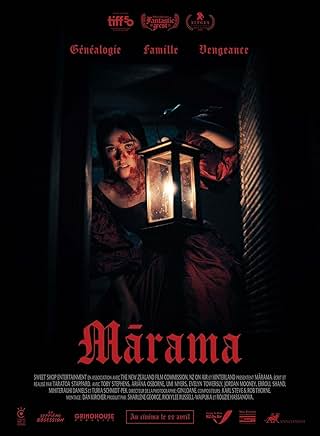

“Mārama” (2025) is a Māori gothic revenge horror movie, i.e. anti-colonialism comes to the heart of the colonizers and reclaims their own. Mary Stevens (Ariana Osborne) comes to Victorian England after receiving a letter from Thomas Boyd (Elliot Blakely). Boyd’s employer, Nathaniel Cole (Toby Stephens), invites her to his home and offers her a job as a governess to his granddaughter, Anne (Evelyn Towersey). While staying at his home, she has visions that reveals that the veneer of civilization and hospitality is thin. Will she be able to avoid the same fate as the women who came before her? Writer and director Taratoa Stappard’s feature film debut may be obvious in its trajectory but satisfying. More please. It would make a terrific double feature with “Is God Is” (2026) even though the films have different goals.
Osborne appears in almost every scene in “Mārama,” and she displays a wide range of traits. Initially Mary seems like a fully assimilated Victorian woman complete with the paleness and fainting, but it turns out that she is just knackered from a long journey thanks to bias and getting bombarded with nonlinear visions without a puzzle box picture to put the pieces together. To get a sense of her character, initially she seems to have the bearing of a woman from a higher class, especially compared to her foil, Peggy (Umi Myers), a woman who works for Cole, but the way that Mary reacts to the visions and Peggy suggests that her appearance and demeanor are not indicative of her inner character.
Cole is eager to have Mary under his roof and seems to be coy about how much he knows about her origins. Does Stephens only accept roles where his character seems like an upstanding leader of the community for a whole two seconds before seeming like a completely sinister figure? Without seeing a lot of his work, just the prior two entries seem as if he has a preference: “The Severed Sun” (2024) and “The Morrigan” (2025). While Cole professes to admire the Māori people and culture, Stappard uses the dialogue to indicate that he others and fetishizes them, and Mary is just an addition to his collection.
With the stage set, everyone is acting on their best behavior, i.e. as if they know less than they do. Mary never reveals that she sees more than they show her except through normal means, but the men of the house can barely stifle their true intentions. During a costume party (holy cultural appropriation, Batman), Cole’s business associate, Jack Fenton (Erroll Shand), mixes envy and mocking of the Māori culture, including his blasphemous claim that he is the closest to a Māori man that anyone present will get to one. The implication of offscreen violence is thick in “Mārama.” Cole points out that prejudice reduces her options thus he offers himself as a solution to a problem that he creates and benefits from. Anne notes that Māori men are becoming extinct. Where are all the Māori men whom the British men supplant and cosplay while gathering the Māori women and girls as if they are charitable guardians? The genocide implied off screen, but visceral and perhaps paralleled with Cole’s sanguine profession as a whaler.
The tools of the whaler are displayed at the party, but in a crass, phallic way that seems rapey at worst and sexually suggestive at best. Whales appear in the artwork and in Mary’s vision. The visions include Anne meeting Hinemoana (Mihi Te Rauhi Daniels) on the beach, another woman (also Osborne) screaming whom Mary believes is herself, but bearing on her chin a moko kauae, a traditional tattoo and an adult rite of passage that represents a woman’s mana, which means authority and dignity. The designs reflect the family history and commitment to culture. Much later, Mary sees an older woman, Arorangi (Turia Schmidt-Peke). As Mary makes sense of the visions, she becomes stronger. In contrast, Cole’s son, Arthur (Jordan Mooney), appears sick to his stomach for the majority of “Mārama” and reveals little about what he knows from his lived experience, but he drinks to self-medicate and deal with his disgust.
Though “Mārama” involves British and Māori culture, it is a story that many would find relatable, but your reaction to each step in the story will determine your spiritual health and ability to discern evil. Ask yourself if it is possible to honor a culture and celebrate the person that invaded it? Is just knowing a language and symbols enough or is understanding deeper? What is the difference between respecting a culture and fundamentally not understanding it and defiling it? What is the meaning of family and how should family treat each other? How can you tell when a person is using a word but attributes the opposite meaning to it? There is a relationship between colonization and patriarchy that is impossible to ignore and though many of the revelations in this story will feel shocking, it is not a stretch, and some variation exists everywhere, including in the US.
When Mary wears an elaborate red dress that Cole gives her that belonged to Anne’s mother, it feels as if he is claiming her. There is a slow burn revelation regarding how Peggy is treated in the house, and she seems like a spectre of Mary’s future. Like the ocean, the house is a dark greenish blue, aquamarine, and that splash of bold color is rare. The party celebrates Cole’s birthday, the source of his riches, whaling on the ship, Emilia, and James Cook, the British explorer who found New Zealand. At the party, the whale’s blood is symbolized with large bits of red paper. Yes, not exactly revolutionary to equate red with blood, but more so for a frail Victorian. When she enters a room during the party, the walls are red.
Mary is the ultimate final girl, a Trojan horse that colonizers see as conquered and assimilated because she bears few of the external markers of the Māori culture and appears to be only theirs, but just as they adopt the Māori culture without honoring it, she does the same, and her inner world is rigorously Māori. The title could refer to a male Polynesian deity, the moon and husband to all women and the cause of menstruation, blood. The moon also has a relationship to the ocean and is out for most of “Mārama.” Mary has a connection to the title, but it is a spoiler. From the beginning of the movie, Mary says why she is there, but arrogance renders them unable to understand the true implication.
“Mārama” is a film that should please horror fans and anti-colonialists alike. If you do not like it, how is your browser history doing? The implicit sexual violence, which never occurs onscreen, may be hard to stomach, but sadly, it feels like the most realistic part of the movie. The only part that feels fictional is the catharsis of the denouement when everyone lays their cards on the tables regarding who they really are and what they really want.