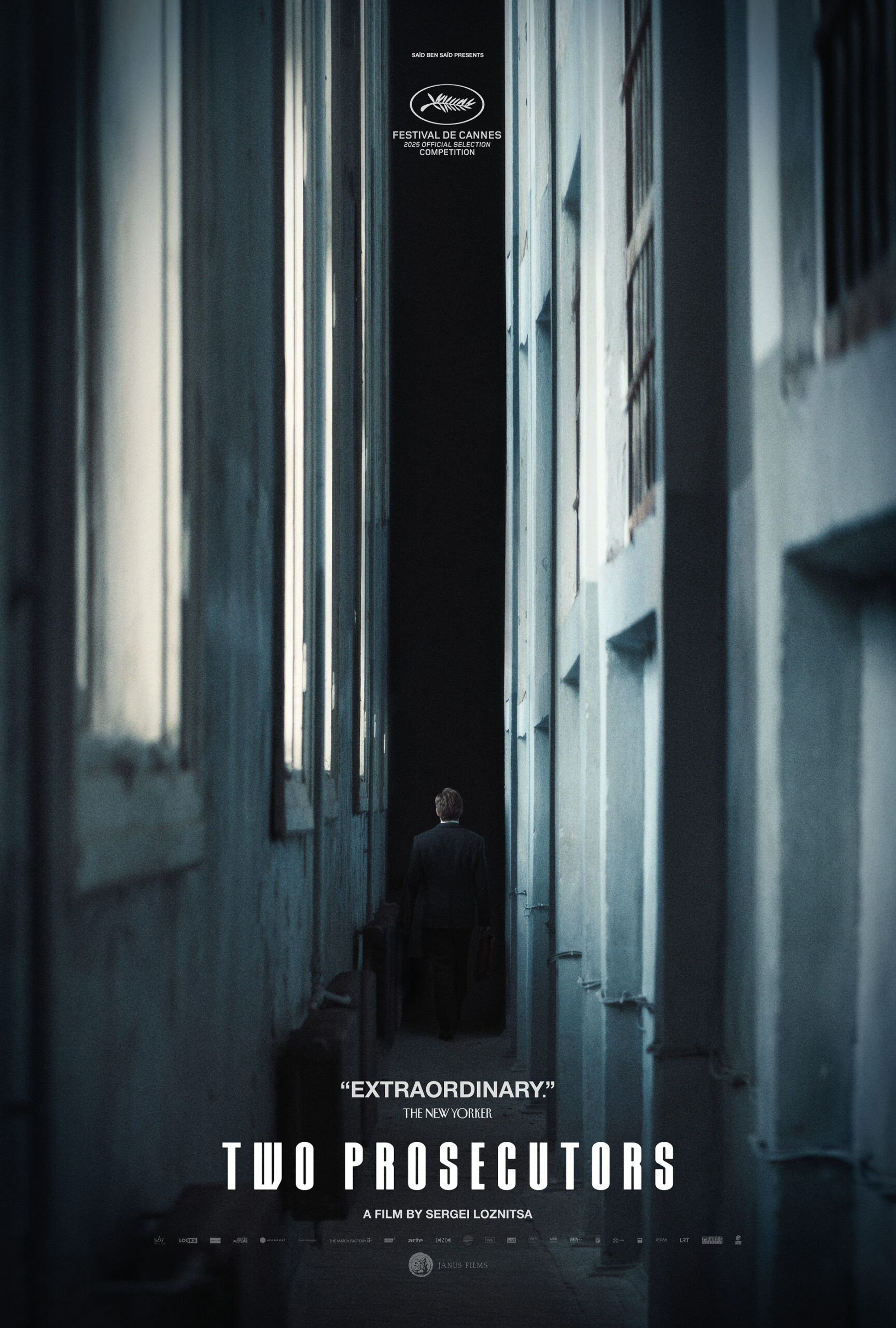

“Two Prosecutors” (2025) adapts Georgy Demidov’s 1969 novella about how doing your job can be hazardous to your well-being, and the corrupt and incompetent will inherit the earth. In 1937, in the town of Bryansk, a letter from Ivan Stepanovich, also known as IS Stepnyak (Aleksandr Filippenko), somehow reaches a local inspector prosecutor of three months, Alexander Mikhailovich Kornyev (Alexander Kuznetsov, who looks like a shorter Javier Bardem), who decides to investigate the NKVD for corruption despite knowing the risks. You need an attention span and a desire to read subtitles for this film, but it is well worth it. It is another film that captures true government terror unlike “One Battle After Another” (2025).
The opening establishing scenes are brilliant. The prison sequence consists of lots of long shots showing grids upon grids as if even the stairs are behind bars. In the room where letters are burned, the tableau looks like a painting. It may be stark, but it is also beautiful with the monochromatic, dark shades and sparse light-created distinct shapes. It would make more sense to burn them outside, but then the letters would be closer to escape. How does the letter make it out? It never gets revealed, but it is almost like an otherworldly test or trap. The note becomes a Rorschach test regarding which side a person belongs.
The protagonist is Kornev, and most of “Two Prosecutors” consists of him entering unfamiliar spaces alone armed only with his suit, his title, his briefcase and his official papers as a party member and an official. There are roughly four acts. The first act takes place in the prison, and “Two Prosecutors” allows the audience to see how the bureaucrats are toying with Kornyev instead of just doing their job because erecting obstacles to justice is a feature, not a flaw. The Prison Governor (Vytautas Kaniusonis) is full of good humor and veiled threats, but undeterred, Kornyev finally reaches his goal of meeting Stepnyak. There are some big, brief revelations about Kornyev as a person and what motivates him, which make the ending obvious. It is interesting that the diegetic sounds of nature are more present in the prison sequences than any subsequent acts. As brutal as it may be, the prison features a more honest and cooperative world.
As “Two Prosecutors” unfolds, Kornyev realizes how outnumbered he is, how many eyes are watching him, and how there is not that much separating him from anyone else except he is not on the right side of the bureaucratic jokes or hidden among the anonymity of the have-not masses. The second and last act take place on a train. Contrast the number of people on the car, the accommodations, the content of the conversation, and how Kornyev reacts to each environment. In both acts, Kornyev is tired and does not really glean the lesson offered in each car because he is so focused on his mission. Sandwiched in between the interior prison scenes, Kornyev gets contrasted with the masses, who know how things work. His pride in his position and work is like a target on his back whereas their numbers and dark, relatively shabbier clothes are like camouflage. In many ways, this film is about class and the perils of upward, professional mobility.
In the train, a disabled veteran (also Filippenko) tells another joke. The jokes share one thing in common. It compares a time before and after the Bolshevik Revolution, but both are dominated with the act of waiting for or amid receiving a punishment or reward. It is a cynical but accurate view of life that after working hard to make things better, the only constants are jail, injury, waiting and begging someone else for justice that even if received, will have to be requested repeatedly.
Kornyev’s trip to and from Moscow is much nicer but has one big difference. “Two Prosecutors” never reveals what the bureaucrats say about Kornyev and their plan on how to treat him. The accommodations are nicer, and unlike the prison, the employees seem more civilized in their suits, adhere to rules and appear genuinely busy. One bewildered man asks how to get out as he stands in front of a white bust of Lenin. Kornyev takes the question literally, but so soon after seeing “Exit 8” (2026), it feels like a more existential question about the Sisyphean plight of going, waiting, asking, rinse and repeat without ever escaping. The man is dressed similarly as Kornyev but older. Bureaucracy is a liminal space of the mind and soul.
Kornyev’s goal is to meet with the Prosecutor General Vyshinsky (Anatoliy Beliy) without following the rules of arranging an appointment. So, there is suspense whether justice will not come because of procedure, corruption or hierarchy. Kornyev is more at ease in this environment because it appears to be the opposite of the jail, and he believes that they share a language and a mindset about the world, but he is also disarming in the way that he admits to not knowing a man who claims to be a former classmate excited to see him.
The final act shares one trait with the first train ride in the second act. Everyone is very interested in Kornyev’s personal life and sexual experience, which is a dig about his youth and inexperience, but in the last act, also feels like an implicit threat on how “they” get leverage over someone that he loves, a threat of intimate physical violence or a leverage move to get him to comply so he can remain outside and experience life. While this take is likely accurate, because it feels like an overly familiar question to ask a stranger even if you are bunking together for a trip in this context, maybe it was normal because he does not seem flustered.
“Two Prosecutors” leaves a haunting impression and some unanswered philosophical questions that most people need to ask themselves regardless of which nation they are from. Is there a point in trying to make things better when inevitably the worst will inherit the earth and punish anyone who does not understand the unspoken rule of success? This film is one of the rare films that tell a lot about a protagonist without revealing anything except his name. He thinks of himself last, takes his job seriously, is self-sacrificial, believes in the principles that he was taught regarding the law and truth, and despite knowing the almost certain risks to himself, persists in his mission. So why even teach principles and create people like Kornyev? Why not deliberately create people like everyone else? Or if everyone is learning the right lessons for success, how do aberrations like Kornyev exist and glean a different lesson from everyone else? What happened to his predecessor? Why does this dynamic repeat regardless of nation, ideology and era?
The cynical answer is that it feeds the system either way. When the just and earnest are on top, the bureaucracy jails the incompetent and the corrupt. When the incompetent and corrupt are on top, the bureaucracy jails the just and earnest. While institutions, jails and bureaucracy seem necessary and neutral, they are also tools that are too indifferent to the needs that they should serve, The challenge seems to be how to create administrations that actually serve the people because no administration is too dangerous too. Sorry, libertarians.