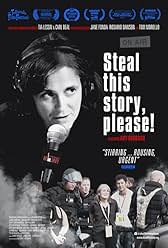

“Steal This Story, Please!” (2025) is a documentary about journalist Amy Goodman, who is best known as the host of “Democracy Now!,” a daily independent news program that operates without commercials or government funds since 1996. The film covers Goodman’s life as a journalist, including the childhood factors which influenced the trajectory of her career, and how “Democracy Now!” centers underrepresented voices when it covers a multitude of international, national and local news stories. At a time when journalism is taking a ton of hits, and journalists are losing their jobs, Goodman and her colleagues are a beacon of prophetic hope showing an alternative, countercultural way to keep the public informed without pulling punches or being slightly elevated regurgitated talking points from the powers that be. If this documentary treats its subjects too gently in honor of its thirtieth anniversary, it is a nice change of pace from their usual routine of getting insulted, arrested, roughed up or breathing toxic fumes to ensure that the news still makes it to the people.
Even though Goodman is the main subject, she is not the main subject. “Steal This Story, Please!” feels more like a career retrospective showing how she worked her way up to helming “Democracy Now!” and her most impactful news coverage with either photograph montages or archived video footage playing while Goodman or her colleagues recollect how it felt to cover the story. Such stories include the release of Bernard White from Louisiana State Penitentiary, the movement for the survival of the Ogoni people in the Nineties and oil companies’ interference, the environmental disaster after 9/11, and Iraq before the war started. The film also contrasts or reflects how journalists covered the same story or did not, so they had to reuse her footage to catch up such as the massacre in East Timor during November 1991 and the Standing Rock pipeline protests; thus, the story behind the title. When Goodman and mainstream journalists cover the same protests, the summary of the events is incredibly different especially Fox news on a Grand Central Station protest. Goodman was also in the business of rescuing news stories coverage from being killed when politicians threatened publicly funded news broadcasts if they broadcast controversial topics such as Mumia Abu Jamal’s jail conditions. She is also tough on both sides of the aisle such as the 2000 election day interview with President Bill Clinton or intervening when reporters were arrested for covering protests during the August 2008 Republican National Convention. The film even opens with a Presidon’t appointed official running from Goodman, who impressively keeps up despite having a likely 9/11 persistent cough and more years on her meter compared to the runner.
So why does it work in a documentary like “Steal This Story, Please!,” but feels like a clip show in “Lorne” (2026)? Well, these headlines were not well known at the time, so it is far fresher and not a part of oversaturated coverage. Also, old school journalism is becoming endangered, so it is almost a time capsule of some artisanal lost art or endangered species. In the future, this film could be used as an instructional manual regarding how to approach a news story: question authority, challenge assumptions or the party line, talk to the people getting hurt first, do not worry about being challenged for your demeanor or tone, especially since Goodman is such a gentle voiced, calm interrogator.
The documentary also shows Goodman’s daily routine in the newsroom. Goodman gives exclusive interviews about how her family, specifically her maternal grandfather, who was a rabbi, showed her how to question everything, complete with family home movies, more photograph montages, which include still shots of the family newspaper and yearbooks, and a couple of exclusive interviews with Amy and members of her family, including her dog, Zazu, and brothers David, who is still a journalist and made a handwritten newspaper when they were children, and George Goodman, who took after their dad, a physician. There is also old footage of her maternal grandmother, Sonia Brock, who, at the time of recording, was one hundred- and six-years-old. Because the film is effectively like watching Goodman grow up, it is easy to miss that there are no details about her personal life outside of her biological family. Is that an accurate representation of a life devoted to work or a reflection of honoring a request to keep her private life off the record? Regardless, she travels back to the Ukraine to honor her family’s memory in Rivine.
“Steal This Story, Please!” also features exclusive interviews with her colleagues such as Dave Isay, Story Corps founder, and NY Daily News columnist Juan Gonzalez, who also cohosts “Democracy Now!.” Other journalists such as Jeremy Schahill, Sharif Abdel Kouddous, and producer of “Democracy Now!” turned cohost Nermeen Shaikh credit her with giving them their big break. Early in the documentary, Goodman describes her dogged efforts to get a job on Phil Donahue’s show and failing, which worked out for all of us, but likely influenced her decision to take green people and train them. It is also a great way to ensure the survival of journalism, especially since it is currently contracting at an alarming rate. She even gives an interview to eighth grader Daniel Sagan for a homework assignment.
“Steal This Story, Please!” also chronicles how the media gets saturated with puff pieces often in deliberate and conscious concert with political agendas. It shows how right-wing male personalities such as Rush Limbaugh. Mike Pence, and G. Gordon Liddy dominated the media while crying foul at the slightest resistance. In retrospect, the coordination is obvious. On the other hand, mainstream corporate news media is more like entertainment and lacks the intellectual will to educate for fear of losing viewers. So, if this documentary is hagiography and derided as propaganda, an appropriate response would be to wave at the other sides of the table. It is a classic David and Goliath story, and the praise is possibly overdue.
If “Steal This Story, Please!” is flawed, it is the assumption that people are familiar with the people and big events covered. While there are brief summaries of each news story, it may still be challenging for people in the future to understand the context or recognize the names referenced. Also, it would have been nice for a portion of the film to be devoted to the logistics of doing a daily news show that has such a big beat to monitor. Also how does Goodman do it given her health challenges, which are downplayed here. On one hand, it would have been interesting to hear how they got funding. On the other hand, it would open “Democracy Now!” to attack.
“Steal This Story, Please!” may be the first documentary of 2026 which may resurface during award season. In the interest of full disclosure, I have never watched a full episode of “Democracy Now!,” and since I do not have the time to watch television and only read the news, I probably will not, but if I ever change my habits, this documentary did its job, and Goodman’s show would be my first stop. It is perfectly timed as a reminder of how journalism should look and how it can potentially help underdogs.