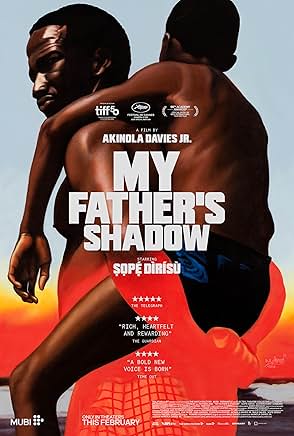

Set in 1993 soon after the Nigerian presidential election, “My Father’s Shadow” (2025) is about two brothers, Remi, short for Olaremi (Chibuike Marvellous Egbo), and Akin (Godwin Egbo) getting to spend a day with their father, Folarin (Sope Dirisu), nicknamed Fola or Kapo, which in Yoruba means “wealth remains” or “all is not lost.” This meaning sheds light on the real reason for the trip from the countryside to Lagos. It also happens to be the first time that the boys are leaving the village and going to a major city. It is an overstimulating day filled with fun, revelations and new experiences, including historic ones. The first film from brothers, director and cowriter Akinola Davies and cowriter Wale Davies, feels like a cinematic scrapbook of fractured memories told from children’s perspective, but retroactively this autofiction film will feel like a ghost story with Folarin as a restless spirit trying to complete unfinished business and convey a lifetime of love to his children in a short amount of time.
It takes thirty-five minutes before the brothers’ names and ages are revealed, but the world is shown through their eyes, and their personalities are distinct. Akin, who maybe could be assumed to be a fictional surrogate for the director, is a bit of a complainer, prefers sweet over savory, keeps his resources for himself and expects his older brother to take care of him. Remi is a typical older child. He reflexively makes food for his brother as well as himself but draws the line at bringing it to him. Remi plays with the wrestling figures that Akin draws much to Akin’s annoyance. It seems as if it is routine for the brothers to be at home and outdoors playing until their mother, Bola (Efòn Wini), returns home, which explains why they are so astonished when they discover that their father is home.
Once out of their comfort zone, they look to their father for guidance on how to get to and navigate the city. The director and editor Omar Guzmán Castro shoot the footage as if it was from a child’s point of view and height then because everything is new to the kids, the cuts are rapid, and composition fragmented. It symbolizes how a child does not know what is important and is taking everything in. Newspaper headlines and radio broadcasts indicate the election, and people casually debate between who should win: the military regime, Bashir Tofa, or the democratic contestant, MKO Abiola, which is short for Moshood Kashimawo Olawale Abiola. Even a quick bite to eat is embedded in interesting times. “My Father’s Shadow” shows and does not tell the effect that the political turning point has on ordinary lives. For instance, the minibus headed to Lagos runs out of fuel, and the father and his sons must improvise regarding how to get into Lagos.
Once in Lagos, the ripple effect is more apparent. The kids suddenly have insight into their parents’ past, their father’s job, his friends and his community. It is a realistic rhythm of meeting a bunch of adults, not having the whole story, and having a random day that covers a broad range of experiences from the joyful to the terrifying whether going to an empty amusement park to a traffic stop with armed soldiers. It is the children’s first experience in the broader world and realizing that their father is a vulnerable human being, not as fearsome as when he initially appears at home. It feels very realistic except it begins and ends with the quote, “Dear Father, I will see you in my dreams,” especially given a scene in which the father explains a brush with the supernatural before he had children. Is “My Father’s Shadow” supposed to be interpreted literally with shadow functioning as a synonym for a ghost?
Before the father appears, the boys are playing outside, and their routine is disrupted. They notice that birds are flying in the distance overhead in a circular pattern. Are the birds circling over dead bodies? These circular birds appear later during the Lagos portion of the day. The sound of flies buzzing dominate the diegetic sound with the camera zooming into the dense brush surrounding the house with nothing emerging. A huge wind makes them stop everything and go inside. The score gets portentous. The boys are concerned when entering their home as if they did not expect their dad to be there. Fola asks for a glass of water, and his irritability decreases. When the father touches cloth in a plastic bag, Castro intercuts a close up shot showing a close up of a knee of a seated person adjusting the cloth, presumably his association when he touches an outfit. It is as if a projectionist decided to insert scenes from another movie into the movie. Later, there are lots of cuts to scenes that do not fit anything but seem to reveal the father’s thoughts. When Fola asks the boys where their mother is, the older brother interrupts the younger, who was saying, “She is preparing.” Preparing what? The last scene seems to answer that question, and Remi does not want his father to know otherwise he would not be able to stay.
In the bus, a newspaper headline screams “Military Deny Deaths at Bonny Camp,” which is fictional and happened ten days before the events in “My Father’s Shadow,” and is referenced during radio broadcasts. It is the site of a protest, and rumors are that five people died. A woman notices a smell on the bus and according to the “who smelt it, dealt it rule,” the father makes a joke at his younger son’s expense. Soon after, his nose bleeds, and the screen goes black. The father is a proud, vocal supporter of MKO Abiola, and in a conversation with a friend called Corridor (Olarotimi Fakunle), they talk about campaign work. When Mekus, a coworker at Kamko Ltd., greets him, he has not seen him in a long time and says that he has not had a shift, but will get him one, which Fola does not seem to care about. Based on Mekus’ description of Kapo, he physically defended Mekus. Afterwards, he overhears a discussion about people dying at the protest, and it cuts to a nighttime scene. His nose bleeds again. Another patron says, “If you die for Nigeria, you die for nothing.” It is as if a suppressed memory is reemerging, and he is fighting the memory. When they bump into Aunty Seyi (Tosin Adeyemi), she is surprised that he is alive. Afterwards, the intercut scenes are at night and show Fola briefly looking at a military buckle. The amusement park guard asks Fola to tell his wife that he missed her, and another intercut scene follows. Fola’s lack of fear of the water could be another sign.
Whenever soldiers appear in vehicles, the camera moves in slow motion as if they are a foreboding sight, which they are, and are staring at him. Later a soldier reassures the other that there were no survivors when they think that they recognize someone who was there. Is the soldier jumpy with a guilty conscience or was that person there? “My Father’s Shadow,” the United Kingdom’s submission to the 2026 Oscars’ “Best International Feature” category, is a brilliant movie, but an emotionally challenging watch whether it serves as a reminder of the limitations of parents, the world’s indifference to human life or the cost of the infinite struggle to make the world a better place.