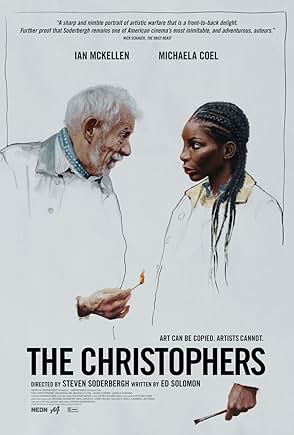

Finally, a real movie! “The Christophers” (2026) is the first movie of 2026 worthy to stay on the list for awards consideration through the end of the year. With the richness of a play but the intimacy of cinema, Michaela Coel and Ian McKellan hypnotize the audience with their individual excellent performances and their crackling dynamic. Director Steven Soderbergh is on a roll and proves that not retiring from film was the right choice. Who knew that writer Ed Solomon, the writer of the “Bill & Ted” franchise, the first two “Now You See Me” movies, “Men in Black” (1997) and “Charlie’s Angels” (2000) had such depths to his soul! 10 out of 10. No notes.
Most people know Coel for “I May Destroy You” (2020). Fans of Coel’s early work, “Chewing Gum,” will also be impressed, but not surprised at her range as the sculptured and sharp Lori Butler, an artist who lives for art and finances that lifestyle restoring *coughs, forging, coughs* art. Coel is beautiful and expressive with the slightest movements. Imagine an actor that can not only stand across from McKellan and hold her ground but make it convincing that her character could stop him in his tracks and shake him to his core. Lori is a fascinating person, especially regarding how she stands when her back should be up against the wall. She works better with truth than a lie, which is ironic considering her profession. The movie portrays art as an emotional autobiography.
Lori went to college with Sallie Milton Sklar (Jessica Gunning), who contacts Lori to do some work. Sallie brings her brother, Barnaby (James Corden), to the meeting at Lori’s local pub. The siblings want Lori to finish their father’s titular third series of paintings because the last set sold for scads, and irrepressible dying dad, Julian (McKellan), refuses to finish them or give them to his children. There is an allusion to Lori’s history with their dad, but no deets, and the whole thing is light and funny without being heavy-handed. Of course, the children are mocked as awful, but also not so bad that they tilt into villain territory. It is a tricky balance for Gunning and Corden to pull off, but they do. Their characters are so different from Julian that the fact that he does not deny them means that they are absolutely his.
McKellan could read a phone book, and it would sound amazing, but he has great material to work with worthy of his time and effort. When Lori enters his world, the first impression of Julian is his booming voice then his wall decorated with framed headlines and photographs of himself in his glory days. The idea that an artist just records cameos all day is hilarious, but when he is done greeting his fans, the real show begins. Everything Julian says is outrageous or profound. There are allusions to a scandal that tanked his career among other things that are left a mystery. They are not central to the story.
“The Christophers” embeds so many mysteries to solve that even as some beats are expected, others are subverted and countercultural, especially when it comes to intergenerational relationships. Julian believes that his kids hired Lori to be his assistant. Lori thinks that she will be able to pull off the scheme because he is too self-absorbed to notice that she exists when they sit across from each other. The real drama begins when he sees her, and through seeing her, sees himself, a hat trick that they perform for each other over the course of the film. First, they surprise each other, and then they surprise us. One meaningless spoiler is that Julian is never so bourgeoisie to threaten to call the cops, and she is more interested in his discovery than the money.
Solomon pulls off the concept of how a stranger can understand a person when that person does not understand themselves. Well, it is the art, silly. There was always the danger of Lori becoming a Magic Negro, but “The Christophers” never steps on that third rail. They take turns with Lori having an advantage that Julian does not. She already faced the worst and knows herself, but it does not mean that there is not room for more growth. The dance between Lori and Julian, her resolute, firm and unflinching, him “obviating” to fill the silence and questions until someone knows him, not his work or persona, but him through knowing and loving his work, not for the success that it could symbolize, but for what it means about a life. Of course, there is a reason that he never finished the series, and he does not want to be as spiritually naked as he is in front of her. There is a freedom to their interaction, a dance of limits with an invisible barrier that the other cannot push through. It is what intrigues him about her: how she resists his casual, often cruel curiosity, but when there is genuine emotion, even if it falls on the negative side of the spectrum, she permits the intrusion because it is not one. The greatest honor in the world is for someone to see you, accept you, want you to be more of who you are and not change you. It is the greatest work of a critic when done well. We show the people, who show the people, themselves.
Soderbergh captures their push-pull dynamic in one shot. Julian has a breakthrough, and they are essentially playing together. The framing and composition in “The Christophers” are gorgeous and delicious. It looks so simple that it is easy to take it for granted but don’t. Pay attention to who is in the frame. How much can you see of one or both people? Who is in focus: one, both or either? What part of them is in focus? In the scene, Julian loses himself for a moment then as he consciously awakens to what he is doing, his defenses come up, and just as gradually, Lori begins to untie and take off her apron then when he returns to his full strength of nastiness, she becomes gradually less visible with a slight shift of the camera until she is entirely visible then her bag slips from the frame, and she is gone entirely.
“The Christophers” is also the rare movie in which the art genuinely looks like art and is as meaningful as the performances around it. Who did it? Was it production designer Antonia Lowe? If so, the work, from “Boy under Cloud” through to its natural conclusion, was genuinely moving as if I could see a life, and two artists in conversation with each other through the work. It was quite lovely. As lovely as the film.