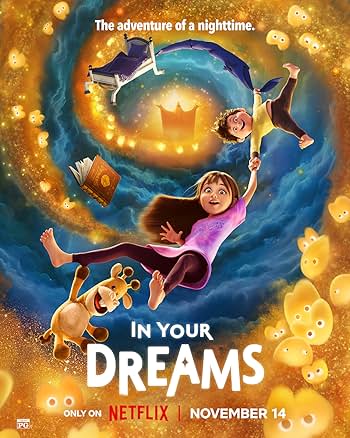

“In Your Dreams” follows Stevie (Jolie Hoang-Rappaport), a perfectionist little girl, who shares a room with her messy little brother, Elliot (Elias Janssen). When Mom (Cristin Milioti) announces that she is leaving town for a teaching job interview in Duluth, Stevie is worried that their family may be falling apart. When Elliot finds a book called “The Legend of the Sandman,” which promises to make all their dreams come true, she decides to look for the Sandman (Omid Djalili), but because they read the spell together, she must work with her brother, whom she perceives as ruining everything. Will Stevie keep her family together? Cowriters and codirectors Erik Benson and Alexander Woo pull punches and pretend that the lesson is about learning to be a child and loving your little brother instead of facing head on the unresolved problem of a potential divorce and how a dad stuck in the past strains every relationship.
Dad (Simu Liu) is drawn as a lovable lug and appears affable. Neither party is shown doing anything bad, but their actions or lack thereof are dangerous. It is easy to root for such a cute family, especially because the parents have an interracial relationship, and the kids are biracial. It is easy to equate such physical traits with a perfect family, but there is no such thing as a family without problems. “In Your Dreams” depicts a recognizable, quotidian family dynamic from the opening scene of a perfect happy family with the father making French toast. Baby Stevie interrupts the perfect picture with crying then Stevie overcompensates to solve the problem. The dreams become a visual metaphor of Stevie’s internal, psychological health. Stevie perceives her parents as helpless and her brother as cataclysmic as an earthquake or a storm. She knows how to solve the problem, but is outside the family, unable to reach them and neglected.
“In Your Dreams” raises some heavy issues, but Benson and Woo lack the same fortitude as Stevie and wants to smooth everything over without making anyone a bad guy. Everyone bears some blame over Stevie feeling insecure and responsible for everyone and everything. It is called parentification, a form of abuse where a parent makes a kid responsible for caretaking duties. It often happens when a parent or both parents are not doing the heavy lifting. Stevie is often shown as taking her dad’s place. As the movie unfolds, pay attention to who is making the French toast. In the first scene that is not a dream, Dad is playing on his guitar, and Mom is working. No one is parenting and making food for the kids. They are both neglecting their duties, but the motivations differ. Before Mom goes away, she secretly puts Stevie in charge of Elliot and ensuring that he does his homework.
See, once Mom and Dad were carefree members of a band called Hypsonics, but then they had kids. It is strange that none of their music is played in “In Your Dreams.” She grows up. He does not. It is easy to go with the flow when someone else is actually steering the ship, and you can sit back. Dad does not want to move, which is the real reason the family may have to break up. Who picks up the slack? The older daughter, a mere child! Let’s be clear. If Mom was willing to treat Dad like an equal partner capable of caring for their children instead of turning to her child to take up the slack or just stick to handling it herself if he is incapable of being an adult, then maybe Stevie would not be anxious over being given a task that neither adult can handle, caring for Elliot.
Benson and Woo set up a common backstory of unequal emotional labor where a child may start to realize that her parents are not up to snuff, but then they brush over it instead of confronting it. A lot of kids would have related to being the unofficial caretaker of their little sibling or the little sibling feeling as if their older sibling is more parental. It instills a lot of resentment. Stevie makes sure that Elliot stays asleep. Benson and Woo kind of do not understand how angry girls are, and none of Stevie’s anger ever gets directed at the parents, only at the brother. The resolution feels hollow because these problematic, harmful dynamics are unresolved other than Dad’s attitude shift and the promise of another band. Resentment between siblings often originates in the parents’ failure.
This discomfort with calling out bad behavior makes “In Your Dreams” lose tension. Benson and Woo do not want any villains even when the behavior is sinister. Benson and Woo understandably did not want to make anything too scary so it would be inappropriate for kids, but the fantasy figures, Sandman and Nightmara (Gia Carides), are ill defined and forgettable. The vocal work is fine, but Carides feels like a brand name Natasha Lyonne. Sandman should feel like a magnetic, mysterious figure. It is interesting how imagery that is usually associated with God and heaven did not fully get appropriated for a secular purpose with a voice actor with the vocal presence of a figure like Charlton Heston.
Otherwise, Benson and Woo nail how kids act. The obsession over food in the waking and dream world is a bit excessive and monotonous, but accurate. Also, food is Stevie’s love language so it makes sense that she would dream of a breakfast world. To conquer the dream world, Stevie must become more like Elliot: relaxed, fearless and messy, i.e. a child. Also because they learn to work together, they become closer. Bad news for adults: dreams are only interesting to the dreamer, and the middle of “In Your Dreams” will get you some solid sleep if you are not fully rested. Prepare for lots of falling, suddenly being naked in a public place, taking a surprise test, lava ball pit, zombie rotting food, etc.
The dream world feels like a mix of “The Wizard of Oz” (1939) and “Labyrinth” (1986), specifically M.C. Escher and the annoying child brother thread. Also, it has oddly sexual moments, which kids would not recognize, but hopefully is an in joke for adults. For instance, when Baloney Tony (Craig Robinson) finally hits the spotlight, he is introduced like a lifeguard from “Baywatch” in slo-mo shaking dust that glows like gold in the light while “Hungry Eyes” plays. The Pussycat Dolls’ “Don’t Cha” chorus becomes the theme song for the animatronics at Polly’s Pizza, which feels very “Five Nights at Freddy’s” (2023). The maze from “The Shining” (1980) is referenced complete with a shout out to Jack Nicholson’s improv line, “Here’s Johnny.”
“In Your Dreams” is well suited streaming on Netflix and is the rare Netflix movie that would not be better in the theater. If the filmmakers were willing to grapple with the heavy issues that they raised, it could be a perfect film because kids want their fears to be treated seriously. Unfortunately, it seems like they may not be fully conscious of the implications of the dynamics that they depicted.