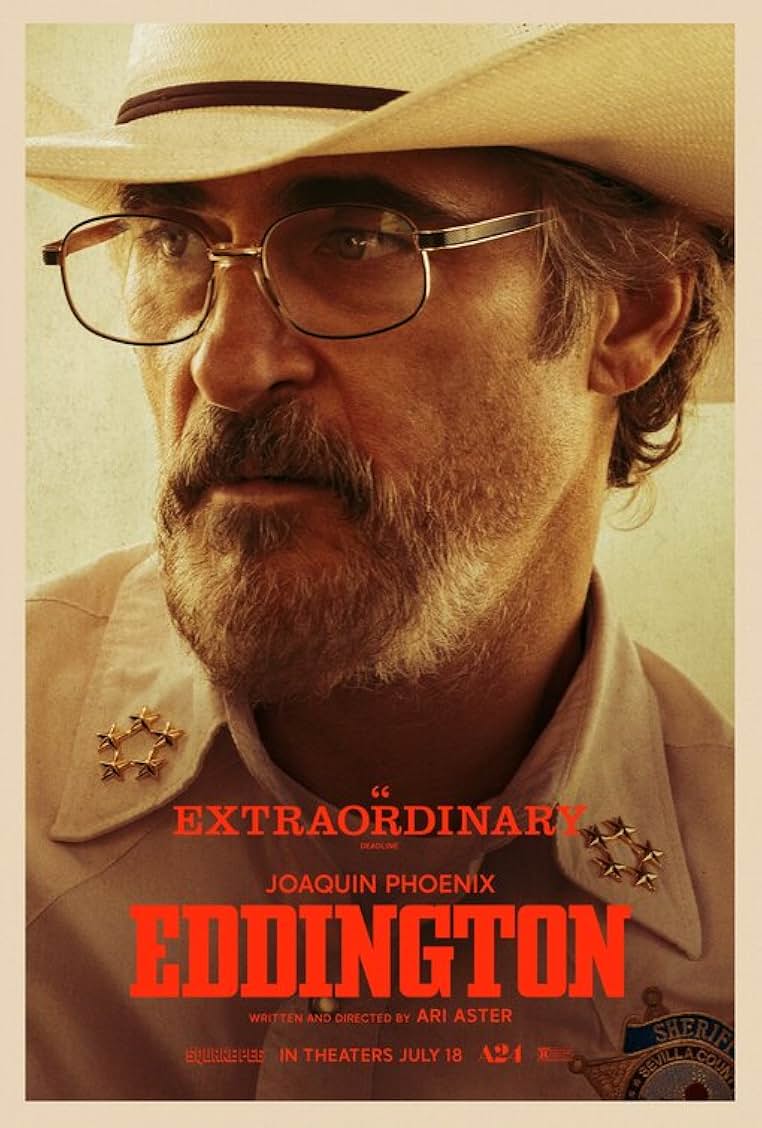

After conquering horror and boldly committing to an almost unwatchable vision that probably hit closer to home than he was ready to explore, Ari Aster turns to safer fare: the neo-Western satire. Set during the Covid-19 pandemic in May 2020, Sevilla County Sheriff Joe Cross (Joaquin Phoenix) finds a lot of people and things irritating: masks, the Pueblo cops, the unhoused man wreaking havoc around town, Lodge (Clifton Collins, Jr.), and Mayor Ted Garcia (Pedro Pascal) and his son Eric (Matt Gomez Hidaka). He does love one person, his wife, Louise (Emma Stone), so much that he lets her ranting, conspiracy theory mom, Dawn (Deirdre O’Connell), live with them in their cramped, cluttered home decorated with Louise’s handsewn creations. He could be tolerant because his deceased father-in-law was the sheriff. Joe decides to do something about it and throw his cowboy hat into the election race for mayor. Can he free what is in the heart of that small town and win as mayor? Well, “Eddington” (2025) is funnier than “Beau Is Afraid” (2023), but you may find yourself rooting for asthma.
Well, it looks like Phoenix is Aster’s official muse, not the far superior stylings of Toni Collette or Florence Pugh. Phoenix’s acting style is like pepper—a little bit goes a long way, and thankfully Aster reins Phoenix in. It is a relief that Joe is not one of those characters that Phoenix does not feel the need to turn the performance dial all the way up to ten because Joe is an interesting character to watch even as the audience can intuit what kind of man he is. Like a lot of the people in the town, Joe wants more than he merits. To bridge the gap, he is like an ape with fire using social media and other powerful and dangerous tools disproportionate to his actual needs to achieve his goals, which he confuses with his actual simple desires. His campaign sparks chaos in the small town, a little civil war clothed in the familiar battleground of the lockdown: mask mandates, Black Lives Matter protests, banned public gatherings and cult of personality. Petty grievances get amplified when elevated and magnified to the city level and clothed in the rhetoric of grievance and conspiracy.
“Eddington” opens with patient zero, Lodge, the likely carrier of the Covid-19 virus, who strikes the first blow and ignites the virus of violence. Pay close attention to his appearance, the route that he takes and his frustration as he imbibes alcohol but does not seem to enjoy. Lodge irritates all sides equally and is immune to the rhetoric that enflames everyone. Collins is such an overlooked character actor and was completely unrecognizable, but he sets the tone for the whole film and could easily be overlooked. Don’t. The ranting, raving communal madman becoming a vaguely menacing public nuisance seems to be an emerging theme in Aster’s recent cycle, and here this archetype’s significance becomes more obvious. He is the essence of this town’s inhabitants stripped of their pretension and rendered unintelligible.
Lodge is a more appropriate foil for Joe though Ted is the more obvious choice. Pascal delivers his best big screen performance of 2025 to date. Ted is a hypocrite using his position to put on Covid theater while flouting the spirit of pandemic health safety measures, but he also is not entirely a monster and is as close to a normal guy that you are going to get in “Eddington.” Behind the scenes, he would prefer his house to be a sanctuary from germs and spouts Covid facts to keep his son safe. In public, he knows how to come out on top in various faceoffs with Joe, but in private, he is just a guy in sweats unwinding after work and watching the news. His life is far less perfect than the envious Joe imagines. He styles himself as bringing in jobs to their town and wants to clear the way for Solidgoldmagikarp, a corporation, to build a data center development despite fears of environmental danger. (Side note: Solidgoldmagikarp is a type of glitch token which produces erratic behavior when training large language models like ChatGPT and produces unpredictable and bizarre results like many an Aster film.)
Ted is considered a minority within the town though it would not be a given in different contexts. Most of the people of color in “Eddington” are public officials. Micheal Cooke (Micheal Ward) works for Joe at the sheriff’s office just like his dad. Cooke is obsessed with Bitcoin and uses his free time to practice at the homemade range. Cooke is a bit of a blank slate, willing to help Joe with his campaign and unresponsive to the point of seeming dim as both sides try to drag him into offering an opinion about the state of the racial divide in the US. Like most of the people of color in “Eddington,” he holds an official position. Indigenous Pueblo Officer Butterfly Jimenez (William Belleau in a scene stealing performance) is the closest that the film gets to a government official doing his job effectively and has upstanding ethics, i.e. does not mix his personal agenda with his public office. Initially Joe’s grievances seem to be bucking against the government telling him what to do, but as the movie unfolds, Aster seems to be implying something that no one watching the movie starts thinking until the story draws closer to the final act. All this lack of trust in the government and posturing could be the veneer of racism, but race is the balm used to excuse the aggrieved’s personal inadequacies.
A lot of the real conflict involves imagined competition for women or protecting them from predators, i.e. dog whistle fears of miscegenation, but these women are stubbornly independent and choose their own suitor. Louise’s past haunts Joe, but Louise is attracted to Vernon Jefferson Peak (Austin Butler), a man who dresses in white, says a lot but not too much. Joe cannot compete with him, so he borrows Vernon’s rhetoric to re-attract his wife, bolster his campaign message, and lob revamped blows at Ted, who shares a history with Louise. Similarly, Brian (Cameron Mann), Eric’s best friend, has a crush on Sarah (Amélie Hoeferle), who set her sights on Eric, so Brian adopts her rhetoric to get closer to her, but to no avail because when she is not busy with Eric, she still hopes to reignite a relationship with Cooke, who Brian has zero connection to. For Joe and Brian, it is an unrequited lovefest.
“Eddington” would not be an Aster film if the solution to what ails them was not a complete bonkers fever dream of a solution at the one hour twenty-five-minute mark. Aster’s commitment to his bleak, sardonic vision of America may be exaggerated, but sadly not by much. His use of social media as an isolating, anti-film experience is conscious and deliberate. While it is a cutting and hilarious indictment on the human condition as much as the state of the nation, it does not take a lot of imagination to see the world as it is. Audiences are hungry for utopian movies who can imagine a better world than this.