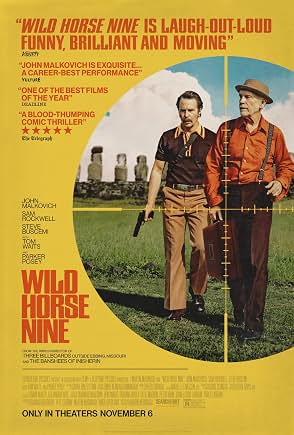

Here is a Herculean writing challenge: write about two of the most amoral, verging on reprehensible men in history then make them sympathetic and redeemable. Writer and director Martin McDonagh’s “Wild Horse Nine” (2026) is a confident, hilarious, poignant bromance about two CIA agents, Chris Carlisle (John Malkovich) and Lee Chesterfield (Sam Rockwell), who are taking a break from destroying democracy in 1973 Chile to visit Easter Island or Rapa Nui to see the big heads or moai. Chris is reconsidering all his life choices, and Lee is just trying to make sure that Chris does not piss off their boss, MJ (Steve Buscemi), or blow their cover with fellow tourists, specifically students Monica (Mariana Di Girólamo) and Alicia (Ailin Salas). Will Chris and Lee trust each other?
McDonagh is a master of tone and turning on a dime blessed with the perfect ensemble cast possessing the innate talent and hard-earned skill to pull it all off. Much of the pair’s dialogue has a matter-of-fact bluntness that reflects that they know that they are not committing benevolent acts but harm on a global scale. McDonagh treats this insensitivity like a running gag, and it mostly works. Chris and Lee are proudly culturally insensitive and dismissive of indigenous names just as their employment does not respect the sovereignty of other nations or anything that does not toe the party line thus allowing the US to dominate other countries. They seem convincing as reprobates, callous killers.
Malkovich does not need any effusive praise after a lifetime of notable performances, but let’s give it anyway. His line deliveries and physicality are so unique that another actor could not replicate it beyond an impression thus Malkovich makes Chris seem like a peculiar but fully realized character. Chris is a Catholic who knows that he has less time ahead than behind, and while he does not exactly feel guilt for all the red on his ledger, he is beginning to contemplate his actions and how it will affect his final destination. He is irritable, forgetful, irreverent and capricious like a dangerous kid with lethal adult capabilities. He has begun casually talking about the job within earshot of people who should not hear top secret details. Chris is also taking account whether he has any value outside of work and the authenticity of his relationships with his only friend and a family member. It would be totally fair for audiences to scoff at an assassin worrying about the technicalities of getting into heaven, especially since he does not sound or act like someone who deserves a peaceful afterlife or feel revulsion that at the eleventh hour, a drop in the bucket of good acts is enough to outweigh the bodies that he left in his wake. He is weird, homicidal and callous, but he is beginning to change and value life.
Rockwell is on a roll. For the second time this year, he is not leveraging his charisma to play a lovable racist character. Well, a lovable colonialist is still close. McDonagh does not visually dwell on Lee’s professional reality but depicts Lee as a patient, protective caretaker to his work partner and a husband who is unusually tolerant of his wife, Madge (the comedically brilliant Parker Posey), who openly cheats on him and is a complete alcoholic. Lee cares about minimizing the cruelty that he inflicts on others. He has a thin, but unwavering code of conduct, and his priority is showing love and devotion to his partner. It is manipulative to sympathize with Lee just because McDonagh is showing him in his off hours, which is when Lee is at his best. It is unclear why Lee goes above and beyond for Chris other than genuine love, but inquiring minds may subconsciously wonder if he is treating Chris how he hopes to be treated. McDonagh uses the film footage that Lee takes to punctuate the movie, and it underscores that Lee wants to remember Chris. It also shows a thread that each of these men have a capacity that is coming alive for the first time or is a miraculous resurrection, an ember that if it burns bright and long enough, could change their future actions and potentially save lives and maybe civilizations. If God is love, can love change a couple of CIA agents’ hearts and minds thus saving their souls?
“Wild Horse Nine” could have taken a wrong turn if it took a sitcom route of misunderstandings and miscommunication between the friends. Instead, it relies on finally clearing things up, embracing radical honest and using stream of consciousness dialogue to keep the momentum going. Think Quentin Tarantino without the N word and far less profanity. Also, there is dialogue about cheese. Malkovich and Rockwell’s chemistry, rhythm and execution sells the idea that they have been together for ages. It makes the audience care about them and thus care about what they care about. When Chris starts brainstorming about ways that a Nazi could get into heaven, it is to hope that he is comparatively better and has a shot. Lee rationalizes that Chris gives freedom through death (how Buffy) and seems to buy the party line that they are the good guys.
“Wild Horse Nine” tackles head on reckoning with a life’s work and applying the morality of what you believe to your actions. How do you make up for it if you fall short? Here is the crux of McDonagh’s film: how do you make amends? Is it giving lip service to politically correct terms, professing the right beliefs or is it action and how big does that action need to be? It is kind of like the starfish parable, which Loren Eiseley originated in the essay titled “The Star Thrower” in the 1969 anthology, “The Unexpected Universe.” (“You can’t possibly save them all. What difference is your effort making?” “It made a difference for this one.”) The moral meter lies in how Monica responds to Chris obeying her suggestion to stop lying. The execution takes a political turn, and McDonagh delivers an action-packed catharsis that feels unexpected given everything that precedes it even though Chekhov’s historical rifle is referenced but does not feel real. If you care to analyze the resolution, McDonagh is done being nice and wants people to start kicking ass to stop fascism. It is a bit of aspirational history imagining what it would look like if a couple of bad guys briefly sided with their future victims.
What does the title mean? A fellow critic said it was because Chris stays in room number 9, but a shot from Lee’s film captures their first glimpse of wild horses on the island, and there are nine horses in a group. Maybe the ninth one is the one that seems drawn to Chris and in many ways is parallel to Chris’ story arc. There is also a reference to a neo-Western shot from the horse’s point of view, and there is a scene set in Monument Valley where John Ford shot most of his films. “Wild Horse Nine” is McDonagh’s take on the neo-Western except instead of being set in the Western part of the US, it is set on the world stage through the microcosm of a tourist site that once was sacred when Western values did not touch it. If it sounds heavy, it was not obvious while watching.
“Wild Horse Nine” is a hilarious, poignant and sublime character driven that is better than it has any right to be. If you are a fan of anyone in the cast or of McDonagh’s work, this movie is required, entertaining and meaningful viewing. Also if you just want to watch it to live vicariously through the characters and be a tourist for the cheap price of a movie ticket, do it.