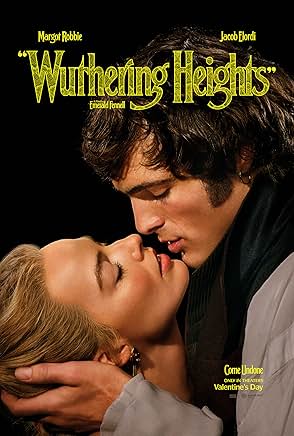

Emerald Fennell does “Wuthering Heights” (2026) starring Margot Robbie and Jacob Elordi as Catherine “Cathy” Earnshaw and Heathcliff, two people who are in love and lust with each other. Because these two crazy kids cannot get their crap together, they make it everyone else’s problem: nouveau riche neighbor Edgar Linton (Shazad Latif), his ward, Isabella (Alison Oliver), and Cathy’s companion, Nelly (Hong Chau). As someone who read the book so long ago that I barely remember it, if you are going to remake the book, maybe give the most interesting characters more screentime or really go wild. If there is a sequel, I want it to be the Isabella and Heathcliff show. After “Saltburn” (2023), with two of the hottest people on the planet, Fennell should have told a more scandalous tale. Aim for shocking the French or the wealthy one percent. Adultery would not do that. The movie is too damn long. At least it looks good.
The Earnshaws are a big fucking deal, but you would not know it. They live in darkness thanks to alcoholic patriarch, Mr. Earnshaw (Martin Clunes). Someone should invent the John Noble award then award it to Clunes. Cathy (Charlotte Mellington) is a wild child with no real adult supervision. Nelly (Vy Nguyen, the best actor among the children for her subtlety), is a child, but also holds an ambiguous position. Unlike the servants, she does not get paid but has responsibilities so money will not protect her. Unlike the Earnshaws, her parentage means that she cannot rely on her status to secure her station. If Fennell race bended the character, it was a great idea because Chau makes Nelly the most inscrutably fascinating character on screen. Who does she love? Nelly is trying to do everything right, but there is no reward, and people play in her face with impunity. Fennell is insightful, and in Chau and Fennell’s hands, they refuse to turn Nelly into a villain but shape her as someone trying to survive with her dignity intact and occasionally get her licks in. Damn, Cathey, can she have something? Must you have it all.
Whether children or adults, the least interesting characters are Cathy and Heathcliff. As children, their characters are so annoying that before the father becomes the worst, it is easy to empathize with his exasperation and desire to flee. Their raison d’etre is their physical attraction and the alleged security that they feel around one another in a dangerous place. They are supposed to be soul mates, but it is unclear why other than the erotic element and a shared childhood in a toxic environment. It is so melodramatic, but not visceral. Fennell almost takes ninety minutes to get them to kiss. Children with Barbie and Ken dolls are lappng them. “Wuthering Heights” is ninety minutes of implying sex or sexual organs: the opening sequence, straw as pubic hair, snails and eggs as lubrication, Cathy clinging to pink walls as if she is trying to mount Heathcliff virtually and give him oral gratification, and so much more. At a certain point, you want them to stop their whinging and get on with it or move on. A few scenes feel like a reference to “Gone with the Wind” (1939) with the bright red sky. The colors are tremendous. If you can get through the gorgeous monotony, it will be because there is a music video logic to the sequences or perhaps Fennell has a future in shooting perfume commercials. “Another Simple Favor” (2025) was sumptuous too and looking for an excuse to wear big crosses and white bridal dresses because who does not love classic Madonna, but movie goers cannot live on spectacle alone. Robbie and Elordi are committed, do their best, and clearly think that they owned it, but it feels a bit paint by the numbers.
Oliver makes “Wuthering Heights” come alive whenever she comes on screen, and if Fennell was going to truly reimagine the story, it would have been interesting to tell it from the Lintons’ point of view. Linton is a good man, Savannah, but who can compete with any man that Elordi plays. Linton is bored after talking to his ward then an angel falls on his property, which is probably why adultery is not a huge dealbreaker. It would have been nice if Fennell extended the time devoted to showing how Cathy began to be happy with Linton and almost forgot about Heathcliff. It is a provocative idea: what if settling can be awesome? Latif can be hot, and Fennell did not maximize his potential. Imagine a world where Linton can compete with Heathcliff. Imagine if he started making Heathcliff uncomfortable with his sexuality. Fennell could have gone bigger. Her imagination failed her.
While Linton’s race is not as much of an issue as it is for Nelly, it is a part of the subtext. Fennell appears to be more interested in her women characters otherwise it would have been nice to see how microaggressions get lobbed at him, and if he notices or how he handles them. There is an implied trust between Nelly and Edgar which does not stem from their differences, but if there was a way to develop it, it would have been terrific. It is not often that Asians from different regions would be depicted as sharing common ground in community in cinema. Another revolutionary idea is his eleventh-hour instinctive fraternity with Heathcliff over their love of Cathy. When people talk about reimagined stories, they do not often think about what works, just what does not.
Oliver manages to steal every scene that she appears in. By watching Isabella, it is easier to understand how much time passes in “Wuthering Heights.” In her first scene, she is an awkward teenager and an avid reader oblivious to how anyone feels about her interest. When the most impossibly beautiful woman enters her life, Isabella befriends her and gifts her the most unhinged presents that sometimes feel like Georgia O’Keefe paintings or makes a pop-up mushroom, an erect phallus surrogate, into a book’s centerpiece. She may not be aware that she has begun her sexual awakening, but her subconscious is sending out clues. Oliver’s scenes with Elordi’s feels like nineteenth century, heterosexual “Pillion” (2026). If you want to understand what enthusiastic consent in the face of bad life decisions look like, check out this movie. Even the scenes between Oliver and Robbie are electric as they fight over the hot guy. Oliver is completely unrecognizable as the hot sister in “Saltburn.” If she was the star, there would not be a boring moment. Now THAT is a reimagining.
“Wuthering Heights” feels more as if Fennell was trying to do a trashy (compliment) Sofia Coppola impression than truly get messy, which is fine, but a letdown after all of the hullabaloo. I still need to see “Promising Young Woman” (2020), but “Saltburn” felt dynamic and urgent. Not a second felt wasted. When reimagining a story, it can literally be anything, and she chose a cliché, le petit mort, death as ecstasy. If Linton can be nice, and Cathy can die a certain way, then anything is up for grabs, which is why it often makes the movie dull. Here she cared more about the trappings of wealth and the idea of womanhood compared with ladylike behavior. Oh no, my hot lover is not rich. Oh no, my rich husband is not hot, and I’m not in love with him. Wah. Florals in spring.
The love story was comparably inert, hysterical and safe. Yes, safe. Adultery in different locations in the missionary position is kind of the bare minimum. They were slightly more risqué when they were kids. Hell, Cathy does not even have to worry about paternity disputes. Real life is more fraught for normie uggos. Their kink is obstacles. If they could be together without them, they would get bored and break up. This translation is Emily Bronte’s Romeo and Juliet meets Wuthering Heights. I wonder if Guillermo del Toro ever wanted to adapt this book. He should open a film school and help Besson with visuals and Fennell with writing. What if Alexander Skarsgård played Cathy and got called Cathal and nicknamed Kit? You can be anything! You can do anything! Fennell, please do not get boring as your film career matures. Let’s buy her a ticket to see “Pillion.”