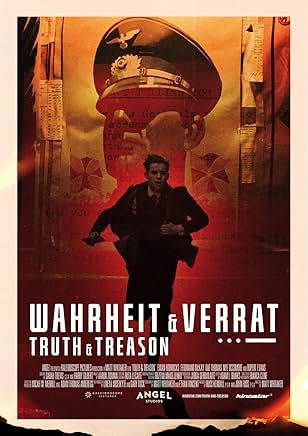

“Truth & Treason” (2025) is a historical biopic about Helmuth Hübener, a German Mormon teen resistance fighter who proved that the pen was mightier than the sword. At a time when he was predominantly exposed to only Nazi propaganda in his formative years and received rewards for toeing the party line, he was willing to give up his life for reading banned books (Shakespeare), listening to news from outside his country and writing and distributing papers about what he learned. Ewan Horrocks plays Hübener. Director and cowriter Matt Whitaker originally conceived of the work as a documentary, “Truth & Conviction” (2002), and made this film as a limited four-episode television series, which was released at the same time as the film. The theatrical version stems from the series. While its serial origins shows, it is still rousing enough to resonate with audiences. It is Whitaker’s directorial scripted feature debut though he is a seasoned cowriter. It is cowriter Ethan Vincent’s first scripted feature, and I do not know him personally so I have no idea whether we are related. While critics derided it as conventional, for first time filmmakers to choose this subject matter at a time like this shows courage.
Let’s get something out of the way before diving in. “Truth & Treason” is in English, and the actors sound British. In old school films, it was normal for British actors play any character regardless of the character’s origins: Romans, Europeans from other countries, etc. People do not like to read subtitles, so I get it. It is a creative choice that does not work when there are radio broadcasts from the British that would have been aired to Germans and been in German, but from British people. It does work because the subliminal cultural associations and assumptions of hearing a British accent is very different from a German accent. Whitaker and Vincent are trying to show this world as a normal, every man where it is a surprise who takes which side, not a foregone conclusion.
“Truth & Treason” depicts Hübener and his friends as ordinary, good German boys that under different circumstances would not rise to historic levels and just go to college, read books, have families and make zero waves. Horrocks depicts Hübener as a guy who is willing to go along to get along unlike his physically more imposing friend, Karl-Heinz Schnibbe (Ferdinand McKay), who prefers to punch Nazis while Hübener is deferential. He enthusiastically wants to take the easier path and is smart, but because of the latter, he cannot ignore the truth. At church, his pastor, Bishop Arthur Zander (Daniel Betts) says “Heil Hitler” then calls for the singing of a hymn, “We do what is right, let the consequence follow,” oblivious to the contradiction or perhaps politically in harmony with it. A fellow church leader, Otto Berndt (Maxim Ays), disapproves, admonishes the pastor, but fails to convince the pastor to stop enthusiastically obeying the party line; however, he plants a seed in Hübener to decide for himself. A friend, Gerhard Kunkle (Maxim Ays), brings in an illegal wireless radio, which exposes Hübener to classical music and news, but Kunkle is another safe voice of dissent since he is a soldier. The Bishop gets Hübener an internship in city hall, which gives Hübener access to banned books.
Whitaker and Vincent framed Hübener as a writer and a voracious learner. He procrastinates writing a patriotic statement, but uses his talent for delivering improvisational, inspirational speeches in the vein of his training as a member of the Hitler Youth. He also uses his talent at church. The first time that he writes passionately, proactively and privately is against Nazism. He is radicalized because of what happens to his fellow Mormon friend, Salomon Schwarz (Nye Occomore). Hübener is the best and the brightest of German youth, which means trouble because thinking differently is a capital offense.
Hübener’s foil is Erwin Mussener (Rupert Evans), another good German, family man and Gestapo member, i.e. casual torturer, which includes women and children. He remains unbothered about the difference between his private and professional life. “Truth & Treason” is framed as a crime thriller with a cop trying to catch a criminal except when he does, he is conflicted. Mussener is also a true believer. Whittaker and Vincent create a scathing villain origin story for his character that is practically Freudian: a college dropout who strikes out against the truth and rejects all associated with a personal betrayal. It makes up for the fact that they reinforce the fiction that it is possible to be a Nazi and otherwise a good person or associate with good people (they take it too easy on Hübener’s mom), but if people keep encouraging the majority to reach out to each other and convert them to do the right thing, maybe this film is what it looks like. In real life, as someone who spoke to people who survived the Holocaust, which includes the children of Nazis who rejected their upbringing, the veneer of civility often hid a severely abusive, often pedophilic private life.
“Truth & Treason” has pacing issues largely because just cutting a limited series down to a movie is not the same as making a movie, which ideally is supposed to be a more targeted affair. It occasionally meanders when it is more focused on making the characters relatable instead of focusing on the character’s raison d’etre. It does a poor job of individuating the friends from each other. Rudi Wobbe (Daf Thomas) is easy to forget. Because of their physical similarities, Thomas and Horrocks can be challenging to distinguish at the beginning before Hübener emerges as the protagonist, and at the end, when they are in the dock. Filmmakers can be so familiar with a subject that it is almost impossible for them to imagine that blank slates are consuming their work and do not know of the importance of Hübener and would not immediately realize that he is the main character. For example, I am unfamiliar with Mormon world history.
Angel Studios released “Truth & Treason,” and it is commonly known to be associated with the Church of Latter-Day Saints. I could be incorrect, but I’m going to assume that a movie about Mormons by Mormons is going to be more flattering than not. Yet “Truth & Treason” still bravely addresses the division within their church over complying with unjust laws versus revolting against them. They frame the rebellion as in the minority instead of patting themselves on the back and inflating their role in history, which is better self-criticism than most individuals and groups are willing to engage in. It did not feel as if they curtailed the conflict for film, and I would not be surprised if the series was more detailed. I am not a Mormon so I cannot say which side actually adheres to their scripture.
I believe that we believe in different people named Jesus and share some scripture, however as a Jesus follower, Hübener’s gospel of Jesus as a revolutionary resonated with my understanding. The conflict within the German church felt relatable except I fear that many American contemporary churches would not even have a debate or crisis of conscience. At a time when mainstream Christianity is getting further away from the gospel, the most publicly and culturally outspoken in the Church of Latter Day Saints seem to be consciously picking up the mantle of Christian abolitionists in the eighteenth century, the Social Gospel Movement of the later nineth century to early twentieth century that protested working conditions the Civil Rights Movement staring in the mid twentieth century, and the contemporary Progressive Christianity movement. They do not have to at a time when it is most advantageous to keep quiet and reap the benefits of being in the passive mainstream. It is lovely, and I’ll enjoy it for however long it lasts. It could stop today. On the other hand, it is equally possible that people will take away the unintended lesson and do everything in their power to discourage their children from any education, allowing anyone else at church or school from educating them, ban more books, and restrict friendships. God forbid.