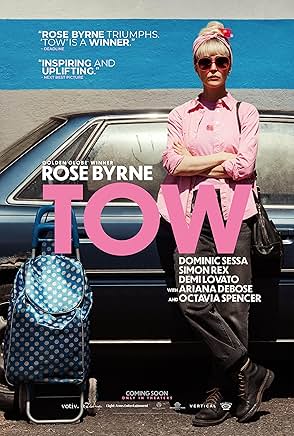

Set in Seattle, Amanda Ogle (Oscar nominated Rose Byrne) owns and lives in her blue 1991 Toyota Camry. When someone steals it, and a tow company, Kaplan Towing Company, finds and tows it, they hit her with the fees, so she sues them and wins, but wait, there is more. For a year, she struggles with the justice system, unemployment, homelessness, estrangement from her daughter, Avery (Elsie Fisher from “Eighth Grade”), among many other things. With a little help from the inexperienced, young lawyer from the Northwest Consumer Law Center, Kevin (Dominic Sessa), she keeps fighting. With plenty of detours and the deck stacked against them, will she get her car back and her life on track? Based on an earnest true story, a stacked ensemble cast and solid production values only slightly elevate “Tow” (2025), which features a television movie narrative that spreads itself thin and simultaneously feels rushed and too slow.
Casting director Sherry Thomas deserves a big pay day for the work that she put into “Tow.” Between the luck of the release date so soon after the 98th Academy Awards and Byrne’s nomination for “Best Actress in a Leading Role” for her performance in “If I Had Legs I’d Kick You” (2025), Byrne is ready to play another flustered woman who is set up to lose. Amanda has a Fifties and Sixties fashion sense, a frank way of speaking and loads of incisive practical experience which puts her ahead of people with more education if she is allowed to do her thing. She is not someone who never gets deterred. In the hands of fairly new writers Jonathan Keasey and Brant Bovin, her story is treated as a window into the world of homeless women and the disastrous domino effect in Amanda’s life and others when one thing goes wrong. It is a noble and necessary dynamic to depict, but it often comes at the expense of the story’s momentum.
“Tow” has so many characters that it feels as if editors Sarah Flack, Joe Klotz and Max Ethan Miller wanted to keep them all, but wound up noticeably leaving out key pivotal points in some of their story arcs. At some point, someone needed to make some hard decisions and kill their darlings, but with so many good actors and varieties of tales, the reluctance is understandable. The story is not just about Amanda’s legal case, but a spoiler issue in her life that contributed to her problems. While the writers need to be true to Amanda’s story, it often felt as if they put Amanda through a gauntlet to earn her win: deal with her problem, be honest and trust people. It gets very trite and respectability politics in the storyline with the also Oscar-nominated Octavia Spencer playing a hardass who runs the shelter with some strict rules, which are never interrogated and are generally cosigned as helpful. On one hand, her rules make sense because they must keep in good graces with the church that lets them use the space. On the other hand, the margin for being human and having needs seems narrow. Spencer never betrays the material and sounds convincing if you do not think too hard about the rules.
The other residents feature familiar faces. Oscar winner Ariana DeBose plays Denise, a recovering substance abuser, mother and fellow shelter resident. It is Denise’s story that feels as if it was awkwardly hacked to pieces. It is not DeBose’s best performance, but since every character feels a bit heavy handed, she is within the margin of error. Demi Lovato actually sings as fellow resident and expectant mother, Nova. If Lovato got to perform, it feels like a missed opportunity that DeBose and Lovato never belted something out together. Why the hell not? Lovato gets to send (a sadly much needed) message about gender, but if movie goers do not recognize her, they may not notice it. Again, while big name actors appear in these roles, the characters barely feel like three-dimensional characters. More intriguingly, it was a pleasant surprise to get a cameo from Lio Mehiel as Ace the Car Rancher, a person who rents cars to people for the night. Mehiel is a serious, up and coming character actor in such films as “Mutt” (2023) and “In the Summers” (2024), but in “After the Hunt” (2025), was not given a lot to work with. Still, it is nice to see them working though hopefully in the future for more than one scene.
If Sessa seems familiar, he is. He had quite the buzz in his first onscreen role with the beloved “The Holdovers” (2023). Well, Kevin is his second, and “Tow” makes Kevin feel like an afterthought. Again, it is based on a true story, but Kevin is a completely forgettable role, especially since Kevin is usually paired with more oversized personalities such as Amanda or opposing counsel, Martin LaRosa (Corbin Bernsen, who feels as if he has been playing lawyers as long as I’ve been alive). Even Becky Ann Baker as his smart cracking receptionist gets a nibble. The hilarious part is that the court room scenes are accurate and solid, but oh too brief. Even Simon Rex stands out as Cliff, the nice employee at the towing company who wants to help but cannot risk losing his job.
Director Stephanie Laing finds new ways to convey the passage of time whether it is the gradual ink fading on the page of Amanda’s journal, the dog photo shoot at the place where Amanda would have worked if she still had her car, the age of Cliff’s dog, the holiday decorations at the shelter or the day countdown that periodically goes up. During the oneiric sequences, once Amanda wakes up, her pink aesthetic is like a flashlight in the middle of the shelter dorm. Laing keeps things as bright and cheery as possible though she also does not pull punches on the surrounding dreariness. Still, there is only so much that can be done when the writing team does not know how to escape the Sisyphean nature of the story, which can lead to monotony.
Despite all its flaws, it would still be nice if “Tow” did well because Amanda’s story does reflect the reality of life in the US. Even when the system works, and the little guy wins, it does not look like one. Also, the ripple effect in other states and other lives show that any possession, even a beater car, matters in unimaginable ways. The most valuable lesson is Amanda owning her story instead of feeling ashamed. The story would have been better if it had stayed with her during the quiet moments instead of leaning so heavily on the more brash ones. While “Scrap” (2022) is glossier, it offers an example of how to make the minor characters feel fleshed out without sacrificing the main plot.