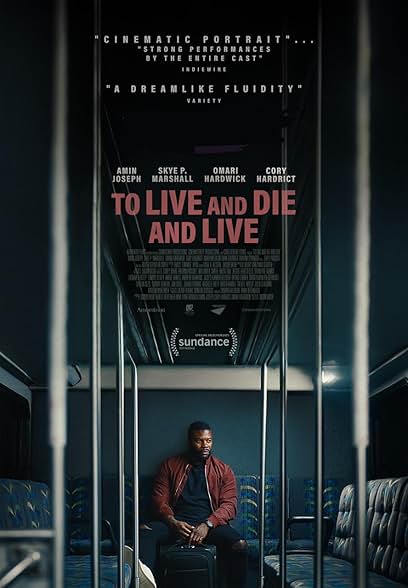

Back in Detroit for a funeral for his revered stepfather, Kalid (Montie Browne), film director Muhammad Abdullah (Amin Joseph) self-medicates with cocaine, alcohol and partying to be functional for his family, to get funding for his film and keep up appearances, but that façade is crumbling. Can Muhammad rely on others to save the day and stop being strong? “To Live and Die and Live” (2023) is a movie so yes.
“To Live and Die and Live” is not the kind of movie that I would normally watch. I tend to steer clear of movies involving drugs, even drug trafficking, because the real world is far less glamorous and unforgiving unless you are a Kennedy, then you can be Secretary of Health and Human Services. I decided to give this movie a chance because it will be the first time that I will see Black writer and director Qasim Basir’s films, and the protagonist is also a Black man so it may genuinely be a story about just mental health and addiction without a moralistic, punishing ending that would distract from the human element of the story.
“To Live and Die and Live” met my expectations with an unrelenting, spiraling Muhammad grappling with career disappointment, family burdens and lack of authentic, open relationships. It appears that there is an emerging genre in Black cinema of bleak films that take moviegoers to the edge of the abyss and just stop short of jumping into the void. It belongs in the same class as “Magazine Dreams” (2023) but is so realistic that it almost feels like a documentary.
On Muhammad’s first night in Detroit, he meets party girl Asia (Skye P. Marshall), who just wants to have fun. It is not until later in “To Live and Die and Live” that the Venn diagram of their attraction becomes clearer. They are drowning out the real world with spectacle and frenzied fun as if they are grown children who stayed out long after the streetlights went out. Basir uses their nightly festivities to show the neon lights and seductive sheen of the new Detroit filled with new construction and façade of glamorous night life.
During the day, with his family, Muhammad struggles to act as the standup man of the family, which is predominantly Muslim and conservative. He meets a new family member, Lisa (Dana Gourrier), who is visiting from New York City, sees the cracks in his façade and helps him keep the show going. His stunning sister, Iman (Maryam Basir), Ummi (Jeryl Prescott), which means mother, judgmental sister, Raina (Travina Springer) and brother Yusuf (Ismail Abdul-Aziz), are less individuated characters, which seems to be Basir’s intention.
“To Live and Die and Live” is shown from Muhammad’s perspective so he would see them in a flat, assumptive way, not in a three-dimensional way as individuals. Also, he is primarily drowning in his own pain, so he has tunnel vision regarding his relationship to other people. Unfortunately, this creative choice makes it harder to get into the story as a viewer trying to deduce the personalities, relationships and dynamics from context clues. This creative choice is also emblematic of the family’s style: a lot is left unspoken and there are plenty of family secrets. Again, having to interpret the silence of an unfamiliar family further complicates the momentum of the story. It is realistic since a backstory prose dump would be unnecessary for any character within the film.
Kevin (Omari Hardwick, the most recognizable actor in the excellent ensemble cast), Khalid’s former business partner, adds an additional task to Muhammad’s full plate: bill collector. Muhammad is a responsibility addict and keeps volunteering to do things when he cannot handle his business. A lot of the movie is a walk down memory lane for Muhammad that suddenly shifts into a tense standoff when the conversation turns to debt. Grand statesman actor Roger Guenveur Smith is unrecognizable as Reed Jennings, a real estate guy who starts off as friendly then flips as quickly as the script when it comes to money. As a result, he feels further isolated and stressed and continues to get besieged with more dry begging. Eventually the lines begin to blur between his separate worlds, and he feels unsupported. He soon discovers that he has no 3 am friends to get through a crisis that he does not fully comprehend.
“To Live and Die and Live” is not a straight grief or mental health crisis movie. It is also about the crushing pressure of making it and realizing that the struggle and hustle will never end, a feeling which is universally relatable for anyone trying to achieve the American dream and realizing that it is a marathon that requires race pacing. Muhammad is only one of many people pretending to be successful but struggling to remain solvent. Now would you want to watch a movie about the most depressing, desperate part of your life with a side of passive aggressive family hospitality, chaos of the effects of excessive drug and alcohol use and shallow human warmth? Nope. It has value and represents the human experience accurately, which is a problem if a movie also wants to be a financial success, not just a work of art. Watching train wrecks are only theoretically impossible to take your eyes off.
Basir may have too much confidence in his audience’s ability to withstand the storm of Muhammad’s nearing rock bottom. The other characters needed solidification to understand what is at stake when Muhammad risks ruining that relationship. Otherwise, everyone feels like random strangers even if they are supposed to be a part of the bedrock of Muhammad’s life. That is not the fault of the ensemble cast supporting Joseph’s performance, but the underwritten or longer than necessary narrative. The two times that it happens successfully is with Lisa and his friend, Akil (Cory Hardrict), who shares the most harrowing scene with Muhammad. Muhammad’s scenes with Lisa, Akil and in a talk at his alma mater, Wayne State University, are the most understandable moments in the film filled with the complexity of Muhammad’s predicament and how his harmful actions put others in jeopardy.
Muhammad’s story also feels like a microcosm of the story of Detroit, a great American city trying to transition from the long gone glory days of the twentieth century and does a good job of appearing like a major city under the perfect mood synthetic lights, but under the warm glare of natural sunlight, the flaws cannot be hidden and are exposed as still existing, unresolved. Success is elusive when the symbol is not a finite marker that can be counted like cars produced. It is a problem for people and cities.
“To Live and Die and Live” may be a great work of art but is still a difficult movie to watch. It is a film about people’s inability to handle and withstand the quotidian and life altering tragedies and how they fail to cope without hurting themselves or others although mercifully unintentionally. At the end, Basir tries to put a bow on the end as an eleventh-hour swing to a miracle. It would be interesting to read a review from a devout Muslim film critic to see if this movie is the equivalent of a come-to-Jesus evangelizing movie to convince viewers to get right with God.