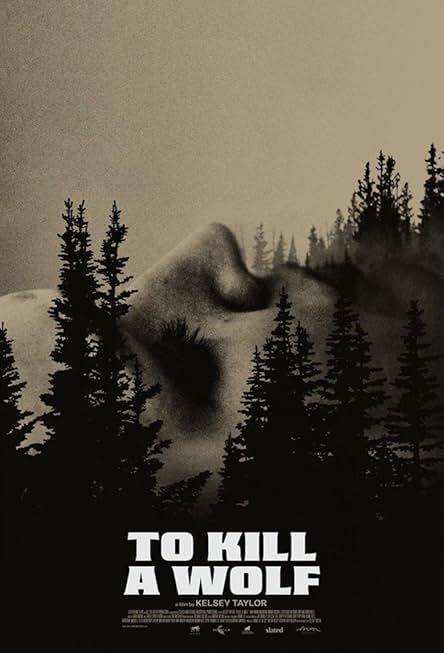

Writer and director Kelsey Taylor’s feature debut, “To Kill a Wolf” (2024), is a contemporary, meditative and poignant retelling of Little Red Riding Hood told in the isolated Oregon forest and is divided into four chapters. It starts with The Woodman, Jonah (Ivan Martin), who discovers Dani (Maddison Brown) in the forest and takes care of her until he can figure out where she came from and what happened to her. She takes him to her grandmother’s house, which is vacant, and does not want to go back to her aunt, Jolene (Kaitlin Doubleday), and uncle, a psychologist, Carey (Michael Esper). Who is the wolf? How do you kill it? Who kills it?
Jonah lives in a cabin, plays records, constantly futzes with the record player, chops wood and enjoys walking in the forest. He is isolated and rarely goes into town where he gets dirty looks. His only visitor is a rancher, Travis (David Knell), who sets traps for wolves on Jonah’s land, which Jonah springs. Wolves get rehabilitated this time around. Jonah cares about what happens to the living creatures in the forest even when he does not have an obligation. As “To Kill a Wolf” unfolds, it reveals his motivation for ensuring that no one, which includes Dani, gets hurt on his watch. While Martin may make it seem easy to play an ordinary guy, it is not. His wordless performance in the first act gets the audience invested, and Taylor establishing his lonely, eccentric routine will make his story the first mystery that viewers will want to solve.
Dani is a quiet girl, who seems reluctant to leave the safety of a stranger’s home. The dynamic between Jonah and Dani is gold because though he is an orator in comparison to Dani, the second that she is conscious, and they begin to interact quietly without a lot of empty filler chatter. They have an instant ease and instinctual choreography between the two though they have never met each other before. It is as if they lived together for years, and she describes herself as his niece, not daughter, which is the first clue to her story. Brown resembles Kate Winslet, but her acting style is unique to her. She is mostly quiet, but there are flashes of calculation as if she has an internal compass and alarm to signal when she is near danger and how much time she has.
In this fairy tale, the literal wolf is rehabilitated. Instead of killing it, Dani goes along with Jonah’s plan to rescue it even though there is danger. Of course, it is a metaphor for Jonah’s dynamic with Dani. A grown man taking care of a teen girl does not look good, and the film actually addresses how others will view him as suspicious in a brilliant scene with Detective Coyne (Dana Millican). “To Kill a Wolf” could be a play on the television series title “To Catch a Predator” except no one is doing a good job of finding that person even though they are in plain sight.
At grandma’s house, Taylor indulges in extended flashbacks to show what happened a month after grandma died. Third time is not a charm, and Dani’s latest set of adults are too busy with their own agendas to consider hers. By all accounts, the never onscreen grandma was a bit of a terror. Jolene only looks out for Dani so she can disguise her attacks on her husband and weaponize caretaking. Doubleday does a brilliant job of playing an unhealed person who will exasperate the audience but is not an innately horrible person. It is easy to imagine what grandma was like based on how Jolene uses dinner as a platform to air her grievances.
Carey positions himself as the chill one and mentor that Dani can lean on, but he also asks questions about her sexual orientation, offers her alcohol and finds reasons to be alone with them. Jolene’s most frustrating trait is how she is constantly running off and leaving Dani alone with Carey. Taylor does not spell anything out but offers plenty of context clues. Esper is too good at playing bad father figures. In “Griffin in Summer” (2024), he played a cheating husband and neglectful dad, and his characters are just getting worse. While watching “To Kill a Wolf,” it is obvious that Esper is bad news, but the audience has Taylor’s framing and composition to help us discern the clues. Near the cathartic conclusion, Taylor constantly shows Esper’s body as invading a fraction of Dani’s frame, so he is sharing the space with Brown. Taylor only increases it as the scene goes on. She puts the viewer in Dani’s shoes hoping for space but not getting any.
“To Kill a Wolf” starts with plenty of space since it starts off in the forest. The wilderness is usually a dangerous place, but it offers a rough freedom and is better than the alternative, peopled civilization in suburbs and peopled neighbors where no one hears you scream, and if they do, they do not ask if you are alright but are more concerned about what it means for them. While the resolution is realistic, it may incite negative feelings that could get misdirected to the movie.
At times, “To Kill a Wolf” does feel like a tease with Jonah silently keeping watch over Dani., which the audience may mistakenly read as a countdown to violent revenge. When reimagined, Little Red Riding Hood usually translates into horror, especially werewolves, but also woodsmen who kill the wolf. Taylor is not interested in making a revenge movie as much as we may want her to, and it is the danger of marketing the movie as a twenty-first century take on the fairy tale. The wrong audience will walk away dissatisfied.
Instead, “To Kill a Wolf” is about Dani and Jonah overcoming their past to have a better future and live openly without feeling trapped in fear and self-condemnation. If people want to criticize the story, it would be fair to be annoyed that a man gets redemption through a girl’s trauma, but it is still a good story. When she refuses to tell him what is wrong, it contributes to him deciding to find his voice and live openly even if it comes at a personal cost. She has a similar experience, but once she finds her voice, she gets more powerful and certain because she knows that Jonah will back her up.
Taylor captures the beauty of Oregon. All the scenes in the woods are just stunning, and the only sense of time and season comes from observing them. It also tells the emotional temperature of the scene. For example, when Dani runs away from her latest and worst (hopefully) guardians, the surrounding land shows a nude patch of land with the trees’ remnants looking red as if they were wounded and bleeding. What is great about Taylor’s direction is that if it was a silent film, it would still work. She is a visual storyteller first. When characters start talking, “To Kill a Wolf” becomes more predictable. Fortunately, from soup to nuts, cinematographer Adam Lee keeps it elevated that it never feels as if its morphing into more melodramatic territory.
At the end of “To Kill a Wolf,” during the credits, the phone number for RAINN (Rape, Abuse& Incest National Network), 800-656-HOPE, appears on screen. Taylor made a stunning debut and embedded a message without sacrificing the artistry or exploiting the survivor unlike a lot of more well-known, well-funded films being released this week (“Eleanor the Great,” “One Battle After Another”). Let’s hope merit wins for a change and Taylor keeps getting to make movies.