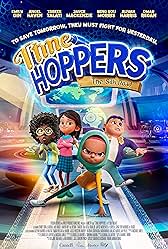

“Time Hoppers: The Silk Road” (2025) adapts a role-playing video game, which was released on July 15, 2024, from Milo Productions, Inc., a Canadian children’s media company. The franchise will be expanding to an animated television series later this year, which will air on MuslimKids.TV, another Milo Productions, Inc. media project. MuslimKids.TV has a global presence and aims to create wholesome, faith-based content, though there does not appear to be anything explicitly religious in this franchise, but it culturally celebrates mathematics and science, which originate in predominantly Musim countries.
Set in 2050, Layla (Jayce McKenzie) and her widowed dad, Habib (Omar Regan), flee from Seattle, Washington to Vancouver, Canada after Zoola, Inc. henchmen try to capture them because he invented time travel. He continues his work at Aqli Academy, which Layla’s aunt, Dean Hafsa (Aliyah Harris), runs. The adult siblings decide to continue the time travel research with the help of the kids: Aysha (Angel Haven Rey), who loves the martial arts and is the only girl who wears a hijab, Khalid (Tareek Talati), nicknamed Calculator, who is Layla’s cousin, and Abdullah (Emily Gin), who loves to eat, accidentally uses the drone camera and gets transported into the past. The other kids follow to rescue him because adults cannot time travel.
When the big bad, Fasid (Morris Seng), gets his hands on Abdullah’s device, it endangers the timeline and the future of science and mathematics as he tries to hurt notable minds such as the father of algebra, Al Khwarizmi (Alhusain Hadidi) in Baghdad, Abbasid Caliphate, during 825 AD; Mansa Musa (Ahmad Harris) in Timbuktu, Mali Empire, during 1327; Ibn Al-Haytham (Ali Ardekani), the father of optics and inventor of the camera obscura, in Cairo, Fatmid Caliphate during 1000; and Maryam Al-Astrolabi (Jenna Abu Tineh), a girl astronomer, who makes astrolabes in Aleppo, Hamdanid Amirate of Syria, 950 AD. The children are determined to stop him, get home safely and preserve the timeline. Got all that? Are you familiar with those eras, those places, those names, the names of these kingdoms? There is absolutely zero explanation of what the Silk Road is. The material goes by quickly. Fortunately, there is no quiz otherwise you would fail.
“Time Hoppers: The Silk Road” treats Calculator like a prose dumper that spouts fun facts about the era, the location and the historical figures broken up with chase scenes. I am probably considered an unusually highly educated American and am in a way older demographic than the target audience of six- to seven-year-olds. Unless someone comes to the movie with preexisting knowledge, this story is going to be challenging for anyone to remember all the information thrown at the audience in a short amount of time. One mistake that a lot of first-time filmmakers, especially when they have a television background, is trying to cover too much ground in a feature film. Director and cowriter Flordeliza Dayrit, a cofounder of Milo Productions, Inc. and wife to and religious pace setter for cofounder Michael Milo, is such a filmmaker, and while it is terrific that a kids’ film is covering important ground, it may not be retainable information.
If “Time Hoppers: The Silk Road” had devoted more time to establishing the school routine on a normal day and fleshing out the characters and their dynamics, then focused on one era and historical figure exhaustively, more information would stick. It would even be easier if all pretense of a story would be jettisoned and just have one character like Calculator tell the story as the historical figure’s achievement unfolded. Combining the historical figure with chase and heist scenarios, which are probably intended to keep kids invested through a veneer of excitement to let the knowledge go down, only distracts and creates no real suspense.
It is possible that this format works better for a global audience than Americans. As a first generation American, daughter of an immigrant who briefly went to a Black academic run private elementary school with some Muslim teachers, I can attest to the fact that students were routinely expected to absorb more information and perform way beyond their grade level, especially in science and math, than in other schools even provate ones. Forget chapter books. There were just books, and they were thick. In labs, we worked on electronics and did calculations using graph paper, and I would not do the latter again until high school. The average American is not trained to know their own history, math and science so asking them to know about other regions and historical figures that were not colonizers is asking a lot from an audience predominantly looking for entertainment.
Maybe it is not fair to expect any child to absorb so much in such little time, which again is a good reason for “Time Hoppers: The Silk Road” to spend more time showing each region in its era and interact more with the historical figure instead of having the kids chase Fasid. I would have loved to learn more in depth about all these eras, regions and people, and the only reason that I could write about it in the review is because I have access to press materials and the movie so I can watch it repeatedly. It is not enough to have educational content. It must be absorbed. I was struggling not to give into sleep because between the sing song line delivery and hurried approach, the overstimulation felt monotonous.
“Time Hoppers: The Silk Road” is well intentioned. It is great to see on screen diversity, nerds be heroes, have colorful and vibrant animation and more history than “in 1492, Columbus sailed the ocean blue.” As someone raised Christian fundamentalist and who was raised on (my) faith-based content, I came to the film moderately concerned about any work with that explicit agenda. I am not Muslim, and I did not feel as if the filmmakers were proselytizing. There are occasional mention of praying, but it was casual. Every character is clothed from head to toe, but if you have ever gone shopping for a little girl and see how overly sexualized the clothing for children can be (measure shorts for boys and girls of the same size, and shorts for girls are shorter), it feels more like a unisex approach than religious except for the hijab. Aunt Aysha just seems as if her fashion choices are Afrocentric, not Muslim, but even if it was, there are no religious statements about how women and girls should dress, and by showing variety, it is not preaching a uniform, which a lot of Westerners get weird about.
If the all-women writing team, Daywrit, cowriter Nuha Elalem, Sakina Fakhri, Sarah Mokh and Asil Moussa, decide to scale down their storytelling ambitions from a fire hose to a refreshing glass of water, “Time Hoppers: The Silk Road” has the potential to elevate the educational entertainment industry. Also, they need to tweak the premise because as is, the adults, who promise to protect and educate kids, are unintentionally endangering them, which subconsciously sends the wrong message. Yes, kids want adventure, but the implications of kids and time travel is covered definitively in “Arco” (2025) to show the devastating consequences so kids will see the dangers of acting in impulsive ways and not listening to their parents’ instructions. These adults are a little too resigned to the situation despite their words of misgivings. I watch actions, not words.