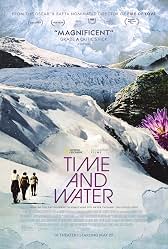

“Time and Water” (2026) is an elegy to grandparents and glaciers and may be a loose adaptation of Icelandic writer Andri Snær Magnason’s “On Time and Water” (2019). While watching this lyrical documentary, it feels like the ice complementary film to “Fire of Love” (2022), and the biggest twist is discovering after finishing it, that Magnason, who is also a filmmaker, only has a cowriting credit and the director and cowriters from the 2022 documentary were behind the scenes in this documentary. They merge nature with human relationships to get the audience invested in science without being pedantic or emotionless. Grief over the loss of a loved one makes visceral the potential loss of glaciers thus making a work of advocacy less a preach to the choir product and more of a human interest, preserving a way of life story that may even appeal to conservatives who are obsessed with Nordic mythology and people. Just because the same filmmakers worked on both projects, the 2026 documentary has more deliberate pacing, and less momentum, which may translate into less of an ability to attract general audience interest than the 2022 film.
Magnason is the narrator of “Time and Water” and appears on screen, but his family takes different turns in the spotlight either in home video/film, exclusive video and interviews. Think of it like “Rent” except time is told in generations, landscapes, stories, etc. His four children, mother of his children, Magga, father and other family members appear briefly on screen, but the focus is on his grandparents: paternal grandparents, grandpa Jon and grandma Disa, and maternal grandparents, grandpa Arni Kjartansson and grandma Hulda, who shares a name with Magnason’s youngest child and daughter, which seems to be an intentional homage to the beginning of another cycle and creating an impression of permanence or a reassurance of permanence where there is none.
All types of recordings, oral mythology, drawings, books, audio recordings, radio, film, VHS, photographs, archived footage from events, interviews, etc., become a way of capturing the transitory nature of life, which seemed permanent until it is not. Even these recordings degrade over time depending on the medium, which leads to an amazing glimpse of the Library of Waters, transparent columns of water, i.e. melted former ice cores. The transformation, whether warped lines in VHS or the atmosphere captured in the ice core, are expressions of time moving forward while simultaneously capturing the past.
Magnason conveys the idea that every generation expects to have similar experiences with the land, i.e. Iceland, which includes glaciers, but now it is not only human life, which is short and finite, but seemingly eternal, fixed elements. These recordings are now the only way to experience the same life as those who came before. Otherwise, there is no longer the possibility of keeping family alive through shared generational experiences over the passage of time but having to overcome more loss. Magnason opens “Time and Water” by saying, “I cannot send you a glacier, but at least I can send you this.” Of course, even these recordings will degrade and not able to pass down.
The real protagonist of “Time and Water” is Iceland’s glaciers: how they sound, which signals how they move, what they look like, how large they are, and how they behave during the seasons. The key to their existence is for the summer melt to be less than the winter snow, and that key is lost. Arni and Hulda’s love story takes place on the largest glacier, Vatnajökull. It is frustrating that only their footage and honeymoon get conveyed, but not all their firsthand stories about life on the glacier. Both grandparents and glaciers and their relationship to each other, are seen from Magnason’s eyes, but as individuals, even the illusion of a complete, comprehensive story is missing. Hulda is an adventurer and unusual for being the only woman on her first expedition, but her life story is only told in a series of impressions, not a comprehensive biography. Arni’s memory loss and change in photographic subjects simultaneously becomes another way to show the effect of time on a person and the impossibility of experiencing the past fully in the present. It is more about their subjective, first-hand experience of being on a glacier than the glacier’s or the featured subjects’ comprehensive story, which means tons of transcendent landscape shots characteristic of National Geographic documentaries and is a good reason to try and see it in the theater so you can experience the vicarious thrill of visiting Iceland without spending a ton of money.
“Time and Water” becomes a way of learning how to say goodbye to people and glaciers, but as it continues, it implies more. What other loss occurs if the glaciers go away? Instead of becoming fear mongering, Magnason talks about how melted glacier water becomes rivers, rain and oceans. Director Sara Dosa shows glaciers that are still at full strength and later shows iterations of the aforementioned cycles. The most powerful example is the diegetic sound of a healthy glacier moving with the latter audio of a glacier in decline, the almost silent atmosphere. Also, it looks different. Iceland is famous for its black sand beaches and volcanic rich dark soil. Gradually the ground under the glaciers appears to be the same though rockier and surprisingly, traces of wood where a forest once stood.
Will the audience instinctually associate the separate montages of the glaciers and the family home footage, which appear at different times in “Time and Water,” from coeditors and cowriters Erin Casper and Jocelyne Chaput and coeditor Mark Harrison? It lends a Terrence Malick-esque feel to the story unfolding. Because the narrative is not conventionally structured, it is possible that the link between climate change and the danger to the people of Iceland will not be obvious though it should be. Again, the filmmakers make it obvious, but lately people need things spelled out for them.
The lack of structure, the lulling tone of Magnason’s voice and plethora of scenic footage also makes it challenging to pay attention to the entire film without distraction at home. “Time and Water” depends on becoming as invested in Magnason’s family as he is. It may have worked better if he only focused on his maternal grandparents and more of their stories with closer parallels to the glaciers. For instance, Arni’s father died at twelve. Why did he get interested in glaciers? What happened to his father? Details of their lives are scattered here and there so the brain automatically is waiting for loose ends to get tied, which means less ability to follow the actual story. At a certain point, it felt as if the relationship between the glaciers and grandparents was tenuous though metaphysically accurate. In contrast, “Fire of Love” feels more exhaustive about the work and the subjects because the relationship between the volcanoes and the scientists are so intricately intertwined. The maternal grandparents’ footage is limited in comparison. Though the home video footage is poignant and nostalgic, compared to the transcendent footage of the environment using today’s filming technology, it falls short.
Shooting a movie in Iceland can overwhelm the best filmmaker whose instinct is to lean on its organic beauty and lose any grasp of a story. “Time and Water” finds a clever way to avoid that pitfall but may not be approachable enough for the average viewer. While it faces oblivion via climate change head on, it does not feel pessimistic or gloomy. It is a gentle reminder of apocalypse devoid of panicked voices, but it may be so gentle that the embedded warning could be missed.