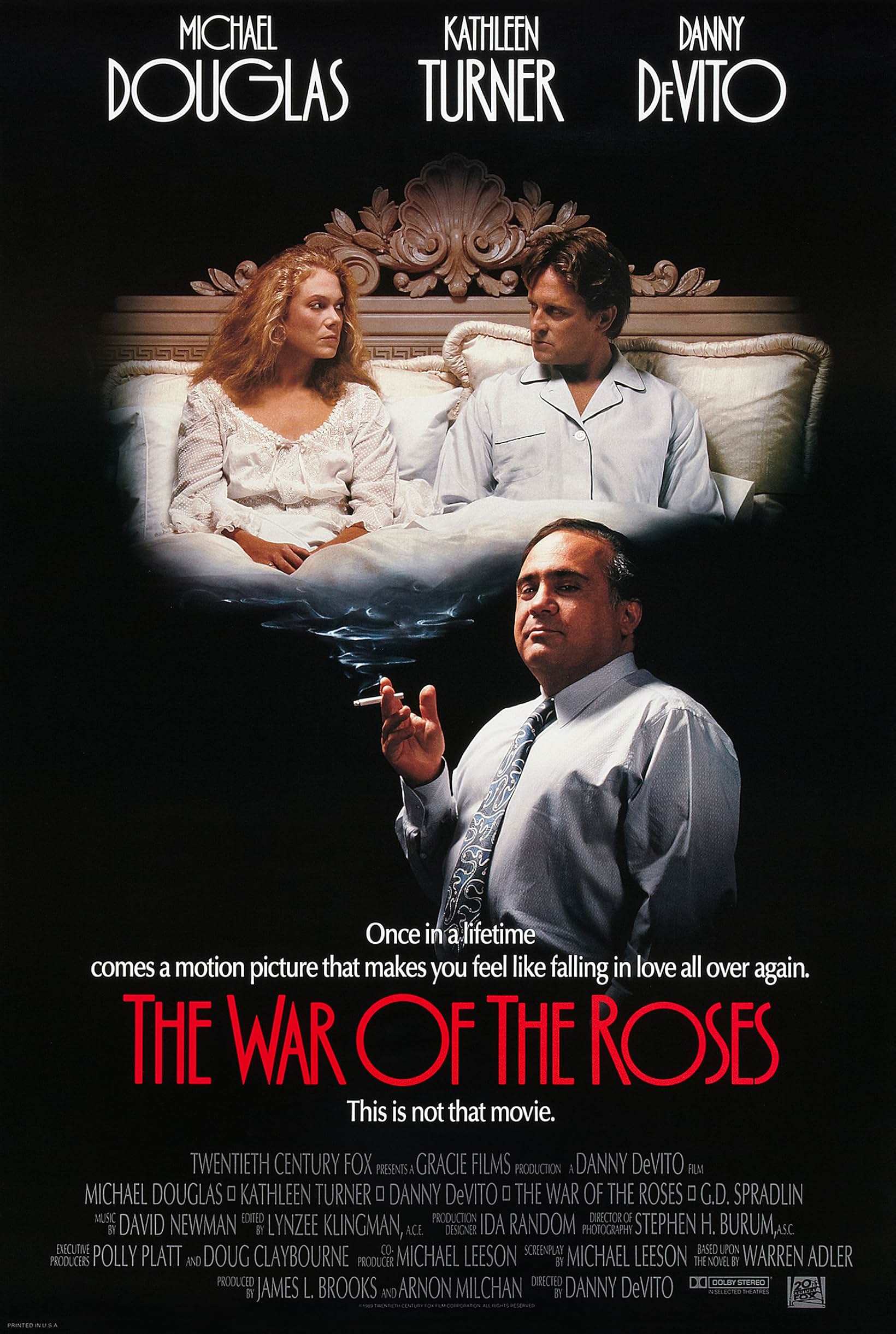

“The War of the Roses” (1989) adapts Warren Adler’s 1981 novel. Starring Kathleen Turner, Michael Douglas and Danny DeVito, who also directed, this film leveraged the success of their prior two films, “Romancing the Stone” (1984) and “The Jewel of the Nile” (1985), which were part of a franchise. Divorce attorney Gavin D’Amato (DeVito) tells this cautionary tale of what happened to his past client and colleague, Attorney Oliver Rose (Douglas), when he fought his wife, Barbara (Turner), for the house in the divorce after an eighteen-year marriage. This movie was the definitive film about what not to do in life, marriage and divorce.
I decided to mix things up and rewatch “The War of the Roses” after seeing “The Roses” (2025) since I am not attached to the original because my memories are not that strong. Also, the thumb is on the scale for Olivia Colman and Benedict Cumberbatch since I see and enjoy their work regularly. For people unfamiliar with Douglas and Turner, the entire universe had a parasocial investment in seeing them as a couple. They were icons, goals and like a two-for-one “Indiana Jones” for combining romance with adventure, i.e. two people with the same aura as Harrison Ford, who would get a new woman with each installment in the Nazi hating professor adventurer franchise.
Turner was always a smoke show with her sensuous voice, curvy body and intelligent, textured performances. Everyone may have sexualized Turner, but Turner did not play dumb. As Barbara, she plays the aggrieved wife as a woman confident in what her body can do with a sense of athleticism that made her a formable foe though still at a physical disadvantage. Barbara is a woman from a humble socioeconomic with a taste for the finer things in life, meets Oliver at a Nantucket estate sale and outbids him at the auction. Their competitive nature is part of the attraction, and Douglas was considered the ultimate American hot guy on the come up.
Douglas is nepo baby prime as the son of two actors, Diana Dill and spitting image of Kirk Douglas. No one minds if you are a nepo baby with talent, and his take on Oliver was a Gordon Gekko figure with vulnerabilities and feet of clay. He was also known as an actor on the front lines in the battle of the sexes in “Fatal Attraction” (1987), “Basic Instinct” (1992) and “Disclosure” (1994). His spirit child was Michael J. Fox’s character in “Family Ties.” Oliver was a Harvard Law School scholarship student. Initially Barbara works to provide for the family while Oliver studies and works. Oliver calls her money “ours,” but he falls into toxic dynamics as he moves up the career ladder, and all of it becomes “my” money. He publicly belittles his wife, finds his children embarrassing and prioritizes work. He understands that he and his wife’s looks help him fit into the upper echelons of DC society, but his friendship with Gavin, a successful attorney with a working-class demeanor and none of Oliver’s pretensions, is the only sign of his origins. He ignores his wife, and when he realizes that he is mortal, he is aggrieved to discover that his family has moved on.
The main difference between “The War of the Roses” and “The Roses” is that Oliver sees Barbara as one of his possessions, does not want to relinquish control of her and constantly changes the goal post of how he wants to delay the divorce. He shifts all his ambitions and attention to Barbara when she has nothing but contempt for him. This movie could have been called “Materialists” as the house gets conflated with their identity. Barbara transforms from a stay-at-home mom and homemaker to an entrepreneur while Oliver rose in the ranks sat his firm. He is more financially successful, but her emerging independence is still threatening to him when he realizes how easily she can move on from him. Because the physical abuse gets introduced early in the film with Oliver tossing her cat, before a half hour into the film, when the situation escalates, it does not feel abrupt, but a comedic version of “The Shining” (1980).
Douglas’ face goes through an array of emotions without minimizing the impact of his spiteful behavior. Douglas’ physical performance is kind of brilliant starting with him silently talking to himself in a smug fashion at the dining room table while his wife looks on astonished. He really plays Oliver like a live action cartoon which is discordant from the polished man trying to impress the partners. The advertisements for “The War of the Roses” made it seem like Barbara gave as good as she got, especially since she landed the first punch and impersonated Bond Girl Xenia Onatopp (Famke Jenssen) from “GoldenEye” (1995). Her reactive abuse consisted of lots of impressive reprisal one upmanship that may have inspired “Home Alone” (1990). It did not hurt that Barbara looked better while Oliver turned into a disheveled, unshaven, sweaty mess. For Nicholson, it is a short walk to derangement whereas for Douglas, it is a stretch and surprising. He seems completely deranged, especially as truly ugly figurines surround his bed.
DeVito manages to depict extreme violence in a way that makes it seem less serious while depicting an unfortunate reality. Women are in the most danger at the end of a relationship. It never seems as if the pair are bent on killing each other even though their actions point in that direction whereas “The Roses” goes full tilt in that direction. “The War of the Roses” is also shot like a color version of classic Hollywood movies with the raw, frank bluntness of the time. The old school glamour and consumption may seem unrealistic, but at least their hijinks seemed private and personal. “The Roses” elevates the conflict into the public eye with their successes and failures national, if not global. It helps that the children in the original, Josh (Sean Astin) and Carolyn (Heather Fairfield), are almost adults and going to college so there are no worries about orphaned underage children.
While DeVito gets some things wrong about the legal profession, he nails others. Gavin starts off full of bravado but is chastened when he realizes that no one will be left standing if he advocates too well for his client. The whole movie is about Gavin lowering expectations for his latest client (Dan Castellaneta). Harry Thurmont (G.D. Spradlin), Barbara’s lawyer, is too absent during the film, and it strains disbelief that he would not have a strategy to counter Gavin and Oliver’s most extreme actions. When Thurmont smiles at the insults that Oliver levies at him, it is indicative that he knows that he is winning, especially when he got under another lawyer’s skin. Oliver’s white shoe law firm did not prepare him for family law though Spradlin’s cameo screams consummate patrician excellence.
While “The Roses” may be filled with great ingredients, it never feels real while “The War of the Roses” feels like an oversized version of reality with civilized people devolving and baser people reform at the horror of the Roses’ downfall. While it is not strictly speaking a comedy, it sticks the landing because of DeVito’s panache for pacing and understanding how to maintain the tone so it does not feel as if it ends on a downbeat.