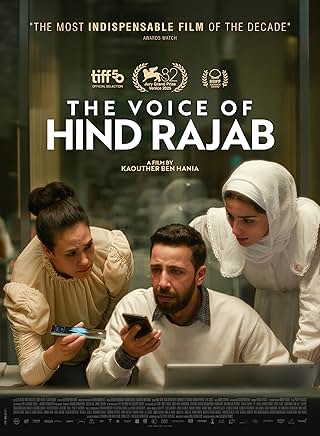

“The Voice of Hind Rajab” (2025) is Tunisia’s submission to the 2026 Oscars “Best International Feature” category and adapts a series of real-life emergency calls from the titular girl and her cousin Layan Hamadeh made on January 29, 2024. The thirty-two minute “Close Your Eyes Hind” (2025) from Syrian Dutch filmmaker Amir Zaza and twenty-four-minute film “Hind Under Siege” from Palestinian Jordanian filmmakers are also about the titular Palestinian girl, but two-time Oscar nominated, Tunisian filmmaker Kaouther Ben Hania’s film is the only feature length and most accessible. The docudrama confines the action to the Palestinian Red Crescent Emergency Call Center (instead of a cross, a crescent) and mostly uses four actors to recreate what it was like to accept the girls’ calls for help but uses the actual audio instead of using actors to recreate the girls’ plight out of respect for their actual suffering and experience.
Like anything set in the Middle East, especially in a certain region, it is fraught with controversy, so Ben Hania plunges the audience into the middle of the drama with little context. If the genre seems familiar, it is because it fits a familiar genre, the dispatcher film, where the caller provides the backdrop so the people at the call center become the central focus, and the emotional fallout of the call is a catalyst to reveal dispatchers’ past trauma and psychological mindset. The confined location intensifies the audience’s empathy to the action on screen, especially the helplessness of not being able to directly intervene or see what is happening on the ground. It also reveals the dispatcher’s frustration over the bureaucratic logjams between agencies with the dispatcher as a heroic figure trying to bridge gaps and flexing their logistic and technical muscles and moral superiority especially compared to the government inefficiencies. Usually, the off-screen person is a girl or woman in distress. I usually skip these types of movies so skip this review if you are looking for more detailed comparison between scripted movies and a film based on an actual situation.
Ben Hania subtly subverts the genre. She begins with a lyrical audio, a combination of sounds of the ocean and static of a call. The audio waves are depicted in blurred blue line against a black background much like an ocean wave or a horizon line. It is a theme that will be important during a meditation calming exercise image between the dispatcher and Hind. Initially the center is depicted as noisy and bustling on a normal day. Gradually the atmosphere quiets, and the office empties leaving the four main characters as the central focus of the action. A map of the region shows that they are dealing with the red zone, which signals that they are in deep waters. Also, the original call comes from outside the country from someone not on the ground thus straining the communication further. It is a high stakes game of telephone with potentially devastating consequences.
Despite working longer than her shift, supervisor Rana Hassan Faqih (Saja Kilani) is covered head to toe in white, but friendly and moving through the space easily. Nisreen Jeries Oawas (Clara Khoury) is a counselor to the staff and seems to be highest in the hierarchy who is most expert at handling all situations. Omar A. Aloam (Motaz Malhees) is depicted as a friendly happy go lucky guy who has playful interactions with his coworkers but after the call starts, he hears shots fired then his entire demeanor changes. Malhees spends the most time onscreen and goes through the most emotional upheaval over the course of “The Voice of Hind Rajab,” but the others go through their own emotional journey.
Ben Hania depicts Mahdi M. Aljamal (Amer Hlehel), the center’s coordinator, physically apart from his coworkers encased in a glass office and wearing red. He seems the most emotionally flat, but as “The Voice of Hind Rajab” unfolds, there are revelations that he is barely keeping it together considering that he is responsible for the safety of far more than a single person. The main conflict is between Omar and Mahdi with Mahdi acting as the scapegoat for the bureaucratic inefficiencies exhibited in the chain of communication used to secure crews safe passage through certain areas. Mahdi must call the Red Cross in Jerusalem or the West Bank Ministry of Health, who calls the Coordinator of Government Activities in the Territories (COGAT), a unit of the Israeli Ministry of Defense, to secure a safe route and the same communication line must separately give the green light to get permission to embark on the journey. Everyone is trying to save a girl, and he is trying to keep the loss from growing thus losing more life and resources for future rescues. It is a long game. He is also trying to preserve professional relationships between all the agencies so he can keep the flawed system from becoming even more ineffectual.
While Omar is more relatable as the guy who wants to cut the red tape and use his personal connections to make things happen, gradually Mahdi’s methods seem less insensitive or cowardly as Omar frames them. There is a brilliant scene where after a huge clash, Omar and Mahdi have a door between them, but they find a way to put it behind them and communicate without words. Side note: if you want to prevent PTSD, you are supposed to play Tetris, so it helps your brain process the trauma. While they are playing a violent video game, it is an interesting touch that may be accidentally more helpful than just mending fences between the men.
Within “The Voice of Hind Rajab,” the dispatchers decide to use the recordings in social media to speed up the bureaucratic response. Similarly, Ben Hania smartly restricts herself to the recordings to avoid getting into a political dispute and keep the question simple: should a little girl or emergency responders be in danger for so long regardless of what is going on around them? No may not be the humane or moral answer, but it is the legal one. Medical care is supposed to be neutral even in war zones. Unfortunately, in the US, a moral question like this would not even work outside of a war zone during a school shooting. If you watch documentaries like “Uvalde Mom” (2025) or read court cases involving crimes and other mass shooting incidents, there is no obligation to save people, especially children, who are left to die, and people who want to save them are threatened with legal repercussions and persecuted for intervening and speaking out. US courts have ruled that there is no public duty doctrine to protect people, which may lead to the question of why law enforcement is funded if not to protect and serve.
“The Voice of Hind Rajab” is a moving film. The casting is impressive, especially when Ben Hania frames scenes showing the actors and the real-life people in the same scene. It is an effective docudrama that actually plunges the audience into the situation without getting distracted and shows the toll that such work takes even far from the violence. It desensationalizes a genre to reflect the realities of trying to save lives.