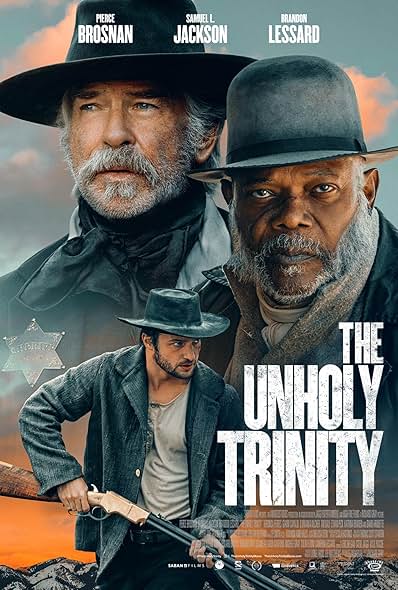

Set in 1888, a Montana Territory community dangles on the edge of chaos with only Sheriff Gabriel Dove (Pierce Brosnan) interested in maintaining justice. Pot stirrer St. Christopher (Samuel L. Jackson) points Henry Broadway (Brandon Lessard) in the direction of the town of Trinity. After his father’s execution, Broadway arrives looking for revenge. The battle for Broadway’s soul will determine the town’s future. If “Rust” cinematographers Halyna Hutchins and Bianca Cline had worked on “The Unholy Trinity” (2024), which features several perfect performances and an ambitious, intricate story that swings big, but does not land every punch, it would be the Western of the year.
If you are a Jackson fan, then “The Unholy Trinity” is a must see. His Iago like character is an impish man on a mission with such a sympathetic backstory and a charming, convincing demeanor that even guarded characters find themselves trusting him despite their better judgment. His first onscreen moment, a wordless one, conveys everything that moviegoers need to know about St. Christopher with Jackson simply directing a smile at Henry’s father (Tim Daly), who also makes a meal out of a morsel in the memorable opening. Jackson and Ealy set the stage for a story that gets more complicated with each passing minute and is filled with suspense.
Director Richard Gray introduces Dove in all black, but no one will be fool enough to believe that he is a villain with Brosnan playing him. Conducting a high wire juggling act to keep everyone from killing each other or him either out of long-standing grudges, greed, prejudice or random brutality, Dove is the real protagonist of “The Unholy Trinity.” Brosnan gets to deploy his Irish accent and good looks to make his character even more appealing than he is written. Even in his seventies, when it is time to switch from drama to action, Brosnan appears more than ready to meet the challenge, and Gray is deft at showing Brosnan and other actors rapidly jump, slide and shoot on uneven terrain and second floor windows. Younger knees could never. Sure, there are probably stunt people, but it feels like the actors are doing it, which is more than anyone could say about the dogshit directing and editing of “A Working Man” (2025) where more of the cast likely did their own stunts.
Henry keeps getting referred to as a boy, and Lessard has not been a boy in decades. It is so absurd that it is hard to take the character seriously or judge Lessard solely on the merits of his performance. Lessard just does not look the part. Kodi Smit-McPhee is around the same age as Lessard, and his genes are still making him appear as if he just exited his adolescence. He has been in two Westerns, “Slow West” (2015) and “The Power of the Dog” (2021), and he just fits. When Henry gets in trouble, it is hard to believe that he would even find himself in that predicament because the story leans heavily on his innocence. The acting is fine, but Lessard and many in the supporting cast are operating on a lower level than Jackson and Brosnan, including Gianni Capaldi, whose character should be emotionally resonant even though the storyline is predictable and tropey, but Capaldi feels as if he is going through the motions and is way too laidback for a man who will do anything for a friend. Henry’s brush with the wrong side of the law is similarly tropey, but so contrived and absurd that it almost threatens to take the audience out of the “The Unholy Trinity.”
Writer Lee Zachariah in his feature film debut does more right than wrong, but it must be perfect on the page so when missteps occur in translating the words to the screen, there is enough margin for error. “The Unholy Trinity” is at its weakest when it transitions and focuses on a different character in the story because either the acting and/or the character does not rise to the same heights as the others. Because this story is like a grand puzzle, each individual character must feel like the protagonist when it is their turn to hold up the story. Running Club (Q’orianka Kilcher) repeats the same lines until the denouement when suddenly her piece of the puzzle fits, which meant it was easy to check out whenever she appeared. The Benton gang are mostly archetypes that exist to wreak havoc, but Isabella Ruby as Nora Benton, the physically abused little sister, is the most interesting one in the bunch because of her acting and the mystery of why she would risk her safety for a stranger. An actor like Travis Fimmel could turn one of her brothers into a riveting, complex psychological profile.
Veronica Ferres held up her end of the deal and was the dark horse, third most riveting character thanks to her acting skills and her chemistry with every one of her acting partners. Ferres has a Lena Olin quality. As Sarah Dove, the sheriff’s wife and town medicine woman, she interacts with the most supporting characters, but regardless of her partner’s acting prowess, she elevates the scene. When it is time for her to switch gears and do action, she kicks ass in a realistic way. Gray deserves kudos for depicting a woman shooting a shotgun in a nonsexual manner. It never randomly dangled between her legs, or she did not suddenly flash her leg to use the appendage as a stand to aim. Sarah is in a fight for her life so there are no ridiculous theatrics. It is practical, convincing gun choreography.
I watched “The Unholy Trinity” on a flat screen television so not as good as the big screen, but far better than a desktop iMac, and while there were not any lighting issues with the nighttime scenes, the daytime scenes sometimes felt as if they lost sharpness and became tube television quality during transition, i.e. not when a single person was on screen, but if a group was going somewhere. Cinematographer Thomas Scott Stanton’s work was inconsistent and along with many of the performances, it had the effect of taking viewers out of the mindset that they were watching a period piece, but that they were watching something shot in the Eighties or Nineties trying to recreate the nineteenth century wild West.
“The Unholy Trinity” introduces overarching, spiritual themes without being too obvious about false idols: the golden calf versus God, which will make people want to rewatch the film to see if there were more clues about the mystery. There were some possibly anachronistic sensibilities that did not track throughout the story. For example, Dove, as an immigrant, seems less prejudiced than the rest of the community regarding the nearby Blackfoot residents, but Running Club is always shown alone. While it was a relief to not have the Quentin Tarantino compulsion to use the N word with every breath, the community was astonishingly accepting of St. Christopher. Random note: cremation was controversial and not widespread in the nineteenth century though possible.
“The Unholy Trinity” is a must-see movie for Jackson and Brosnan fans. Western afficionados will not be disappointed. It may not be as transcendently visually arresting as other Westerns, but the story is complex and innovative enough to earn its place in the genre. It is not perfect, but it is notable.