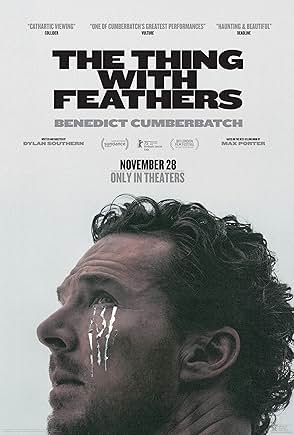

“The Thing With Feathers” (2025) is more of an abstract, lyrical acting exercise than a story so if that does not appeal to you, keep it pushing. Benedict Cumberbatch plays Dad (eyeroll), a graphic novelist and grieving widower with two sons. He is either transforming his grief into art or is delusional as he imagines that a human sized Crow (David Thewlis as the voice and Eric Lampaert in the crow costume) taunts him to snap him out of it. The film adapts Max Porter’s 2015 novella, which Emily Dickinson’s poem, “’Hope is the thing with feathers,” and Ted Hughes’ 1970 poetry book, “Crow: From the Life and Songs of the Crow,” inspired. For those unfamiliar with Hughes, he wrote that book after his wife, Sylvia Plath, died. Hughes allegedly beat her, which caused a miscarriage, then cheated on her with the married Assia Wevill and left this woman famously known for suffering from depression to raise their two kids alone without financial support then was broken when she committed suicide. Hughes wrote about his wife’s death, “That’s the end of my life. The rest is posthumous.” Sure. Ok, buddy. May I suggest going on TikTok and looking up men’s reaction to their partners discovering that they are cheating to experience for yourself my reaction to this statement. Cue Nancy Pelosi side clap. Anyway, that is neither here nor there. In turn, Leonard Baskin’s drawings inspired Hughes’ poems, which in turn, probably influenced the sketches shown in this film.
Cumberbatch is a great actor, but “The Thing With Feathers” is such a generic, self-owning examination of grief and despair that all his theatrics are not enough to help this film take flight. Writer and director Dylan Southern in his feature film debut lacks subtlety. There is even a scene with the Dad and his two sons walking in a barren snowy wilderness while Mum (Claire Cartwright) is buried under snow as a puddle of blood in the form of a cross that could also doubles as a dagger forms under her head. The film is better when Southern captures Dad trying to do quotidian things like have the entire family brush their teeth with one toothbrush left in the cup, not yet thrown out. It is not long before he is fobbing the children off to his brother, Paul (Sam Spruell), so he could fully indulge in drinking, playing loud music and pretending to be a crow while working on his latest graphic novel, which is later revealed to be named after the movie and source material at a book signing. (Punches the air and rolls eyes again.)
New rule to filmmakers: you can be as artsy fartsy as you want, but if there are two kids in your movie, you must name them. They cannot be Boy 1 and Boy 2. In real life, the two children actors are brothers, Henry and Richard Boxall, and for all intents and purposes, are almost interchangeable other than being described as older or younger. Not naming your characters or only hearing the name late in the film. is beginning to fill me with rage. “The Thing With Feathers” is not the first movie to do this but is the straw that metaphorically broke this camel’s back. The line must be drawn here. I’m sick of no name character movies as if a noun is enough to encompass the entire human condition.
There are so many other men besides Dad (eyeroll) in “The Thing With Feathers” who are barely indistinguishable thanks to the way that it is shot to reflect the tenebrous atmosphere of the film. These various men exist to support Dad, but their relationship to him is only offered in sparse context clues. It leaves very little to hold on to. It is the specificity of the human condition that makes it relatable and universal, not giving them as few individual characteristics as possible. The family therapist who is not doing any heavy lifting despite being concerned about Dad’s state of mind probably does not deserve a name because of his incompetence.
In the beginning, “The Thing With Feathers” lighting is red. During the naturalistic scenes, Southern shoots everything to make the light harsh, not warm, and plunges everything into darkness. Eventually he drenches everything in blue lighting because get it, it is sad! It also dovetails nicely with the blue black of crow feathers. These artistic flourishes soon dominate the film until it becomes a tete a tete between Dad and the Crow with not a single blessed Brendon Lee or Bill Skarsgård in sight (I kid, but you can only type The Crow so many times before making the association). Thewlis’ voice acting grounds the entire proceeding and gives it shape, but barely. The Crow is the most relatable character in the bunch besides the School Mum (Jessie Cave), who tosses awkward sympathy towards Dad’s way. Don’t hate the player. Hate the game. When the Crow and Dad battle despair, it is an underdeveloped story that gets fleshed out as if The Demon (Kevin Howarth as the voice and Adam Basil as the body) wanted to attack the family. Making emotion literal loses something in translation. Despair is as dangerous as a demon, but the concept gives no visceral distinction with grief or conveys that emotion to the audience.
As someone who absolutely adores horror, horror is an effective metaphor for real life troubles but when expressing emotion and psychological concepts becomes too challenging backing into horror tropes is a copout. If I had a nickel for every time a movie with an enormous bird switched to horror midstream, I would have two nickels, which is not a lot, but it’s weird that it happened twice. The other bird movie is the allegory “Tuesday” (2024), which is more about addressing death before it strikes, and though flawed, is far more resonant than this self-indulgent journey. In these stories, the literal horror is just flashy to distract from the hard, real stuff. Get back to the toothbrushes! Near the end of the movie, unless it is a ruse, Dad possibly still does not have milk though he went to the supermarket. Here is where the real drama lies, not an ill-defined demon fighting a human-sized crow. Before Mum died, was he like that?
Through the editing and the aforementioned frozen tundra sequence, there is a glimpse of what Dad was like before. “Did you rely on her? “For everything.” Low key, with no malice, but Dad killed Mum. Unintentionally, but when you find out what happened, it will make sense. I have a friend whose partner was allegedly caring for them while sick, and this friend fell without ever truly recovering from the ensuing fall’s injuries. That friend did not feel cared for. Does the film grapple with the guilt? Nope, not really. Instead, it becomes a trite story about the redemptive nature of art and soon Dad is getting pats on the back for his vision, including literally from the Crow. Nope, God forbid Dad must face himself, and the fact that he consigned himself to a life sentence of doing the monotonous child rearing and house maintenance that Mum was sentenced to. He even says something that amounts to it. He knows that his death would not be so earth shattering because she would still be functional. It is so annoying. Put a woman in the same situation, and if she dumped her kids on her sister to work, she would be judged as a bad mom even if she was privileged enough to get a book deal. Does he even know her, himself or his kids? Since moviegoers will walk away with no impression, the answer seems to be no, which is the real tragedy.
The Crow chides Dad, “This is fucking awful.” Yup. When adapting a book, if it is abstract, there is nothing wrong with fleshing out details, and it is possible to be faithful while taking artistic liberties. If you love the cast, see “The Thing With Feathers,” otherwise skip this overwrought nonsense. It turns out Porter wrote the book in honor of his dad, who died when he was six, which makes more sense than *waves hand generally*. Maybe the book is brilliant.