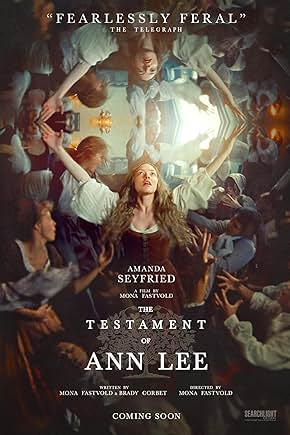

Set in the eighteenth century, moving from Manchester in Great Britain to New York, “The Testament of Ann Lee” (2025) is a historical, musical biopic about Ann Lee and the founding of the Shakers, who later renamed themselves the United Society of Believers in Christ’s Second Appearing. Amanda Seyfried plays the titular character as an adult who decides to draw closer to God through celibacy and dancing that resembles the Martha Graham technique. Her followers likened her to the second coming of Christ. Because of the noise that their worship generates, their celibacy and commitment to pacifism, they met tough reprisals from surrounding communities. This film’s commitment to immersing moviegoers into the lived experience of the early Shakers will not appeal to most but is nonetheless powerful and impressive.
Seyfried did her thang. Her performance is an unrelenting, strenuous, seamless, emotional and psychological marathon. Viewed with modern eyes, it would be easy to just dismiss a figure like Ann Lee as someone coping with real trauma because of her individual experiences and systematic oppression as a woman who wants to have a meaningful life, not just live an ordinary, short life as a broodmare and work horse. In Seyfried’s hands, the figure never seems like a scammer or just a madwoman, but a true, well-intentioned believer.
“The Testament of Ann Lee” is challenging because even though there is a narrator, Mary Partington (Thomasin McKenzie), one of Ann’s early followers, who explains everything, there is not a lot of context. Moviegoers are dropped into this world. With the accents, it could be challenging to comprehend what is being said…or sung. My kingdom for subtitles. No one in the cast is known for singing or dancing, but yes, there is singing and dancing presumably in the style of the Shakers, so it feels odd because it is unfamiliar. It is not meant to be the kind of singing and dancing that is meant to be observed dispassionately but is best understood as a fellow singer and dancer. The lack of participation probably hurts or slows the empathy process. 2025 was the year of the theater kid with films like “A Big Bold Beautiful Journey” (2025), and this movie continues the trend of just going for something regardless of how cringey it may be.
The cast is unselfconscious as they beat their chest, exhale, dance with each other or alone. The entire cast disappears into their characters’ sense of ecstasy as they get closer to God. Norwegian director and cowriter Mona Fastvold, who was the cowriter in “The Brutalist” (2024), and editor Sofia Subercaseaux convey the length of the worshippers’ daily devotion. Extended sequences show the weather as it changes. The quality of the light also reflects the season. It is often an abstract, experiential film. If you have no exposure to charismatic or fundamental worship styles, these sequences will be like nothing that you have ever seen before, especially considering the cast is majority white and dressed in period outfits. It is not often to see people thrashing around in a costume drama and not a member of the global majority.
If all she wants to do is dance and not make romance, then why would the Shakers feel threatening to some people? They are against war and sex and have a woman leader. The two most cathartic sequences are the moment of peace and prosperity as the Shakers devote themselves to woodwork and the last bit of cataclysmic violence levied against the Shakers in the US sounds more like trans genocide rhetoric than most people will be comfortable with recognizing. Regardless of how bonkers or culty these people seem, they are essentially harmless except for being different.
Fastvold stages the worship in sequences that would normally be part of a horror movie like “Antichrist” (2009) with people emerging out of the woods in a strange way or the group sharing of emotions and breathing from “Midsommar” (2019) among many other images that are normally associated with witches. While watching “The Testament of Ann Lee,” you may ask yourself what came first, the demonization of the Shakers for dancing in the woods or the Satanic panic that derided people dancing in the woods as witches dancing with the devil. Fastvold drains these images of their popular culture associations and returns them to their original meaning. It is a provocative concept that is not overly communicated in dialogue but is impossible to ignore once noticed.
“The Testament of Ann Lee” looks like a film, and it feels as if you are in a time machine experiencing the past as it unfolds. It feels like the kind of period film that has not been made since the Seventies. Intercutting between the slow-motion horse riders of oppression on either side of the pond with the Shakers dancing then Ann praising God for defeating all tyrannical governments, it is so incredibly naïve and sad because *gestures to general surroundings*. It is a film that makes you realize the arduous journey from their homeland to a new place that feels more like home for it to betray them as more dangerous and less civilized. There is nowhere to run.
“The Testament of Ann Lee” is not just a film where women take center stage. Of note is Lewis Pullman’s outstanding turn as Ann’s brother and number one fan, William Lee. After Seyfried, Pullman is right behind or beside her or at the forefront when she is not on screen. He is like a laconic, chill John the Baptist. His farewell to the flesh scene is a blink and miss it casual moment that feels organic without being prurient unlike most films with male same sex scenes that look as if they are closing the deal on a house sale (looking at you, “The Choral”). It is totally tasteful and real. Most unexpectedly are the older worshippers, John Hocknell (David Cale) and James Wardley (Scott Handy), who shake their groove things without a hint of awkwardness and complete delight over communing with God. Christopher Abbott plays Ann’s husband, Abraham Standerin, who doubles as Ann’s Freudian issues with her dad transmuted to her husband, the association with whipping and sex, and an everyman who cannot quite get on board with the tenets of his wife’s new spiritual practice but tries to fake it for awhile. Even though he plays a straight man, his character provides some comedic relief with his deadpan reactions to everyone else’s enthusiastic commitment. Tim Blake Nelson looks too modern as a pastor who reads Paul’s teachings like most people but is still drawn to learning more about the Shakers.
As someone brought up as fundamentalist, “The Testament of Ann Lee” could be triggering even if their way of worship had a different purpose than contemporary evangelical tradition, so consider yourself warned. Even if you like historical films with a clear, chronological narrative, there are enough vision, oneiric sequences and worship singing that it may completely throw you off. If you have a penchant for artsy fartsy, independent films that buck convention, definitely check it out.