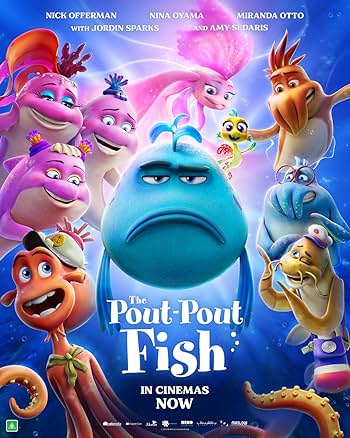

“The Pout-Pout Fish” (2026) adapts Deborah Diesen’s 2008 children’s book,, which is the first in a variety of book series. Fun fact: in 2019, it was adapted into a musical! Mr. Fish (Nick Offerman) is a blue ocean pout fish who frowns and self-isolates from people until the outgoing, energetic Pip (Nina Oyama), a leafy seadragon who is prepping for the arrival of her brothers and sisters, which winds up in the accidental destruction of both their houses. In search of new homes, the odd couple set out to look for Shimmer (Jordin Sparks), a pink Siamese fighting fish whom they believe has the power to grant wishes. Will they find a way to make their wishes come true? While the film has many great characters and lessons, when it diverts focus from the main pair, it tends to bring momentum to a screeching halt. If you can hang in there, it will be rewarding but drink coffee.
Offerman is always an engaging presence regardless of whether he is only using his voice or his entire self. At times, he sounds completely immersed in playing the very sympathetic, grumpy Mr. Fish, but when it is lesson time, his voice noticeably changes as if he is reading to a bedtime story to a child and no longer sounds as if it is an organic part of dialogue. Because it is a kid’s movie, no one is going to notice or care, but it does make the entire story feel more stylized as if Keenan Ivory Wayans dressed as a mailman and is about to jump out of the bushes and exclaim to the camera, “Message!” (reference to “I’m Gonna Git You Sucka”). Many women will relate to Mr. Fish’s plight as someone as people constantly tell him to smile, and the movie makes it clear that Mr. Fish’s problem is not his demeanor. “We will turn that smile upside down because that would make you more palatable to me.” The movie encourages introverts and extroverts to be authentic. “The Pout-Pout Fish” really puts the moviegoer in his shoes and makes his routine visceral, but not monotonous.
There are flashbacks of Mr. Fish as a curious, adventurous child (Lucas Haddrick) and the overprotective, fearful Poppa Fish (Christopher James Baker). These scenes impart a powerful lesson about how raising a child with your habits and world view can fundamentally affect their entire life. During their journey, Mr. Fish finds himself repeating his father’s lessons to Pip when they disagree about detouring to help others or prioritize solving their problems first.
The airplane industry is shaking its fist at “The Pout-Pout Fish” for not sharing the same messaging to put on your oxygen mask first before helping others. The message is further complicated because the incentive for helping people is the expectation that they will help you later. The movie should come with the caution to not try this at home because while reciprocity is nice, transactional help is not a guarantee and an oxymoron unless the terms of expectation are stated up front before giving help. While it is key to the trajectory of this story and delightfully rewarding within the context of the animated feature, in the real world, it is not a way to set up a relationship for success. At its best, it is about breaking generational curses and reassessing a mindset to nurture relationships and cease zero sum games to create community.
Another problem with this approach is that “The Pout-Pout Fish” loses momentum as more characters cross their path, and the film depicts their point of view. In the abyss underneath where Mr. Fish and Pip live, the cuttlefish live in a hierarchal system, and two of them alternate with taking centerstage from Mr. Fish and Pip. The film does a decent job of setting up the mythology of Shimmer. Before the homelessness theme, the idea of Shimmer as a supernatural force is the one thing that everyone agrees on, even Mr. Fish. Benji (Remy Hil) is the son of the cuttlefish ruler, Marin (Miranda Otto), and he goes on his own quest for Shimmer because their home is in peril. Meanwhile his friend, Archie (Nazeem Hussain), covers for him so Marin does not find out. It is noticeable when Benji’s scenes are scuttled but referenced in the central storyline. The cuttlefish are great characters with interesting characteristics that also have a supernatural feel rooted in science. One unexpected side effect of watching this movie is learning so much about creatures that live in the ocean.
The story slows down because of the lack of rhythm in alternating between their story and the main characters, and their journey is less surprising. At the eleventh hour, there is a story about colonialism or gentrification or corporatization or might makes right, which is visually evoked as well. Shimmer seems powerful because she appears to emit light, and the cuttlefish blot it out with the ink that they produce. It feels as if Pip’s character development got somewhat sidelined as a result but is the most relatable for the intended audience because of middle child syndrome and anxiety about socio-economic implications of having a bigger family. Her generation of siblings have already left home, and Pip calls herself a late bloomer, but she is also aware that with her parents expecting, her status could plunge even further. Does she still have an innate sense of self-worth? Absolutely. “I’d rather fail alone out there than give up with someone like you in here.” Yes, Pip! She can see a backhanded compliment coming from a mile away. Another valuable lesson: do not accept company at the price of your dignity. Even though “The Pout-Pout Fish” is a proponent of community, it is not at any cost
Try to be eagle-eyed so you can catch all the clever jokes. The starfish are treated like spies, and instead of shades, they wear mussel shells. A bunch of sea creatures go to the beauty salon holding magazines that have names that are clever turns of phrases that merge ocean references with famous magazines. On a more poignant note, when Mr. Blue’s routine town life gets disturbed, it suddenly seems quaint and precious in retrospect. It is a bit of a slog but once the film ties all the threads together, it ends on a high note.
“The Pout-Pout Fish” is a well-intentioned animated film that needed a bit more polishing and focusing on the odd couple, intergenerational friendship than diluting its focus even if it meant having fewer take home lessons for families to apply to real-life after they leave the theater. While it may not be a part of the big leagues, it also does not look like crap. There is more good than not and even a post credit scene to tie up one loose thread.