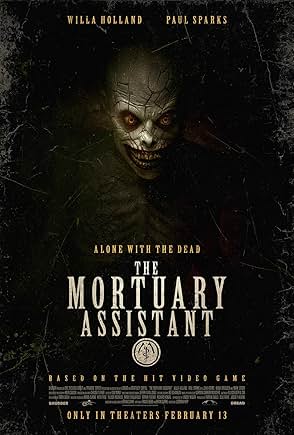

“The Mortuary Assistant” (2026) adapts a 2022 video game. After finishing her internship, Rebecca Owens (Willa Holland, who played Thea Queen/Speedy from “Arrow”) works for Raymond Delver (Paul Sparks) at the River Fields Mortuary. When she unexpectedly must cover the night shift, she starts losing time and notices strange things happening. Raymond delivers the bad news: a demon is trying to possess her. She must follow some poorly conveyed instructions to stop it. Will she succeed? The real question is will you have any idea what is going on if you are unfamiliar with the video game’s mythology? The answer is not without repeated viewings, a note pad and the ability to rewind, and even that may not be sufficient.
The cast is a solid reason to see “The Mortuary Assistant.” I could not place Holland’s face while watching the movie. Holland reminded me of Amy Acker and Morena Baccarin, all good company. Holland’s acting style is natural and organic when it could have been monotonous considering that she plays a scared character for ninety minutes, but her performance feels as if she is really going through it for the first time. Cowriters Tracee Beebe in her feature debut and Brian Clarke, who created the video game, offer enough backstory to make Rebecca sympathetic and easy to root for. On paper, it sounds cliché, but Holland makes it visceral for the audience and conveys how important it is for Rebecca specifically to trust her judgment and do well at her job.
Sparks is a great character actor, which means that you have seen him in everything and may not know his name. He may be best known for playing the high-pitched gangster Mickey Doyle on “Boardwalk Empire,” but he has been in a laundry list of renown movies and televised projects. He disappears into roles, which is the mark of a good actor, but not a good way for audiences to remember him. He may never play the same type of character twice. Raymond is creepy, but it is hard to put a finger on why. It could be the monotone voice, the profession, the firm boundaries, his furtive demeanor or his hangdog, grim appearance. He is visibly straining in trying to be an effusive, encouraging boss, but he is not a people person, and it is unclear why.
To discuss the rest of the actors and their roles would constitute a spoiler, but Keena Ferguson Frasier in a lead supporting role lays the firmest foundation of the danger that Rebecca and others are in. Unfortunately, her early appearance may be so strong in setting the pace that the rest of “The Mortuary Assistant” falters as a result. The filmmakers seem to have too much faith in their audience’s ability to pick up on the mythology of this universe. Director Jeremiah Kipp deserves credit for showing and not telling because it is possible, though unlikely, to discern the rules of fighting demon possession from carefully watching the movie, but it is a big ask. It took three tries to get through it once.
During the first watch, I noticed that I lost focus around the middle of “The Mortuary Assistant.” It is soon after Raymond reveals the mythology in the most bread crummy way. It is likely a creative choice to keep the audience relating to Rebecca’s confusion and fear. Rebecca is an unreliable narrator because the possession attempts create hallucinations embedded with flashbacks and perhaps objective witnessing of supernatural figures such as animated corpses and a mimic (Mark Steger). Players of the game may love this style of film adaptation considering the success of “Iron Lung” (2026) and the desire to experience a story through the player’s actions, but not necessarily in a traditional rewarding storytelling way with gleaning answers and lessons. The point is to survive and live. The bigger picture is extraneous in these types of narratives, but not for people who like horror movies as something separate from faithfully reenacting a video game experience.
“The Mortuary Assistant” is one of the few times that I experienced a phenomenon in a US film that I had hitherto fore only experienced while watching foreign horror films. Movies like “The Wailing” (2016) will use well known supernatural figure names, but not the underlying mythology associated with that figure, which is understandable because places like South Korea incorporate a Western influence into their mythology. Instead of creating new figures and a new mythology, the video game creators take demons, possession, mimics, etc. to form an ecology unfamiliar to any horror expert, which only adds to the confusion, and never fully explains how that world works. It creates something that I dub the “Looper” (2012) problem. A creative can only put so many premises in a film before a moviegoer is ready to throw the whole thing away as some inedible goulash.
The acting and visual atmosphere are strong enough in “The Mortuary Assistant” to stick with it, but just barely. The narrative structure choices are puzzling, which is where Beebe and Clarke’s lack of movie storytelling experience are revealed. The found footage element is promising but limited to one scene. Raymond’s repeated promises to reveal everything then not do so may make viewers relate to Rebecca further, but it additionally could make them feel distant from the movie. It is not a satisfying experience like working a puzzle and watching everything fit. During the second viewing attempt, I fell solidly asleep sitting up in a chair. It could be because I was tired, but dozing off in a chair is a first. A couch makes more sense.
S
P
O
I
L
E
R
S
Was Rebecca marked for possession when she was fourteen or is the Mimic completely unrelated or a hindsight demon influence distorting her memory? Is the Mimic the visual manifestation of the demon? How and when did Rebecca start getting possessed? Is everyone who works at morgues in danger of being possessed since demons start possessing dead people? Where are the deceased’s loved ones, especially if they did not want cremation? How the fuck are the sigils showing the demon’s name? How does the mark work, i.e. rules of the order of placing the sigils? How is staying in the morgue better than being outside? Did Vallery used to work there? 3 houses of hell? That’s it? If the demon keeps coming back, what is the permanent solution?
Video game creators, please work on your storytelling so the universe is fully fleshed out in your head even if it is not told in the video game or movie adaptation. Seasoned horror movie fans can tell the difference even when the film is ambiguous and unclear. When it is well thought out, rewatching feels edifying. When it does not feel complete, it feels like a gimmick and shoddy craftsmanship, which is a shame when everything else about “The Mortuary Assistant” is so well done.