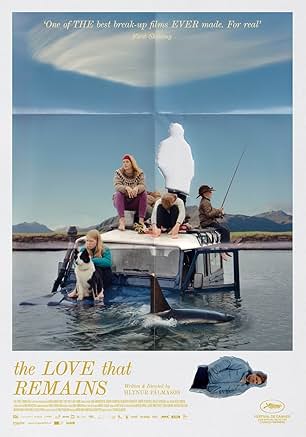

“The Love That Remains” (2025) was Iceland’s submission to the 2026 Oscars’ “Best International Feature.” It portrays a family adjusting to life after the parents, Anna (Saga Garðarsdóttir) and Magnús, nicknamed Maggi (Sverrir Gudnasson), split. Their family life is more ideal than most intact families, but if you are looking for a clear resolution like “Is This Thing On?” (2025), keep it moving. It is an often abstract, occasionally surreal slice of life where the total sum is an elusive number.
Anna is an artist, who is briefly at sea when she loses one studio and must find another. For her, “The Love That Remains” is about her adjusting to the new space, continuing her work while enjoying her time with the children: eldest daughter, Ída (Ída Mekin Hlynsdóttir), and twin boys, Grímur (Grímur Hlynsson) and Þorgils (Þorgils Hlynsson). Side note: they are writer and director Hlynur Pálmason’s children. The work and her children ground her. There is only one moment where she is shown with another adult woman before the denouement. Actually, it is during the opening credits when the family is having their first onscreen meal. She communicates with two men outside her family in connection with her art: Swedish gallery owner, Martin (Anders Mossling), and Danni, Daniel (Halldór Laxness Halldórsson), who may be a publicist but is constantly hitting on her over the phone. Anna is just existing, and any unrelated man in her orbit wants something from her, but their desires fall short of the reality.
All the guys have sex on the brain except for the Swede, whose appetites are depicted as more casually colonialist and wants something for nothing, a consumer, a taker, like a vampire. Pálmason depicts his fellow men as at sea metaphorically and/or literally. After a call, Danni repeats, “Pussy” absentmindedly. Maggi works on a fish trawler, and there is a calendar with a naked woman. His coworkers are introduced talking about sex, but when they are not, they grumble in a way reminiscent of how Maggi does when at home. The twins are aware of sex and trying to discern the societal meaning of how it works in their nature’s circle: for their sister who, in their imagination, is on the verge of being able to choose any boyfriend that she wants, the hens and rooster, and their mom and dad. The only fulfilled fantasy is getting a driver’s license, which gets juxtaposed with the reality: a moment to chastise a parent and vow to do better. Maggi is needy and welcomed, but not allowed to stay. He looks for a way to get a foothold back into the house whether through verbal rebuke of the kids or going overboard literally and metaphorically in meeting Anna and the family’s needs.
“The Love That Remains” often has moments that are fantastical either imagined, nightmares or real, and those moments feel impossible to predict. The storyline with the rooster parallels Maggi’s predicament, i.e. why do men start being pugnacious and disrupt the family. He is a treasured member of the family, but when he disrupts the dynamic or his harmfulness outweighs the benefit of his presence, he is ejected. Maggi is often the one who is responsible for these flights of fantasy, which includes an extended up the skirt shot of his wife with the place between her legs clothed in the sun as the orbit that he wants to follow. He is filled with anxiety about his plight, his unreciprocated desire, and the nexus between torture, death and desire. A scarecrow on the beach next to Anna’s workspace gradually becomes whole as the movie unfolds until it coalesces into the woman of Maggi’s dreams or nightmares.
In contrast, when Anna sees the world in slow motion, it is often when she sees the essence of a man whether it is her brother celebrating success at machine assembly or the Swede revealing that he did not obey her instructions and is a thief. Her fantasy is about punishing him for his transgression, but because Anna is in touch with her desires, she does not have additional flights of fantasy. She is filed with rage and has murder in her heart, but she keeps it there.
“The Love That Remains” devotes a lot of time showing quieter moments in the family’s life: hikes, making art, cooking, foraging for food, oxidization. Iceland is a beautiful place, and filmmakers who shoot there cannot help but try to capture its majesty. Pálmason uses these montages, which include home video of the chickens, to establish the family dynamic. The story is restricted to showing the children at home and in the surrounding environment except when disaster strikes, but not at school or with friends. The story may seem organic, but it is hyper stylized and selective in how Pálmason decides to depict the characters. The parents’ work is germane, so it is shown, but not the parents’ relationships outside of the family except occasionally Maggi’s coworkers. There are no trips to the post office, the supermarket, gas station. The central concept is the family and the essential elements that support the family, i.e. the practical reality of finances.
Because of these more abstract moments, “The Love That Remains” may be better seen on a big screen, not at home. I found it challenging to stay invested in the film, and if I was not a completist, I would probably just stop watching. There are some people who fast forward during a film. If I had, I would have been the poorer for it, but I wanted to. The deliberate pacing and unconventional narrative structure made it hard to get invested in the characters, their dynamic, the themes and the overall story except theoretically. After I finished the movie, I watched the trailer, which advised, “You can also go see something else. It’s ok.” That is good advice if any aspect of this film does not sound as if it is for you. This review gives it a structure which may not be instinctually assessable to the average viewer, but on a positive note, it is not the only way to read the film.
“The Love That Remains” is for people who are satiated at beautiful imagery of nature and simple home life. It is also for people who do not need a lot of context or backstory, which is unnecessary. Also, there is an adorable Icelandic sheepdog named Panda. The film offers an aspirational image of family life at a point of crisis, still whole while fractured. Even though the pacing is deliberate, the ending feels rushed as if Pálmason was rushing to wrap up any dangling threads that he left untied, specifically the legacy of conflict, including war, and how it affects unintended targets. No one is unscathed.