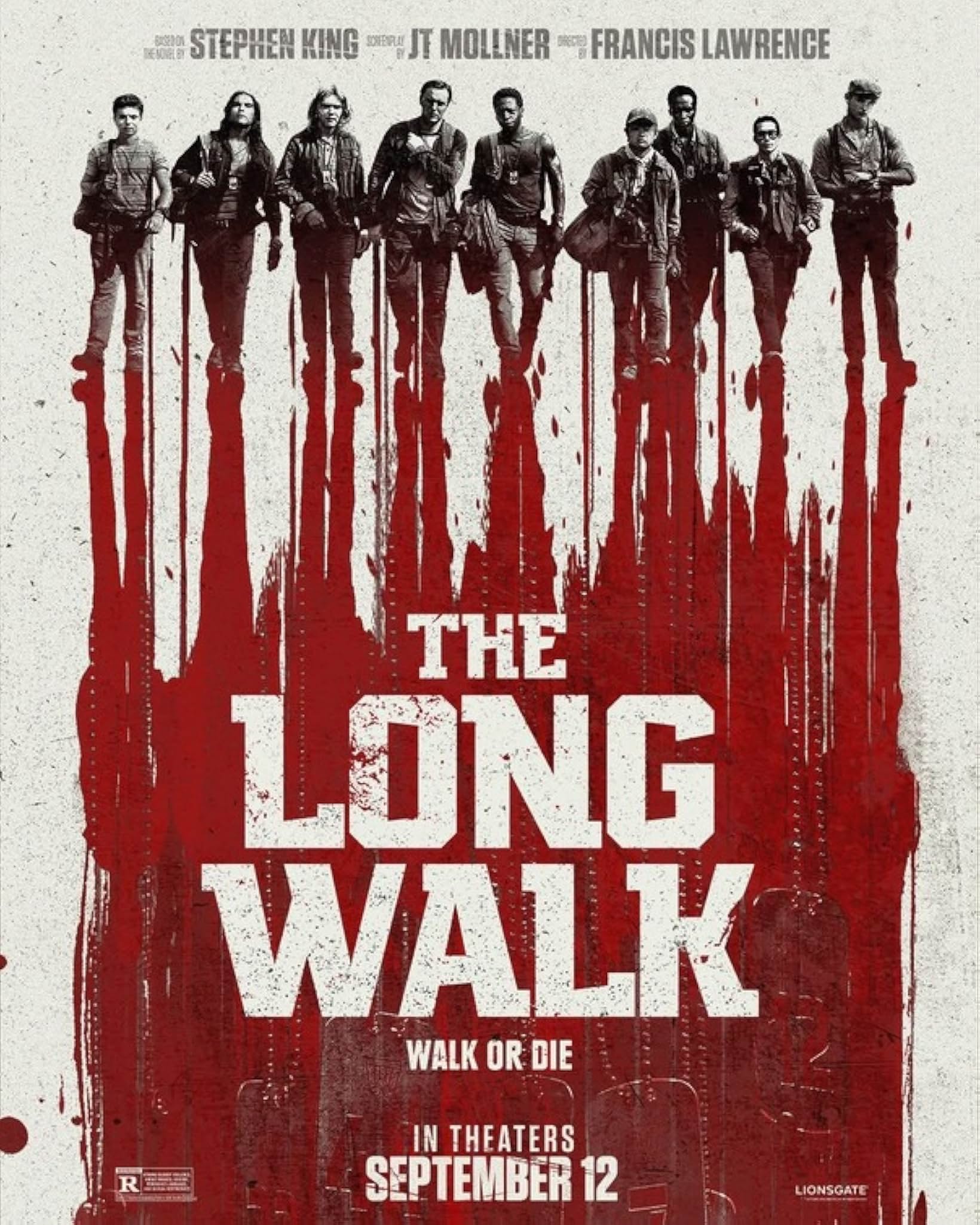

“The Long Walk” (2025) adapts Stephen King’s first novel, which was released under his pseudonym Richard Bachman. In a dystopia America nineteen years after the Great War, a group of teenage boys and young men participate in the titular contest which can only have one winner who gets money and a wish. This walk is broadcast to the public. With no finish line, the only rule is to walk above a certain pace. If you do not, you get a warning. Get three, and you’re out. One of the soldiers will kill that person. If you leave the highway, you get shot. There is no permissible reason to get a warning. What would you wish for?
The cast of “The Long Walk” is stacked. The protagonist, Raymond Garraty (Cooper Hoffman) is not playing for money and makes fast friends with many of the contestants. While watching the “The Long Walk,” I did not know the actor’s name or anything about him but thought that he looked like a grown man similar to Philip Seymour Hoffman. Well, Hoffman is every bit as good as his daddy. No one cares if you are a nepo baby if you are talented, and with talent like his, a lot of people who loved his father are ready to roll all our good will and wishes to him. He plays the one character whose dreams and memories are depicted on screen instead of getting discussed.
Like most reality shows, in theory, no one is there to make friends, especially since all those friends are going to die. Peter “Pete” McVries (David Jonsson) is not like that, and he becomes Garraty’s brother over the course of their walk, which amplifies the good will as they try to save others even though it will make their lives harder. Jonsson is the man who owned “Alien: Romulus” (2024). Hoffman and Jonsson take turns sharing the spotlight, but Jonsson is so good that you will find yourself hoping that his character is not a Magical Negro who exists to keep Garraty alive and change his heart. He is not, but his character is the moral core of the group whose judgment weighs heavily on others.
Gary Barkovitch (Charlie Plummer) is one of those people who cannot handle McVries’ condemnation but miscalculates before a verdict is rendered as he tries and succeeds at playing the villain for the masses. Plummer as a child worked on “Boardwalk Empire,” i.e. no home for young boys. Plummer is the kind of actor that you never recognize because he disappears into his roles and becomes the character: “The Dinner” (2017), “All the Money in the World” (2017) and “The Clovehitch Killer” (2018). Perhaps he was too annoying in “The Return” (2024) as Odysseus’ son.
Those who wisely choose to bask in the warm glow of McVries and Garrity’s good will are Hank Olson (Ben Wang from “Karate Kid: Legends”—two movies in one year) and Arthur Baker (Tut Nyuot), who are individuated based on the actors’ performances, but only have vague backgrounds that their possessions symbolize. Olson eats an orange fruit that could be clementines, and Baker wears a cross and seems to carry a Bible. People on the edges of this community are Richard Harkness (Jordan Gonzalez), who has a distinctive wardrobe that signals his professional ambition, Collie Parker (Joshua Odjick), an absolutely gorgeous indigenous man who is a city boy, and Stebbins (Garrett Wareing), a cryptic intense guy who is really into the contest and seems along with Parker seems more physically advantaged to win.
You would think that a movie where people are just walking and talking to each other on a mostly empty road would get old fast, but “The Long Walk” does not because it is so horrifying and endless. It is not necessary, utterly arbitrary and merciless with no reasonable exceptions to the rules. Many have considered this story to be an analogy for the draft during the Vietnam war, but spiritually, it still feels germane. The famous eerie Taylor Holmes’ reading of Rudyard Kipling’s 1903 poem, “Boots,” would have fit perfectly here, but would have destroyed the sense of realism that the story mostly adheres to. There is no diegetic sound. The camera only occasionally shows the group from a distance which shows the surrounding area, which can be verdant and beautiful from afar. The camera is like one of the contestants though occasionally it also shows their point of view and then the impact of what they saw. There is no escape for the guys or the moviegoers. The movie does not often show each murder, but just the sound of the shot is enough to cause them to flinch. Eventually the images blur at the time of execution as if to honor the person’s final request that the surviving participants do not look. It is a “voluntary” death march, which was an integral part of the transatlantic slave trade as the enslaved marched to the shore, the Trail of Tears or any other conflicts except instead of captured people, it is cannibalizing their population for entertainment. There are signs of the Great War’s other casualties that are not walking such as a blind cat, strewn animal bodies, kids on crutches without legs.
Most of these contestants would not know of a world before this game existed so it would feel normal. It is a death cult that requires child sacrifice. The soldiers who guard them and include women only betray any sense of shame in a nighttime scene when a soldier switches from holding a gun to a kid’s head to getting that same kid a canteen when requested per the rules. While Mark Hamill is a brilliant actor, his role as the Major may be his weakest yet because he is mostly an annoying man in love with his voice but does not feel like a real person.
There is a meta tension inherent in the story. Like the people in this universe, moviegoers are watching children, the future, dying for no reason. Such behavior is the sign of a demented society. Was King’s novel the first of its kind to imagine such a scenario? Since then, there have been scores of movies devoted to similar barbaric schemes like “Battle Royale” (2000) and “The Hunger Games” franchise, which shares the same director, Francis Lawrence, as “The Long Walk.” Of course, there are plenty involving adults like “The Running Man” (1987), which will be rebooted this year, and “Squid Game.” If you go further back, the roots may be grounded in ancient Rome’s gladiators combined with feeding atheists, which were what Christians were considered for not believing in other gods, to animals. The concept of gladiators date back to third century BC. People who were part of the outsider classes exist to entertain, and if they do so well, they get to survive. If King’s concept is even more horrifying, there is no option to fight back. It is impossible to believe that this particular group is the first to make friends along the way. Unlike the other cinematic or historical contests, these contestants are not trying to kill each other so getting to know people is an inherent aspect of this game, which means trauma is another bonus prize.
“The Long Walk” does make changes in writer JT Mollner’s translation from the page to the screen, which could be controversial, especially at the end. It feels as if it is making a statement about the appropriate responses in contemporary times. It makes a clear and decisive statement about how such a society kills the utopian impulse that would provide hope for the future and perpetrates the values of the game even when someone tries to stop it, and that action is also right. There are no winners just people losing different things.