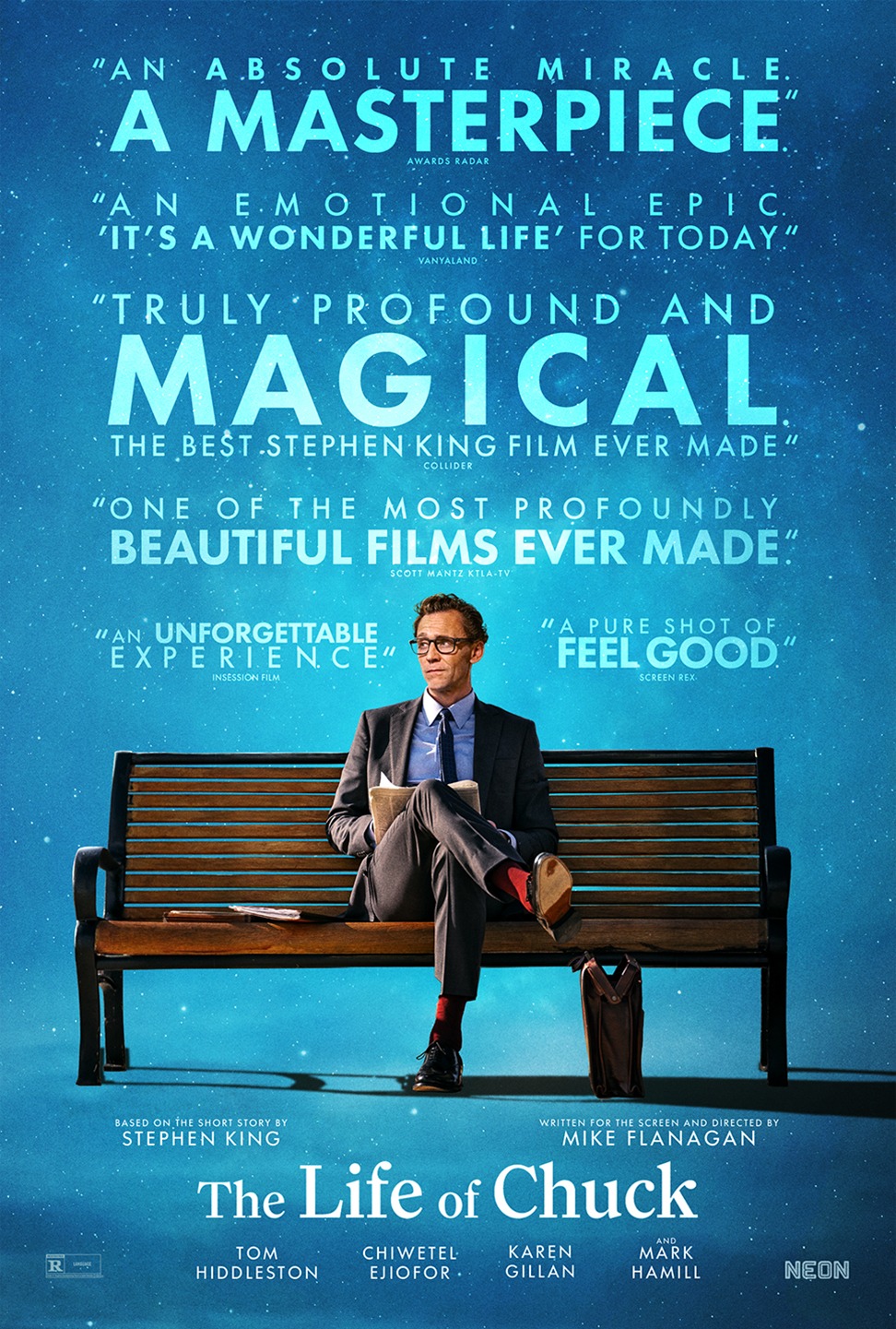

“The Life of Chuck” (2025) adapts a Stephen King novella from “If It Bleeds” (2020), which consists of a total of four novellas. Like the source material, the story occurs in three acts moving backwards from the latest story to the earliest story. Think “A Prayer for Owen Meany” meets the narrative structure from “Memento” (2020). Walt Whitman’s poem “Song of Myself” from “Leaves of Grass” (1855) inspires the story which imagines what multitudes, both real and imagined, are contained within Chuck (Tom Hiddleston), a thirty-nine-year-old man.
From the Marvel Cinematic Universe as Loki to writer and director Mike Flanagan’s latest film, images of Hiddleston, preferably dancing, is appealing to society. The biggest suspension of disbelief is pretending that Hiddleston is just some normal dude because they slap him in a suit and some glasses. Hiddleston is a great actor, but he is not ordinary, which is the movie’s raison d’etre: that every individual is amazing. Movies are not just art but a business, so it is easier to put a multilingual, handsome, iconic Brit than some ordinary guy that is capable of such a sizable glow up worthy of the big screen. To be fair, the average guy has a lot of audacity, may think that the universe revolves around him and grades himself higher than objective observers would, so maybe the casting of Hiddleston as every man works. Chuck is an accountant, a faithful husband and beloved father so the film’s reverse order story lays out a mystery for the audience to solve in the first act: how are the people in the first act related to Chuck?
“The Life of Chuck” begins with the most relatable story. This act revolves around divorced English teacher Marty Anderson (Chiwetel Ejiofor) and his ex-wife and nurse, Felicia Gordon (Karen Gillan), as they reconnect to weather the storm of the last days. The world is going to crap on every level while people try to function normally. Sound familiar? Eventually the obstacles increase exponentially, which forces people to stop pretending everything is normal and accept the end. Meanwhile, all over town, Chuck’s mug keeps appearing on ads expressing gratitude, and they are popping up all over the place. It is a solid image of apocalypse with great sound effects but does not feel sensationalistic or exploitive. It is a tasteful movie and end-of-the world scenario. Zero sex or violence. When the average person thinks of King or Flanagan, the third and first acts are what people are expecting, but when you start with an apocalypse, it is hard to sustain that level of suspense through the more quotidian subsequent stories.
The middle of “The Life of Chuck” works better because it has a long dance number in the middle of the street so at last, viewers can just enjoy what they are watching instead of being told what to feel. The posters and previews spoiled too much. It would have been better for it to be a surprise when Chuck starts dancing so movie watchers could be as blown away as the spectators on the street. This section begins to explain the opening and introduces the mystery of Chuck’s sudden motivation to be a busker for a moment. Why does an accountant know how to dance and why would he suddenly feel compelled to do it at that point in his life?
“The Life of Chuck” ends with Chuck’s childhood story with three young actors playing Chuck at three stages in his life: Cody Flanagan (yes, Mike’s son), Benjamin Pajak and Jacob Tremblay. Here is where the pieces of the puzzle ultimately come together. It is a real treat to see Mark Hamill and Mia Sara, who has not acted since 2013, play Chuck’s grandparents, Albie and Sarah Krantz. They feel like the real heart of the film. The supernatural briefly rears its head, but it feels more like an afterthought than a crucial element.
The entire cast must be perfect to get through the reams of heavy-handed dialogue, thinly disguised prose dumping, which tells moviegoers how to feel and edelineates what they are watching instead of showing. It is hard to get swept away when a film keeps interrupting your absorption in the story when it feels the need to constantly explain it. It is not the narrator’s fault. Nick Offerman makes it as engaging as possible.bThere are some terrific, brief performances from Carl Lumbly, Matthew Lillard, and David Dastmalchian. As Felicia’s coworker, Bri, Rahul Kohli gets a more prestigious role than his former “iZombie” costar Malcolm Goodwin, whose movie, “Resurrection Road” (2025), releases the same day, which feels like an inadvertent explanation for why this movie works for some and not others. Both are equals, but one gets to be a bit actor in an acclaimed movie that is more hype and the other gets to star in a movie that is not good and will go unnoticed. Being average is only special and possible for some people so the diverse cast is burying the lead.
If “Once Upon a Time…in Hollywood” (2019) lost people when Brad Pitt’s character beats a fictional Bruce Lee, “The Life of Chuck” may get the same reaction for depicting a kid in the Eighties who invents the Moonwalk. Chuck’s alias better be as a young alternate dimension Michael Jackson or Bob Fosse with a time machine who kicked Michael J. Fox out of the DeLorean to travel to the future—see “The Little Prince” (1974) where Fosse plays The Snake. Michael Jackson fans are going to use word-of-mouth to tank this movie. Cue the meme of Annaliese Keating getting up with her purse directing a sour look at the screen. Even today’s best entertainers are derided when anyone dares to describe them as the next Michael Jackson so as sweet and well-intentioned as this movie is, that one move could tank the story. Hear me out-couldn’t Chuck just be a good dancer? Did history have to be revised? Without the unfortunate creative choice, the dancing can be appreciated on its own terms, but comparing Chuck to Michael Jackson for those ticket buyers who will recognize the reference will make the dancing seem amateurish and undercut the message of the movie.
“The Life of Chuck” has a handful of moments that will prevent you from getting swept away. There is a casual dismissal that man could cause climate change. In the first act, couples are getting back together in the face of disaster. To be fair, King’s story got published during the year of the pandemic but was likely written long before. In the face of cataclysmic upheaval, people get divorced and want freedom from the person and things that weighed them down. Everyone loves King, but his finger has not been on the pulse of accurate majority sentiment in a while.
Younger or vulnerable moviegoers will eat up “The Life of Chuck” and let it sweep them away, but people who have been around the block in life and watch too many movies require more subtle storytelling techniques to hook them. The ensemble cast is excellent and without them and Flanagan’s visual talent for drawing the eye on all the clues, this movie would be unwatchable. As it is, it is entertaining, but not as life changing and dry begging for a repeat watch as it wants to be.
S
P
O
I
L
E
R
S
Chuck grew up in a house with a cupola, dome structure at the top floor of the house, and anyone who enters the space will accurately see the future, usually someone’s death, possibly their own. While Albie lives, he stops Chuck from satisfying his curiosity and going in there. Sarah taught Chuck how to dance as a way to overcome death and grief after losing Chuck’s parents and unborn sister. When he was a kid, he has this pivotal point in life where he transcended his ordinary self through dance, which includes inventing the moonwalk, but his mortality brings him back to Earth. Albie shows how math is also transcendent though ordinary. So, Chuck is multitudes embracing art and science. When Albie dies, Chuck sees his death but does not know when it will be, so he feels a sense of unbearable dread while waiting. When the brain tumor is about to destroy his life, and Chuck is still unaware of its existence, Chuck suddenly dances in the street to a busker’s drumming like a last burst before a sun/star collapses in on itself. The third act represents Chuck’s mind creating a story and combining images from his childhood and adulthood to make a cohesive story about the end of the world to explain his death to himself. It is not global, but a personal apocalypse. Marty and Felicia worked at the school as teachers. Sam (Lumbly) was the caretaker at the funeral home and met Chuck after Albie died. Bri (Kohli) was sitting outdoors the evening after adult Chuck danced in public, and the little girl in roller skates passed them. There are probably more details, but I’m not watching “The Life of Chuck” again, and you get the point.
There is a theory that no one can imagine a face so when you write a story or dream, the characters look like people that you know in real life, which is what is happening here. Fortunately, this theory is one of the few that is not repeatedly explained within the movie. Call me a Grinch, but these details did not do anything for me. To quote “Family Guy,” this movie insists upon itself. While this image of death may feel comforting on some level, it just is not this beautiful, safe and pat. The absence of palpable pain and struggling through death makes this feel like a fairy tale.
Postscript: On 6/13/25, thanks to Dion Briggs, who wrote in with the following:
“Chuck said he learned the moonwalk by rewinding over and over. (stumbled upon your review) … they are not saying he invented the moonwalk.”