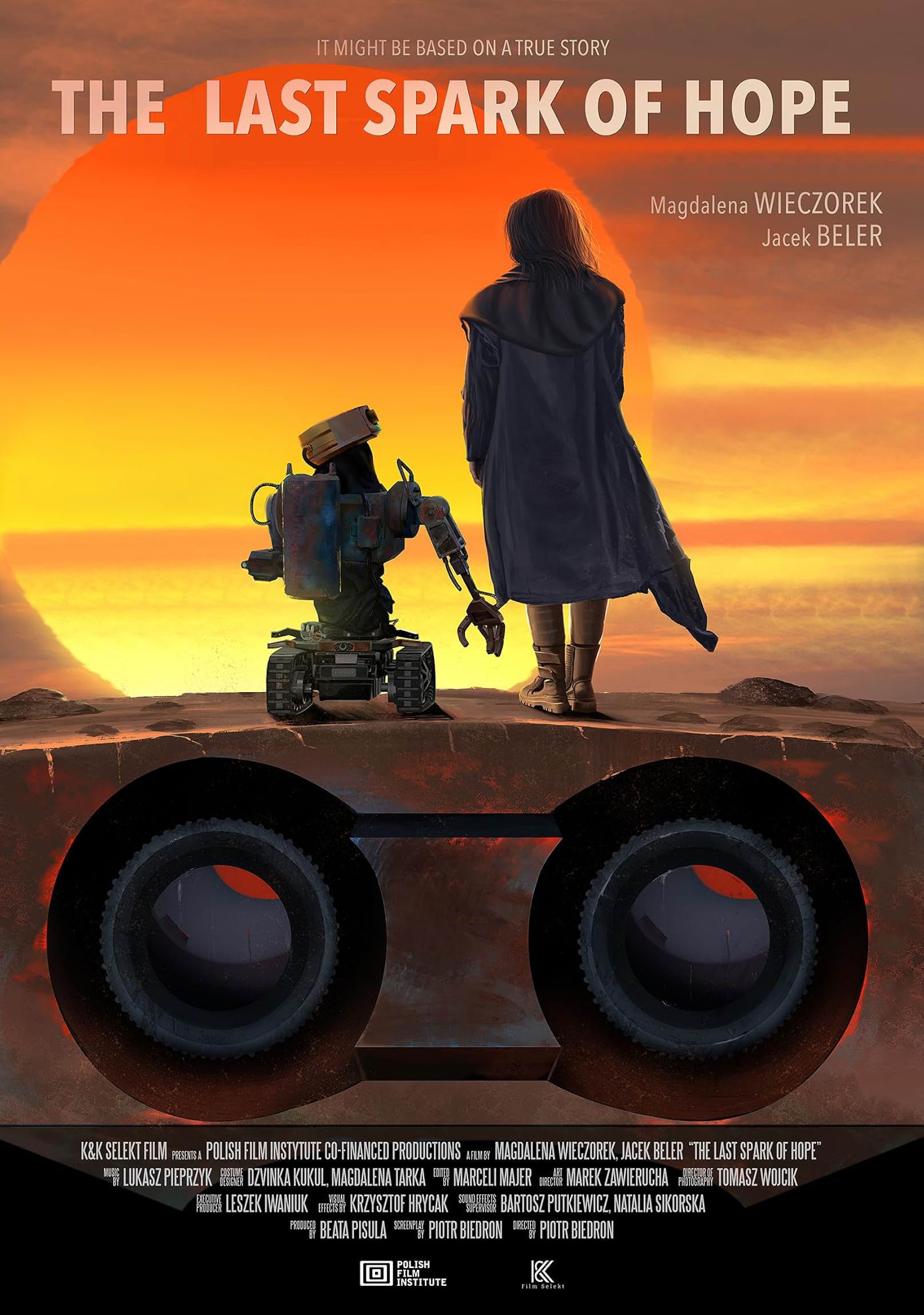

“The Last Spark of Hope” (2023), original title “W nich cala nadzieja,” occurs in the future after 2040 when Earth has become mostly uninhabitable. Eva (Magdalena Wieczorek), who lives with Artur (Jacek Beler), a robot programmed to protect her from intruders after serving in the Climate Wars, live on a mountain base near Laziska Górne, a town in Silesia, Poland (thanks to Irish Film Critic for that detail). Eva spends her time maintaining the base, chatting with Artur and hoping to find another survivor. When Artur confronts an intruder, Eva must figure out a way to get necessities. Will Artur fulfill its mission? Polish writer and director Piotr Biedron uses a bleak, dystopian story to deliver a cautionary tale about human limitations in his first feature.
Eva, a military kid, is the narrator and protagonist who gets a briefer back story than Earth and Artur. She is kind of mean to her robot, but Artur seems mostly impervious to her jabs. She has established a monotonous routine, but keeps busy, is able-bodied and has the most fashionable hazmat suit which she wears when she goes into town to scavenge for supplies. Eva adheres to all the safety programs, but in a casual way that feels more quotidian than perilous and forgets that one small misstep could be fatal. She wears oxygen to avoid contamination. Whenever she walks on the base, she must give the password. Wieczorek has a thankless job, but she does it well. She is basically acting alone for almost ninety minutes and is believable when engaging in survival. She does a solid job, but it is impossible for any actor to overcome the story’s limitations.
Artur is devoted to its job, but its programming leaves it limited in its capacity to help Eva. It is inflexible and does not do anything except patrol and talk so no heavy lifting or executing other tasks that would make Eva’s life easier. It does not understand humor and rejects Eva’s attempt to project human attributes on to it, but there are flashes of uniqueness. It enjoys riddles and wants a new eye for Christmas. Eva states that its programming was erased and tells it about its history, but it dismisses her account as lies since it does not remember it. Beler’s voice acting sounds like a machine, and Artur resembles WALL-E. Because of its appearance and sound, it is easier for the audience to get lulled into this sweet story between a girl and her robot and read more warmth into Artur’s words than he is giving, but Beler never tips too far in the other direction by giving him a personality. Beler has a difficult balancing act.
“The Last Spark of Hope” starts strong but cannot maintain its momentum and is not the kind of movie that you should watch if you expect to be entertained. The opening narration offers humanity’s backstory and will sound familiar, especially all the haves leaving in rockets, but with nowhere to go. [It feels like a sidequel to “Mickey 17,” which is a more optimistic movie.] It is a theme that dominates the film. Human beings keep telling dystopian instead of apocalyptic tales, and Biedron’s goal is to shock his audience back into remembering that apocalypse is always on the table during a dystopia, to abandon the fantasy of being a survivor and embrace facing hopelessness. It is an audacious goal that seems inherently impossible to make riveting because of the nature of the story. Biedron deserves credit for committing to his story.
Even though the catalyst sparking the events in “The Last Spark of Hope” is climate change, and the story’s lesson is a cri de coeur cautioning people against taking their homes for granted, which will lead to extinction, it is also a movie about the madness of inhumane bureaucracy in the face of crisis. Artur’s history is at odds with its mission, but it lacks the capacity to reflect on its actions. It is kind of like the Syrian crisis or anytime human beings who are considered “other” need help. The people with resources want the credit of caring, create frameworks to offer it and then argue lack of resources to deny actually giving help. Artur is a robot. It has an excuse. What excuse do people have? Its programming is a metaphor for ineffective bureaucracy. Tying life-saving aid to bureaucracy is the same as killing someone. The lesson is devastatingly urgent, but will anyone watch the movie to the bitter end to get it.
What “The Last Spark of Hope” lacks in propulsion, it maintains in visual style thanks to cinematographer Tomasz Wójcik, and it is only his second time working on a fiction film. It feels related to “Young Ones” (2014), but less stylized and more realistic. There is a hazy quality to each shot that will make viewers intrigued about what is around the corner and constantly waiting for something to pop out and attack Eva, especially when entering a power plant. Low budget can be beautiful. Earlier she mentions an ax, then Chekhov’s ax gets used. Lukasz Pieprzyk’s soundtrack, which is electric, raises the stakes in tempo and guides the viewer through the emotions that the film wants people to feel when watching the movie without being too intrusive.
If you suffer from intrusive thoughts of logic flaws while watching a movie, “The Last Spark of Hope” may drive you crazy. I kept thinking that Eva should have had this problem, which is a spoiler and not revealed in the trailer so critics need to stop giving it away, a long time ago or perhaps started earlier to show her thirty day routine so that when she deviates from it, the change will feel like more of a kick to the ribs than when it happens in the movie. Also the movie has a lot of time to fill so Biedron should have shown more ways that she tried to overcome it because the average person will have suggestions and feel frustrated instead of getting the point.
If you are watching “The Last Spark of Hope” expecting a traditional sci-fi film like the “Terminator” franchise, move on because you are going to hate it. There are subtitles so if you hate to read at the movies, skip it. People who do not mind deliberate pacing and love depressing films should watch it immediately, especially considering the end reveal is one of those gut punches that maybe ties the various themes together in too tight and tidy a bow but works and feels rewarding. Even if you enjoy it, it will be a struggle to stay engaged throughout the film. Hopefully Bierdon will find a way to execute his concepts in a way that retains its unflinching rigor while not being a soporific.
Side note: What is the answer to the riddle? I know that it is not the point and callous to ask, but I’d still like to know.
S
P
O
I
L
E
R
Postscript: Thanks to V. S. Rawat in India for the riddle answer: The answer to the riddle is – “The Third Robot Lied”.