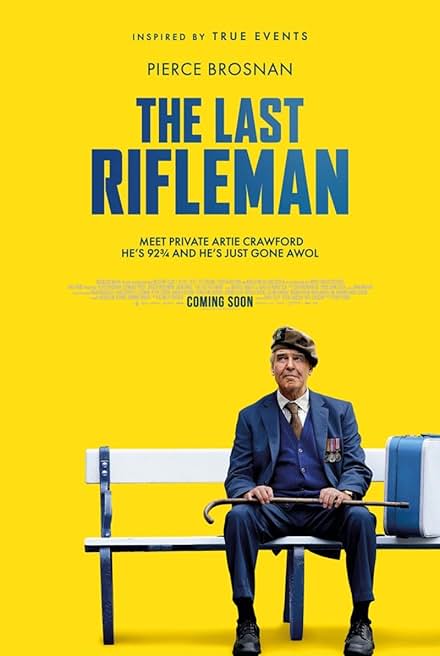

Around June 6, 2014, Bernard Jordan, a British World War II veteran, escaped his England nursing home to attend the 70th anniversary of D-Day, and his true story inspired two movies: “The Great Escaper” (2023) starring Michael Caine, which is unavailable in the US, and “The Last Rifleman” (2023), starring Pierce Brosnan, which is streaming in the US. Memorial Day is a hard day to depict in film because it is a day held specifically to honor those who died while serving, not veterans in general, when only the living can tell those stories. It is a challenge not to center the stories of the living and neglect conveying the sacrifice of those killed in action. This movie does a decent job of remembering those lost, and while watching a movie cannot replace in person visits to memorials and cemeteries, for those who are unable to do so, this film will do. The fictional Arthur “Artie” Crawford (Brosnan) is ninety-two years old and lives at Lough Valley Nursing Home. The televisions are buzzing with news of the upcoming 75th anniversary of D-Day, and after suffering a personal tragedy, he decides to embark on a journey to join his fellow veterans from the British Army’s Second Battalion, Royal Ulster Rifles, even though he does not have permission or adequate identification to reach France. Will he join his battalion?
Brosnan was seventy years old when he filmed “The Last Rifleman” so don’t expect to see the Brosnan that you are familiar with from the subsequently released “Black Bag” (2025). He is under a lot of makeup and likely prosthetics to convincingly play a man decades older, but the makeup does not smother his performance. His portrait of Artie is not the usual naughty elderly person depicted in the pablum marketed to older viewers like “Poms” (2019), “The Leisure Seeker” (2018) and “80 for Brady” (2023). The road trip is neither about adventure nor a last hurrah, but a somber, symbolic remembrance of people gone but constantly in mind as if they were still there yesterday. Artie is an understated man who does not need to impress any one or do anything flashy. He treats his travels as a private affair that would be more routine without the obstacles. Though he walks with a cane, he is unbothered at the prospect that his body is incapable of this travel because he survived worse and never got hurt. For Artie, his entire life should not have occurred, and he has been on borrowed time for ages.
The obstacles are plentiful: his list of ailments, the need for round the clock medication, navigating the outside world as a disabled and elderly person (those are two different things), not having adequate identification, and the people who would stand in his way. Those people include busy body Tom Malcolmson (Ian McElhinney from “Game of Thrones”) who does not miss a moment to make Artie’s life his business, the nursing home administrators and various government authorities and medical personnel that Artie meets along the way. When journalists, including Tony McCann (Desmond Eastwood) from the Irish Journal, get wind of Artie’s escape, Tony embarks on his own road trip and acts as a humorous foil considering how he finds international travel more challenging despite having nicer accommodations.
Once Artie is on his way, “The Last Rifleman” offers snapshots of the kind people along the way, and as he gets closer to his destination, the stories focus more on World War II. Writer Kevin Fitzpatrick puts the story in a minefield that may make some viewers explode namely the way that he depicts German veterans from that era. If you are an adherent to Daniel Goldhagen’s book “Hitler’s Willing Executioners,” you may shout, “You mean Nazis!?!” Yes. The movie walks a tightrope not excusing the atrocities and ideology behind it but emphasizing that kids raised in such an environment would not know that they are on the wrong side until the fighting is over. Jürgen Prochnow’s performance as Friedrich Mueller, one of the Good Samaritans that helps Artie, is like an extended apology and search for redemption while never receiving the forgiveness that he is searching for, only politeness. Honestly the movie almost lost me during this scene because it felt littered with false equivalencies, but having a former World War II German vet disavow his side is not a common type of character seen in media, and one that is urgently needed and germane in contemporary times
“The Last Rifleman” counterbalances that moment to ensure that no one walks away from the movie with the wrong lesson when Artie crosses paths with an American WWII veteran, Corporal Lincoln Jefferson Adams (John Amos in his final performance). When Artie tells his new friend about his encounter with Friedrich, the Corporal correctly points out that he is only repentant because the Allies won. This scene does not just clear up any possible wrong conclusions from the prior scene, but ties into the broader theme of survivor’s guilt, which is the real motivation of Artie’s journey.
“The Last Rifleman” is not a perfect film. The flashbacks are a necessary element of the story but are the shakiest part of the film though the editor John Walters use of juxtaposition with the past and present helps alleviate noticing the flaws. The Normandy scenes never feel as if they were shot during WWII, and the actors barely look like a straight line from the past to present. There is one scene when Brosnan gets to use his real face, and that scene hits hard because it shows how there are different types of war: a literal one during WWII then the battle of illness robbing him of more loved ones. Another Good Samaritan, a French mother, Juliette Bellamy (Clémence Poésy), uses the phrase “The Three Musketeers” to describe the close relationship that she has with her children, and this phrase’s double significance will be revealed at the denouement. It is probably an obvious revelation, but it seemed like a necessary one. The average person may not be able to relate to losing someone serving in a war, but everyone tackles illness and loss. The parallel may make Artie’s story more relatable instead of a rote way to give lip service to history instead of viscerally appreciating it.
If you are worried that “The Last Rifleman” will be another movie centering an older person but actually insults their intelligence and does not adequately represent their experiences, don’t. It is a poignant story about grief and living with the devastating knowledge that despite not being better than those who passed, life persists. The most devastating scene is how Artie witnesses people treat D-Day Remembrance like a fair or a playground. So, while enjoying the three-day weekend, do not forget that many around you do not see it as a holiday, but a time to honor those who made the ultimate sacrifice.