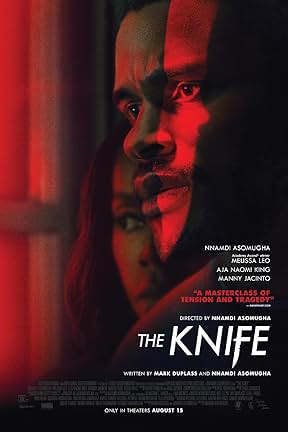

A family of five live in their “new to them” house in a bad neighborhood. When an intruder (Lucinda Jenney) breaks in and enters their kitchen at 1:37 am, the thirty-six-year-old father, Chris (Nnamdi Asomugha, who also directs and cowrote), aka Christian, has an encounter with her. When the family streams downstairs, panic ensues before Chris calls the police. The twist is that the family is Black, and the intruder is a white woman so they are worried that the police will not trust them. “The Knife” (2024) asks if it is a self-fulfilling prophecy or a justified fear? Neither because by the end of the movie, the family are the bad guys albeit they are supposed to be sympathetic ones.
I always try to prioritize films with Black talent in front of and behind the camera. “The Knife” is Asomugha’s first feature. He introduces the protagonist as a hard worker who loves his wife and adores his kid but gradually unravels the perfect family facade to depict inthe dialogue to solo scenes how the stress in their lives turns up. The action occurs in one location, the family home, at night. He raises the stakes when a marital exchange reveals how many important events are happening the following day. They need a good night’s sleep, and they are not going to get one.
The gorgeous and talented Aja Naomi King is most famous for playing one of Annelise Keating’s law students in “How to Get Away with Murder.” Fans of Shonda Rhimes television series will correctly anticipate that King’s character, Chris’ wife, Alex, will do something to further complicate the matter. Aiden Gabrielle Price as oldest daughter Ryley and Amari Alexis Price as Kendra, the middle child, are pitch perfect, which makes sense since they are real life sisters and the whole proceeding hard to watch. They immediately try to be helpful and still have complete faith in the system while Mom is immediately activated and on guard to protect her family.
Manny Jacinto has less screentime as Officer Padilla than he did in “Freakier Friday” (2025) as the fiancé to Lindsay Lohan’s character but is basically the hype man before Detective Frances Carlsen (Melissa Leo) is introduced. Once Leo appears, “The Knife” becomes her movie, and only King manages to go toe to toe for a few brief seconds because hell, she acted opposite Viola Davis for six years. Long before it is spelled out, King emphasizes the word “victim,” echoing how the detective feels about the intruder versus the family, but the thumb is on the scale. Detective Carlsen is an example of copaganda, which I often love, especially any “Law & Order” franchise or comic book related television series or movie, so the entire universe is primed to believe that the detective is really here for the truth. Moviegoers will be on her side because Asomugha deliberately omits showing the confrontation that could vindicate or condemn his character and does show how and when the family is lying. The average person does not know how to spot when a detective is violating proper police protocol, but they can compare what they see with what they later hear, and to expect otherwise may signal too much faith in the audience to pick up on the nuance, especially if they suffer from the same unconscious bias.
In the interest of full disclosure, screeners come in different packages. Some you can play on a television screen, and some can only be played on smaller devices. My advice to filmmakers is to shoot a film for the big screen but look at it on a small screen because it will be available longer for home viewing than a big screen so if nighttime scenes are hard to discern, you are not doing yourself any favors. Asomugha is in good company because “Game of Thrones” probably had a bigger budget, more technology and experience, and they screwed it up. If you are interested in seeing “The Knife” see it in theaters, because I saw it on an iMac, and it was not always easy to see what was happening so I could have missed something that obviously vindicates the family.
To be fair, in real life, people do stupid things all the time so “The Knife” is not unrealistic, just annoying as the family commits a series of rookie mistakes that the average home viewer who is a fan of crime series would know not to make such as touching the body, moving things, not hustling the kids anywhere but the kitchen, acting jumpy at the most inopportune times. If this movie was just about dumb human beings who happen to be Black, it would be easy to watch, but it deliberately leans on the racial angle while depicting stereotypes regardless of how picture perfect and sympathetic the family is.
If you Google or ask AI for “cases where Black people are convicted when they hurt someone who entered their home,” the results show examples of police not following procedure and includes results not related to a home invasion but did not include one famous case. When you’re Black, you do not need a search engine or a large language model. I remember the case of John White in Long Island. On August 9, 2006, in Miller Place, Long Island, a group of teens demanded at the foot of his driveway that John White produce his nineteen-year-old son. He shot seventeen-year-old, Daniel Cicciaro, one of the teens standing on his driveway. On December 23, 2007, he was convicted of second-degree manslaughter with a two-to-four-year sentence. After White served five months, then outgoing New York Gov David Paterson commuted his sentence on December 23, 2010, and White was released. After disobeying police orders, Zimmerman followed and killed seventeen-year-old Trayvon Martin on February 26, 2012 and was acquitted. There could be many reasons for the difference in outcomes. Florida is a “stand your ground” state, and New York is not, but most people highlight the racial differences of the shooter and the victim because it is definitely not the location of where they decided to allegedly defend themselves—a home versus a public sidewalk. A documentary like “I Am Not Your Negro” (2016) quotes James Baldwin who alleges that Black people are denied the human right to self-defense and empathy.
“The Knife” (2024) plays with this tension then slowly deconstructs it to reveal “the truth,” which sympathizes with a Black family while gently introducing stereotypes that reinforce the image of Black people as inherently criminal thus vindicating presumptions of guilt. Fair or not, my respectability politics pearls are on, and I am clutching them, unable to take them off, so I will suggest an alternate reading of the film that my intellectual brain can offer. Asomugha is Black and in collaboration with cowriter Mark Duplass, who is famous for encouraging people to make independent films in the most economical, community-based way possible, so they definitely brought good intentions to the table. A friend and former successful theater actor and I had a conversation about “Luce” (2019), and she correctly explained that Black actors have the human right to have a range of roles available to them that reflect the human spectrum, which includes villains. “Luce” felt like a movie about a criminal that they tried to jeuje up with race whereas this film is trying to depict a human story (the American dream of a home, the nightmare of the opioid epidemic and inadequate healthcare) that hits every branch of the stereotype tree (substance use, unemployment, more kids than they can afford, liars). It may not have occurred to the filmmakers that moviegoers may see the family through a biased, pathological lens instead of a relatable, human story of making a mistake then spiraling.
“The Knife” is going to be a Rorschach test for moviegoers at a time when a larger test was implemented, and a lot of people failed under clearer circumstances. For me, it is like the crime drama version of “The Help” (2011), but maybe Asomugha and Leo could team up and create a television series. If you are interested in watching a film with Black villains who are wrongdoers without falling into racial stereotypes and express universal negative human behavior and emotions, watch “Eye for an Eye” (2025).
“The Knife” will be in theaters on August 15, 2025.