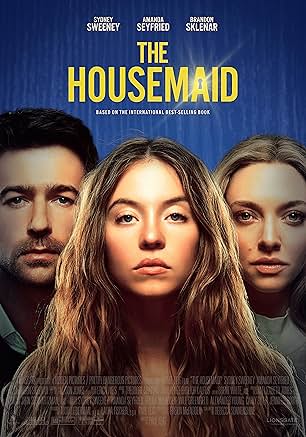

Do not confuse this film with the South Korean films from 1960 and 2010. Better than “Avatar: Fire and Ash” (2025), “The Housemaid” (2025) titillates, thrills and tickles every fancy in a pulpy adaptation of Freida McFadden’s 2022 novel. Without a lot of viable employment opportunities, Millie Calloway (Sydney Sweeney) is eager to work for Nina (Amanda Seyfried) and Andrew (Brandon Sklenar) Winchester, no relation to Sam and Dean, to occupy the titular profession and care for their daughter, Ceci (Indiana Elle), but everyone is hiding something and not who they appear to be. Director Paul Feig apologizes for “Another Simple Favor” (2025) with this entertaining, uproarious, unashamedly predictable with its tongue firmly planted in cheek, over the top, contemporary Gothic film. Everyone understood the assignment, including writer Rebecca Sonnenshine who stayed faithful to the source material.
Seyfried did two movies for herself, “Seven Veils” (2023) and “The Testament of Ann Lee” (2025), and one for us, “The Housemaid.” If the world was fair, all three would be hits. Anyone charting Seyfried’s career would not be surprised that Seyfried has range. She has always been more than a pretty face or the latest blonde starlet, and it is a delight to see her get top billing in 2025. Seyfried has great fun as Nina. Clad in all white or beige, Nina seems like the perfect upbeat housewife before turning on a dime and turning into a nightmare employer, she either treasures Millie or is determined to tear her apart. Feig does same great blocking to make Nina seem more terrifying. In a competition with Glenn Close’s character in “Wake Up Dead Man: A Knives Out Mystery” (2025), it would be hard to say who would be better at sneaking up on the other. It is always a joy to see a great actor not feel above the work and tackle it with relish.
Like Josh O’Connor, Sweeney is also in four films this year: “Eden” (2024), “Echo Valley” (2025), “Christy” (2025) and now “The Housemaid.” One great critic wrote something to the gist of most acting is not the same as best acting, and Sweeney proves this rule, but at least she is ending on a high note. This character plays to her strengths: an unexpected physicality, an element of shadiness, a crude sexuality and an underdog scrappiness unlike “Christy” which required a less languid, more spirited and athletic performance. For “Christy,” everyone mistook the real-life prizefighter’s deadpan vocal delivery for a less lively person. It is Sweeney’s eyes. They are a little dead and somnolent so when she starts as an underdog who can rise above it, it is a genuine surprise. Her Millie is an earnest try-hard willing to stick to the script at the cost of her mental health, but she also has the added incentive of openly salivating over the married Andrew, a completely relatable character flaw that movie goers attracted to men will share.
Sklenar is a great sport as he understands his place in the acting world and accepts it with grace. As an actor, he is so amenable to fitting into whatever slot assigned to him in chick lit: rescuer, rake and damoiseau in distress. If he looks familiar, he should as the heroine’s first love in the controversial “It Ends with Us” (2024) and the date in danger in “Drop” (2025). As Andrew, he is sexy, and he knows it. Also, thanks to Feig for being subversive and counter cultural with more male than female nudity and multiple sex sequences which moved the story forward instead of putting the brakes on the action for some action. It is actually integral to the plot. Sklenar and Seyfried do a great job of offering occasional hints of the twists to come.
The first hour of “The Housemaid” is predictable, cheesy and melodramatic, but more importantly, Feig and Sonnenshine want moviegoers to howl over how ridiculous everything is. Sweeney, Seyfried and Sklenar play the scenario straight without breaking character and fully committing to the bit. Everyone is awful in the most tropey way, and it is delicious, has almost no nutritional value and involves chewing a lot of scenery. If you can get through the first hour without enjoying the artisanal quality and care devoted to the trashiest, base romance storylines, then you may be fighting for your life in the second half.
Without any spoilers, the second half of “The Housemaid” finally delivers revelations, ties all the dangling threads together into a neat, guilty pleasure bow. It answers all the questions that you may ask yourself during the first half, namely, what is the catch? There are three to match each side of this love triangle. In the denouement, there is one moment of ludicrous stupidity that feels inconsistent with everything that came before, but there is no other way to get to the end that the filmmakers wanted, which is slightly different from the original.
The supporting cast is stellar. Elizabeth Perkins as Evelyn Winchester, Andrew’s mom, is chilly and seems to be prepared to dethrone Close or Emma Stone if Disney ever needs another Cruella de Vil or Meryl Streep needs an understudy for the upcoming “The Devil Wears Prada” sequel. Elle fills the holes left in the script regarding her character. “The Housemaid” missed some connective tissue for her character’s storyline and probably left it on the cutting room floor. Ceci is initially more of a snob than her parents, and Millie and Ceci openly beef with each other. Elle’s physical performance lays the foundation for the story. Michele Morrone literally exists to be hot, brooding and suspicious.
Feig films are always detailed and sumptuous. Costume designer Renee Ehrlich Kalfus did a phenomenal job embodying each character. Production designer Elizabeth J. Jones and set decorators Cindy Fain-Vreeland and Paige Mitchell made the interior of the house in “The Housemaid” tell the story before it is revealed. In the tiniest of quibbles, the exterior shots can be shabby. One overhead shot reveals neighboring houses too close, a more humble, easily scalable fence lining the property’s borders. It could be the point that it is a veneer of prosperity hiding something shabbier or that this location looked luxurious from the front, and everyone was hoping that no one would look too closely and notice that it was not as affluent as it initially appeared. The interior and clothes scream infinite money. The exterior suggests otherwise.
“The Housemaid” was screened the day after the Boston Society of Film Critics spent a fun day deliberating the best movies of 2025, and a handful of us had the energy to attend. It felt like the perfect way to close another year of movies, the perfect palette cleanser scratching at the perfect image and revealing the underbelly of the haves and their need for have nots.