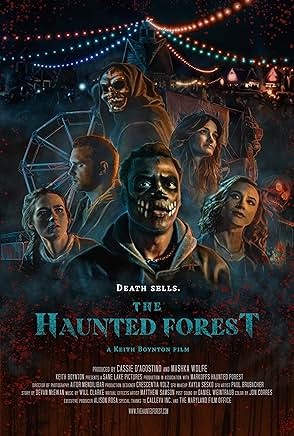

“The Haunted Forest” (2025) follows a high school senior age teen, Zach (Grayson Gwaze), who bounces from an elite boarding school during the week to spending the weekends with his cousin, Mark (Cedric Gegel), and work at Markoff’s Haunted Forest for October. When people start getting injured and losing their lives at the haunt, Zach’s horror oasis becomes a nightmare that starts affecting him at school. Why are bad things happening? If you can stay awake long enough to find out, you may not care.
“The Haunted Forest” is billed as a horror movie about a Black kid, who loves horror and lives in predominantly white spaces, including attending a private school and having a white family. All these interesting elements, which happen to be incredibly relatable to me, fall flat as the story conflates unfolding events with character development. While the cast is functional, the line delivery does not sound natural. Everyone delivers their lines as if they are reciting it and have the same cadence. It feels more like watching a stage play.
Zach’s mom is away and/or sick. Why? Dunno. His school life is shown in three ways: his fantasy life which are the equivalent of horror shorts, his English classroom and studying at the library with Carly (Meghan Reed), who gets introduced relatively late during “The Haunted Forest,” about a half hour in, but is a pivotal character as the story chugs along. He seems to have no other friends, and his dorm room never makes an appearance, which is probably the real reason that he is sleepy. He has no bed! J/k. Most of the film takes place at the haunt, and Mark delivers so many speeches. So. Many. Speeches. Zach’s deepest connections form there.
Sarah (Kaitlyn Lunardi) does the makeup and runs a group to honor the alleged massacred Piscataway people who once lived on the grounds. Jacko (Keith Boynton, who also writes and directs), the haunt’s fellow founder, also trains Zach and knows the history of the place. There are lots of sequences showing Zach getting accustomed to his new routine, something unsettling disrupts it and then being relieved as the aftermath gradually restores calm, but during each round, the stakes get raised as people start getting hurt. Unfortunately, when bad things happen, the pacing is off. It should start small and gradually build: an accident, an ambiguous death then more deaths. It is hard to get invested because all the characters feel like sketches, not three-dimensional people.
“The Haunted Forest” initially makes the story seem like a peek into the lives of the people who work at a haunt and showing Zach finally feeling as if he found his home. Only one problem: no one has any chemistry, and a real routine is not established before things go nuts. Zach keeps saying that he loves it, but that feeling is just words, not visceral. Everyone seems as if they met each other when the movie started as opposed to knowing each other for years. There is a social media thread that feels dropped out of nowhere. Fun fact: people apparently zipline at haunts. Random. The more you know. Then Zach, who is a senior at high school, becomes the object of everyone’s affection. There is a rival haunt, Phantom Wood, and a former disgruntled associate, which introduces the idea that the problems are sabotage or publicity stunts. Then there is the idea that the place could be cursed because of the massacre. The story never coalesces into a whole and feels fractured. A buffet without plates and finger foods.
More importantly, “The Haunted Forest” is not scary. The horror does not feel intimately linked with whatever is supposed to be going on with Zach, and why he prefers a haunt over a school. Zach’s epiphany that death is not entertaining but devastating feels as if it should tie into his mother’s story, but because his mom’s situation is reduced to a single line, there is no hope of an emotional impact. Boynton could have leaned into the elephant in the room, the idea of a Black kid scaring people could put a target on Black scarers back and put them in real danger. Boynton gets really close to the idea but does not develop it beyond one incident. He takes a different path, which could have worked, but does not because Zach is Black.
S
P
O
I
L
E
R
S
“The sins of our people.” Who is we? The villain of “The Haunted Forest” is white guilt meets slasher cult conspiracy. While casting a Black person as a protagonist should not automatically mean that the character should have to address race relations in the US, if you are going to have a group of predominantly white people feel so guilty about stolen land and massacred indigenous people that they are willing to kill each other, set up Black men for their crime, and poorly misappropriate indigenous culture, you have to address race head on instead of being coy. Sorry, I did not make the scenario. The slashers could have been anyone as listed above. Boynton made his choice. Literally the cult tried to frame two Black men as psycho killers while simultaneously trying to recruit one of them into the cult.
Let’s tease out the story as it is. In hindsight, Mark is supposed to be sincere, not a bloviating hypocrite who puts his family in danger for a quick buck and developing a drinking problem. So Mark’s little speech claiming that his business honors the indigenous is valid whereas Sarah’s weird posturing is not. As an outsider, both seemed random, and it did seem intriguing that Zach was willing to play along because it fit into his horror framework but still viewed it skeptically. Boynton could have done more with that because Zach left one world that he did not find comfortable, finally fits in just to get disillusioned again. Boynton hit gold and did not realize it.
Instead, Boynton’s coming age story is really a war between two women: Sarah versus Carly. Mark is not as important as his allotted screen time would indicate. He does not even get a proper onscreen death, just diegetic sound to indicate how he died. He is just a MacGuffin. When the violence comes, it is too casual and anticlimactic. It feels like a tepid murder mystery or a budget Bond villain monologue, not a horror movie. Zach and Carly kill to defend themselves and others, but these kills have no psychological or visual impact. The kills feel perfunctory.
In the end, “The Haunted Forest” feels like an elaborate intervention to get Zach to stop being into horror and enamored with death and embrace being a normal kid at school through choosing the right woman. It is not even psychological horror because Zach is underdeveloped. Now that Zach is free, what happened to the other Black guy, name unknown, who got set up and arrested for hurting someone with a chainsaw. Because he uses recreational drugs, he falls under the horror movie punishment rules. Come on! Perhaps the film would have been better as a straight drama, and perhaps teaming with a Black cowriter to tease out the elements would have made the story stronger. You don’t know what you don’t know.