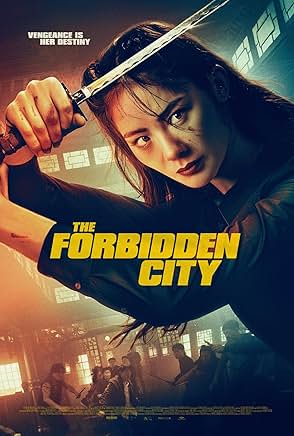

“The Forbidden City” (2025), originally titled “La Citta Probita,” is two hours nineteen minutes and will leave you wanting more. It feels like a new genre, kung fu dark romance, got invented, and it works. Stop reading this review because the less that you know going into the movie, the more fun you will have. One woman army, Mei (Yaxi Liu), leaves China and comes to Rome to find out what happened to her sister. She is willing to rough up anyone that Mr. Wang (Shanshan Chunyu) and local loan shark, Annibale (Marco Giallini), throw at her even harmless chef, Marcello (Enrico Borello), whom she believes has a clue. While nursing his wounds, Marcello is also tending to his father’s restaurant and his mother, Lorena (Sabrina Ferilli), who is horrified that his sixty-year-old father, Alfredo (Luca Zingaretti), left them for another woman, Yun (Haijin Ye). Turns out that Mei and Marcello actually share more common ground than they originally believe.
Is Liu the second coming of Michelle Yeoh and Xena, the Warrior Princess? Up to now, Liu has mostly been a stunt double starting with “Mulan” (2020). She kicks so much ass. Her collaboration with director Gabriele Mainetti is as close to perfect in capturing Mei’s agility, strength and strategic mind as one can get nowadays with chaos cinema having the action genre in a frustrating chokehold. Mei is an unrelenting revenge goddess, and she makes Jason Bourne seem dull. She can turn anything into a weapon. This film is not cheap with the action, and for most of her screentime, she is fighting everyone until her last fight when she faces off with the final boss. Stunt coordinator Troy Milenov or Trayan Milenov-Troy did some inventive work while paying homage to the classic fight sequences such as the restaurant grade kitchen fight without getting boring. They give her a historically significant backstory to elevate a reason for her love for her sister, but it was unnecessary except to explain why Mei refuses to take the ordinary safety precautions that most heroes take when two crime bosses are after them. It does ground “The Forbidden City” in reality and does not take too much time.
“The Forbidden City” is so long because writers Stefano Bises, Gabriele Mainetti and Davide Serino do not cheap out on the action, but they also do not want to shortchange Marcello, the deuteragonist. Marcello is the normal person in the movie who just wants to stay in the kitchen and cook for his guests while feeling aggrieved over his father’s irresponsibility. Marcello sees Mei as a villain, and as she is laying into him, even she stops because he is not a threat in the least. Santi (Thomal Islam) is his sous chef. Borello is a great example of positive masculinity because he never tries to assert dominance, embraces his gifts, feels his feelings, and when he does step out of his lane, course corrects because he is not the guy who seeks violent revenge or is aggressive in any way. He owes a ton of money to Annibale, the friendly, xenophobic local loan shark, who likes him because he has a crush on Marcello’s hot mom and acts like his fairy godfather.
The Italian world is mostly depicted as palette cleansing comedic relief, and comedy is the most subjective genre of all in an already subjective forum like film. Humor also does not always translate across borders. While you may not laugh out loud, you will be amused, and if you just want to rush and get through Marcello’s parts because you are just here for the action, it does pay off when they finally team up. Rome is depicted as multicultural with most immigrants exploited and treated badly, but appearing to be salt of the earth except for Wang’s section part, which occupies more space and has more of a secure foothold in Rome than other groups.
Mei’s storyline is immersed in the Chinese part of Rome, which is as serious as a heart attack. There is human trafficking, sexual exploitation and violence. Lots of it. The only nudity in “The Forbidden City” is nothing to lust over. It is women being judged like cattle to determine what work they will do as they essentially become slaves, which makes Mei’s power and personal stakes feel like an extreme, necessary countercultural shift that immediately gets the audience invested in her plight. It also explains why her attack on Marcello feels so serious because she is perpetrating one value from a system that she is trying to destroy and knows that she is better than that, just understandably emotional over an impossible situation. Mr. Wang appears to be a smiling, servile host of the titular restaurant and gambling area, but he rolls deep, has a quick temper and shows that he became a boss because he has those hands. He also randomly likes to rap (cringe), and there is a poignant storyline behind it that is effective as it approaches the denouement.
Mr. Wang and Annibale are in opposition with each other thus setting up a culture war in “The Forbidden City.” Mei , who only speaks Chinese, and Marcello , who only speaks Italian, end up being the antidote to this unnecessary conflict. Cue lighthearted tourism sequence as Marcello shows Mei all the major tourist sites in Rome at night on the back of his moped. It is kind of adorable, especially since neither of them ever leave their corner of the world at least mentally. Also, Mei rarely smiles or appears happy in this movie because she does not have a reason. She left China to go to Rome and never had the tourist experience, which hammers home how serious her mission is. It emotionally elevates the simple revenge quest. It is also the first time that Marcello is not shown suffering or feeling aggrieved. The audience needed the break between intensity and revelations as much as they did even though it is as cheesy as the dairy section.
There are flashbacks to reveal what happened to their respective loved ones so do not worry about feeling ripped off. The flashbacks are the first onscreen appearances of the characters that the entire plot revolves around. “The Forbidden City” uses these scenes and Annibale’s interactions with Marcello to make the most effective reframing of adultery into a grand love story. The film sticks the landing, especially when it should not work on multiple factors, especially age gap. Zingaretti and Ye make a meal out of a morsel.
“The Forbidden City” should not work, and maybe the mashup of genres, tones and personalities may give you whiplash. It is a wonderful, bone-crushing romp for people who use movies as vacation destinations, people who love romance between an unlikely duo, or just see women kicking ass. Also, it shows how creative people can use diversity and technology to make a story more interesting instead of seeing them as obstacles.