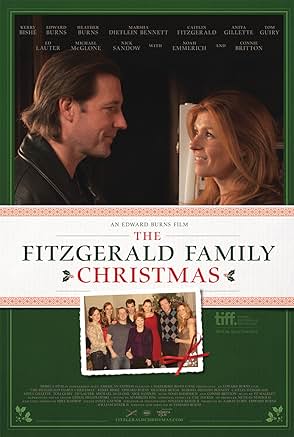

“The Fitzgerald Family Christmas” (2012) asks about the true, practical meaning of Christmas and the real concept and application of forgiveness. After twenty years, Gerry (writer and director Edward Burns) is trying to get his six siblings and mother, Rosie (Anita Gilette) to meet before Christmas to decide whether their father, Jim (Ed Lauter), could spend Christmas with his family for the first time since he left them. While some may have an argument in favor of deriding it as a Lifetime movie for men, Burns’ film is actually a masterpiece for juggling multiple storylines, creating a plethora of unique characters and tackling serious questions in a realistic way without pulling punches in a Christmas movie, a genre lately kept simplistic and saccharine.
Burns is a great writer, a functional director and a solid actor known for his films about Irish American life. As Gerry, the eldest, he prioritizes everyone except himself, treats everyone even handedly without judgment, but has no delusions about whether someone is right or wrong. Trying to get everyone under one roof is like herding cats, but the failure gives him a chance to carve out a little bit of life for himself with a meet cute with nurse Nora Daugherty (Connie Britton), who is caring for his mom’s friend, Mrs. McGowan (Joyce Van Patten). Normally eyerolls would be harvested with a romance coming out of nowhere, but he practically must be forced into it because Gerry is so focused on family and the middling family business that it would not occur to him to have a life, especially since he has his own tragic backstory. It is easier to focus on others than deal with himself. Fortunately, he is not good at controlling things and giving up is the gift to himself.
“The Fitzgerald Family Christmas” is interesting because of the unexpected way that the siblings eventually do congregate. Youngest sister, Sharon (Kerry Bishé), who lives in Manhattan and dates an older man, Francis Xavier, nicknamed FX (Noah Emmerich), ends up hanging out with her way older brother, Quinn (Michael McGlone), who has his own business, to avoid the family drama. Dottie (Marsha Dietlein) is having a midlife crisis or a second adolescence and is male centered in a cliché way but is capable of more if she can be shaken out of her hedonistic proclivities. Connie (Caitlin FitzGerald, no relation) is ignoring the growing crisis in her house and looks at her husband through rose-colored glasses, but no one else has the same prescription. Cyril (Tom Guiry) is fresh out of rehab. While juggling her first baby, Erin (Heather Burns) is uptight but has more in common with Gerry than anyone knows.
Over the course of three days, Burns gives his audience plenty of time to get to know each character, how they feel about each other, and the way that they navigate the world. When Jim gets thrown into the mix, it becomes as serious as “12 Angry Men” (1957). In “The Fitzgerald Family Christmas,” forgiveness is hard and almost impossible. People’s sins are not easily brushed aside even when a priest, Father Mike (Malachy McCourt), demands it at Christmas time. The miracle of Christmas, a person willing to suffer all the indignities of the flesh, including death, to give life and forgiveness to people who do not deserve it, is harder when it is your turn even if you celebrate the holiday for all the right reasons.
The forgiveness camp shifts along various lines, depending on which kids excuse bad behavior and which cannot for their own personal reasons; the kids’ allegiance to mom and those who do not think that it is a choice and who is disinterested in sacrificing their personal agendas to spend what time is available with their father. In the latter group, it falls along the same lines as who is interested in spending time with their mom. Just when you think that you know how to read these people, more surprises are in store, particularly with Sharon and Connie almost exchanging personalities at the eleventh hour to cinch the vote. During these debates, Gerry is on the borders of the family discussion, which further reveals how alone Gerry is. At some point, he stopped being a sibling and is more of a parent without the power. Implicit in these dynamics is how much the children favor their father and prioritize their personal agendas with lots of empty talk about family that can only get activated during crisis or holidays, but not in moments of celebration or quotidian moments.
“The Fitzgerald Family Christmas” deals with the realities of old grievances, aging and death. Mrs. McGowan has an invisible disability that prevents her from leaving the house, and the world has forgotten her except for Gerry and Rosie, but it is depicted as a fact, an accepted way of life. In contrast, everyone except Gerry ditches Rosie on a special day, and Burns allows for a little manipulative heart tugging on that score, which makes the fervent debate about dear old dad surprising. Burns highlights what activates people and what circumstances are taken for granted. The men’s pain is loud and require immediate, urgent rallying whereas the women’s pain is invisible and unnoticed without witnesses. If Burns slipped up a bit, a lot of the sisters complain about how their mother treats them differently from Gerry but does not show it. Son-in-law, Corey (Nick Sandow), Erin’s husband, who has the most reason for grievance, seems to find her antics amusing.
The events of 9/11/01 seem to be tacitly referenced but could easily be missed if a viewer watching “The Fitzgerald Family Christmas” did not live through those events. New Yorker filmmakers are generally better at handling this historic tragedy without turning into an orgy of grief or feeling exploitive, which means that the film ages well. Pre pandemic, it felt suitable, but post pandemic, with the toll of global death ignored and brushed aside, overdoing it would seem self-indulgent. Burns strikes solemn note and keeps it pushing.
Visually “The Fitzgerald Family Christmas” is functional. It is a little annoying how often scenes are caught like a verbal tennis match instead of people being in the same frame together. Otherwise, the movie does feel organic and lived in. The locations feel like real homes, not something out of a glossy magazine, even when the action shifts to the Hamptons. Compare it to “Splitsville” (2025), and this characters seem impoverished in comparison because the landscape of today’s movies hues more to fantasy. Some critics complained about the reams of dialogue, but people talk like that. If it was not set in New York, it could easily be set in Massachusetts.
Over a decade later, “The Fitzgerald Family Christmas” still stands head and shoulders above other Christmas movies. If you have not seen it and are not into the treacly crap, this movie may be for you, but if you still find it hard to choke down the concept that family comes together, even when it is hard earned, you may find the gravitational pull towards that sentiment a bit much to tolerate and should probably skip it.