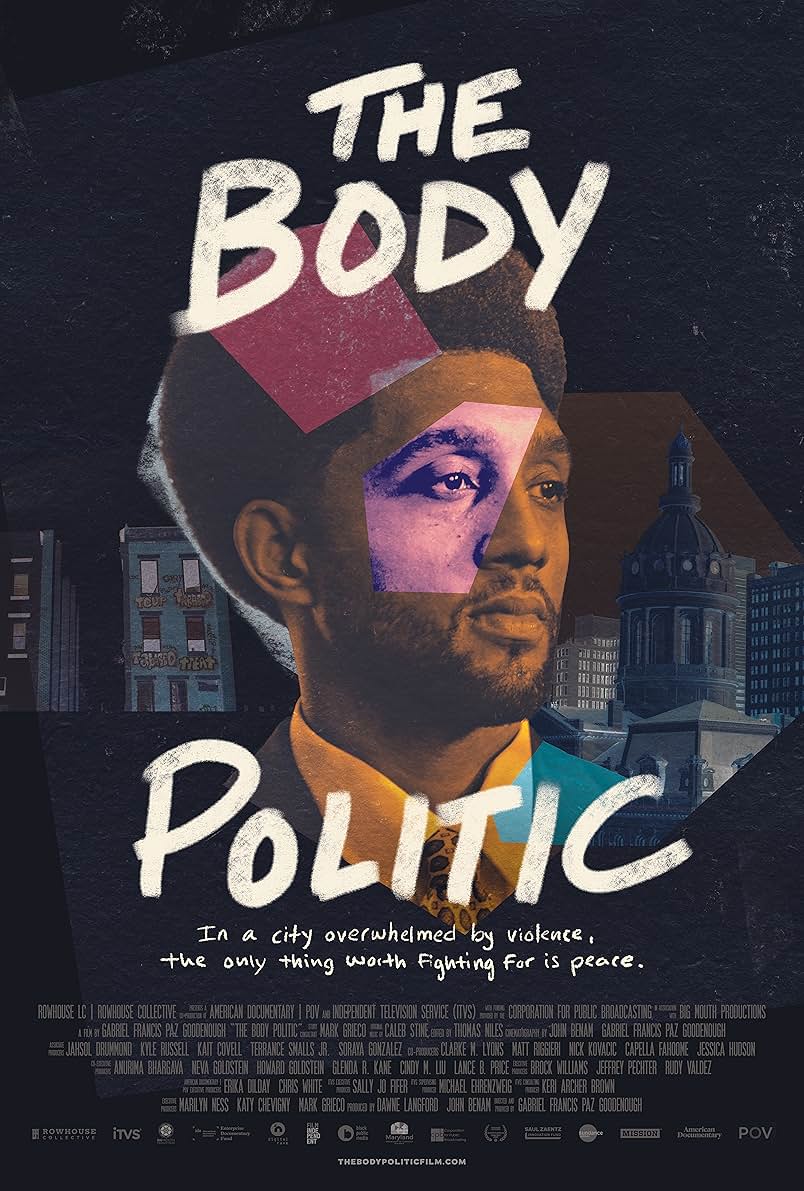

PBS’ “POV: The Body Politic” (2023), one of six Emmy nominated documentaries in the Outstanding Politics & Governance category, charts the rise of Brandon Scott from City Council President to the youngest mayor in Baltimore’s history. As a youngster exposed to gun violence and zero tolerance policing, Mayor Scott has a vision for long-term solutions to reduce homicides and create strong neighborhoods, but he needs the support of federal and state forces to make it happen. Spanning from February 2020 through New Year’s Day 2022, can he and his supporters save lives in their community once they have the political power? Third generation Baltimorean Gabriel Francis Paz Goodenough commences with the conventional politic documentary formula then switches course to chart the challenge to be realistic, optimistic and above politics.
Initially “The Body Politic” follows the expected beats from the outset: campaigning, victory and hope. Mayor Scott is framed as the city’s son and his victory is framed as a win for ordinary people. Scott’s Uncle Terry, a local mechanic, antiviolence organizer and possible survivor of gun violence Erricka Bridgeford, and campaign manager, Marvin James, are those in Mayor Scott’s corner thus symbolizing Mayor Scott’s allegiance to the ordinary voter, not professional political movers and shakers. Recognizing and respecting their outrage, Mayor Scott’s interest in the George Floyd protests depicts him as an early bridge between government and its people. If the audience is filled with skeptics who side eye this portion of the documentary, it is forgivable considering the scientifically guaranteed deleterious effect that power has on brains, which can erode a person’s memory of their humble beginnings.
Even with the Covid pandemic raging (the documentary is filled with masking), the main concern is gun violence. Most people know about Baltimore from the HBO series “The Wire,” but the documentary never references the television series. Side note: Goodenough was a camera assistant on the series. Instead, it repeatedly swats at the misconception that gangs cause gun violence and claims that ordinary people do. It is described as “interpersonal conflict.” Scott’s administration may lack governing experience, but they have plenty of lived experience as people exposed to gun violence and with enough skin in the game to see the cause as more than a political talking point, but an issue that affects their loved ones. Even though political rhetoric frames Mayor Scott as radical, Baltimore Police Commissioner Michael Harrison routinely appears to be someone ready for a fresh approach and seems to recognize that the system is broke, so it is time to fix it. It is with great contrast to the immediate naysayers who complain that Mayor Scott couldn’t deliver on his campaign promise immediately.
Goodenough documents how each person is a piece of the puzzle in this long-term plan described as “Group Violence Reduction Strategy” (GVRS). Exclusive one-on-one interviews with Scott lays out how the plan works: using federal funds; eliciting the Governor’s support through collaboration with state agencies such as parole and probation, corrections, juvenile services, and city jails; and expanding Safe Streets, which deploys “violence interrupters,” and other on the ground services that offer door-to-door outreach. This structure also informs the viewer of the importance that each person plays for this plan to work.
Director of Neighborhood Safety Shantay Jackson is the person who implements Mayor Scott’s plans in the streets and before the City Council. When she does not have easy answers, she gives a deliberate, measured, honest and complex answer which fails to satisfy the established voices who want fast food results and are confident that their past failed solutions should be reimplemented despite knowing that it does not work. Mayor Scott’s term is less about anti-gun violence theater, polished empty media ready responses, and more about hard numbers. As “The Body Politic” unfolds, it is not politics as usual, which makes it a refreshing instead of a stale, stations-of-the-cross, safe documentary.
The federal actors only make a cameo appearance: US senator Ben Cardin and US Representative Kweisi Mfume, but the meatier, dramatic theme is the initial refusal of Governor Larry Hogan to meet Mayor Scott, which results in not providing enough support to the on-the-ground peacekeepers. The following Safe Streets members appear on screen: Tater Barksdale, the leader, Belhair-Edison neighborhood violence interrupters and Dante Johnson and Al Williams. Irene Conway, a member of GVRS, does community outreach to deescalate heightened conflict and get jobs for people most at risk to engage in and/or become targets of gun violence. Though Conway’s work is not flashy and has to be redacted to protect participants’ privacy, it would have been interesting if “The Body Politic” devoted more time to breaking down the practical logistics of how that program worked. It is clearly the meat and potatoes that is only possible when the federal, state and city government form Voltron. It also has many applicable uses besides preventing gun violence. This idea clearly needs to be evangelized everywhere, but with Presidon’t in charge of destroying the federal government, maybe it is for the best that it was not documented so there is not a step-by-step guide on how to destroy it.
After a spate of watching political documentaries like “Prime Minister” (2025) and “State of Firsts” (2025), it becomes boring to watch one person, especially when they are a politician, unless they find a way to be simultaneously diplomatic and raw. While Mayor Scott is not a typical politician, “The Body Politic” has momentum rooted in a community-led movement, not a man. With all her woo woo, sage-burning, fairy wings wearing ways, Bridgeford ends up standing out as the most riveting figure in the documentary. Unlike the elected and government officials, when the mainstream media goes on the attack, “You’ve been doing this and violence isn’t really going down,” Bridgeford flips the script, “Your question frames the narrative.” Bridgeford gives a complex, textured answer and offers a practical vision of how to create utopia instead of giving up. Then she turns around and mentors a younger person to let them know how to question the established dynamic instead of playing a game that is not designed for them to win.
In contrast Mayor Scott accepts the condemnation from ordinary people, city council members and reporters without any spin. His administration does not see reduced death as a success but inaugurated a virtual Vigil of Remembrance to remember all the people who died because of gun violence. Even though it turned out that his plan would be a success, any death is correctly deemed as unacceptable. Again, Bridgeford comes to the rescue, so Mayor Scott will not surrender to his despair and defeat.
If “The Body Politic” has a serious flaw, it is the opening. It records a conversation between Mayor Scott and police commissioner Richard Worley, who is unidentified and says something in confidence. Goodenough never shows Scott saying that he is on speaker phone and a cameraman is recording the rainy evening drive. It makes Mayor Scott seem sketchy from the outset, which does not last, but was an unnecessary speed bump.
It is a relief that “The Body Politic” is not just another compilation of archival news segments with a sprinkling of exclusive interviews, but a political documentary that depicts how the sausage is made, the ordinary heroes that support the government initiatives and the difficult lessons of governance as a slow burn, not a quick and easy fix. It also never loses sight of the people who are lost despite the best efforts of everyone involved. Stories like this prove that the system can work if the power is with the people.
Side note: Mayor Scott won a second term, which will be his last unless he decides to run again four years after the second term. Because “The Body Politic” covered a limited period, it did not cover the Strategic Management and Alternative Response Tactics (SMART) initiative, which redirected non-emergency and mental health issues from the BPD to other services. It also did not cover the Polymer80 lawsuit, which alleged that the company overran the city with privately made guns and was settled. He also worked on housing reform, an issue alluded to in the documentary with buildings being torn down. He also piloted a guaranteed income program, a program alluded to in other locations and documentaries. Transportation access, in part through the “Let’s Ride to Work” program, was also key for ensuring that people could stay employed once they got a job. Time to make more documentaries. Chop chop. Is everyone’s record as impressive and they just are not good at messaging or is Baltimore special?