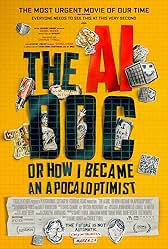

What makes a documentary good? What is a successful documentary? The answer is not “if I like it,” which is good because “The AI Doc: Or How I Became an Apocaloptimist” (2026) lost me before the forty-minute mark. Consider yourself warned. It depends on the type of documentary it is, if it succeeds at accomplishing the filmmakers’ goals, and if it can find and satisfy its audience. Based on that criteria, codirectors Daniel Roher and Charlie Tyrell get a positive score by the skin of their teeth. Concerned about the effect of AI on the world now that his first baby is coming, Roher talks to a bunch of people related to AI to see if it is bad or good then offers a list of suggestions to tilt the scales towards good. It takes a long time to get there, fails to interrogate and challenge a lot of assumptions that the talking heads bring to the table and is largely emotional than informative, which means it may echo its target audience’s approach to the subject matter, but will be frustrating to people more in the know and boring for those who are not.
“The AI Doc: Or How I Became an Apocaloptimist” has a main character, Roher, a frame story to hang everything on, the preparation and anxiety for preparing for a new baby, a supporting cast of Roher’s family, especially his wife, filmmaker Caroline Lindy (“Your Monster”), who are tellingly not credited on IMDb, and a revolving door of talking heads from the leaders in the AI world, critics, proponents and disruptors. The directors keep the momentum going with animation, stylistic touches of home videos, archival news clips and TED Talks. The narrative structure gets messier as it approaches the end, and there are plenty of false endings, none of which are as nostalgia inducing as the end of a certain Peter Jackson trilogy. Most shocking of all is the assumption that AI works, is exponentially getting more powerful and is here to stay. Most of the interviews are a string of assertions with no proof offered and accepted in good faith…from the people who make the product. OK. Does someone have a bridge that they would like to sell Roher? For instance, one talking head talks about AI making weapons. Cool. Give an example. Nope. If they say AI has not made weapons, then they reveal their hand that they are overselling a product, but if they say they do, then they must reveal something that is a trade secret or can get backlash. Watching this documentary often feels like an infomercial with the veneer of professionalism.
To be fair, “The AI Doc: Or How I Became an Apocaloptimist” is not an expository documentary that wants to inform or persuade from an investigative journalist. It is a participatory documentary, which means that the filmmaker’s participation affects the narrative structure and conclusions of a subject external to the filmmaker. In contrast, a reflexive documentary is more purely autobiographical. If this film was a scripted feature, such a blend would be called autofiction, maybe an easier title than participatory would be autofactual film. Roher’s anxieties and feelings about the interviewees affect how the film unfolds. For instance, Roher finds the CEO of OpenAI Sam Altman to be incredibly comforting though a brief, earlier montage shows Altman talking to a group of Saudis then Presidon’t while expressing verbal concern about authoritarianism. So, Altman’s demeanor outweighs his actions without details of context to deter detractors from saying “Birds of a feather,” even when the directors know of the contradiction in sentiment and practice because Altman is expecting his first child as well. Seriously. The bar is in hell.
Are moviegoers sophisticated enough to sniff out the fact that just because a movie is a documentary, it does not mean that it represents or is trying to determine the objective truth of an issue? It is a larger problem unrelated to whether “The AI Doc: Or How I Became an Apocaloptimist” is actually good. Roher prioritizes his feelings, his subjective criteria for what makes someone worthy to participate in the documentary and how much screentime that they will get. It embeds his bias of who will help write his stories regardless of whether he intends to do it or not. He does nothing to counterbalance it. While this documentary beats other documentaries about AI in terms of access, it sacrifices critical thought for entry while shielding itself behind universal sentiment based in primal biological imperatives, i.e. reproduction.
“The AI Doc: Or How I Became an Apocaloptimist” is less about AI than parenthood and family. Lindy is the best part of the documentary though again not credited on IMDb. She is not a documentarian, but her questions lead to a strong end. Fun fact: if you Google, “Who is Daniel Roher’s wife,” the answer is dated to a partner that he never married, and the AI overview has zero information, but if you ask, “Who is Daniel Roher’s wife Caroline,” then an accurate answer is forthcoming. Is this your God? Is this the technology that is smarter than a human being? This documentary is part of a proud tradition of men’s work that leans heavily on their wife’s greater incisiveness without giving them credit thus erasing them from history and search engines unless one is determined to notice and highlight it for him and posterity. Whether it is deliberate or just the default patriarchal impulse, this omission and the documentary’s agenda, to reassure audiences that family is wonderful, and you should have a baby, are aligned with a reactionary agenda that overlaps with someone like Elon Musk, but not a growing sentiment among normal people, especially women, who seem wary of having a child because of the work that goes into it, which they have to do.
There is a common joke that when it is a holiday, women fall into default roles and execute invisible labor then act as the house manager and ask the guy for help who immediately goes outside and rearranges the tools in the garage or some task that bears zero relationship to the spirit of her request. “The AI Doc: Or How I Became an Apocaloptimist” feels like that kind of movie. Lindy’s credits do not reflect that she has any upcoming films, and she does not have to. It is her choice to stop working in film and prioritize her child and her husband’s work, but it is interesting that for the filmmakers, a baby gets leveraged into more visible work for them without a cast credit for Lindy. Did I mention that already? I have credited Lindy more times than IMDb or the press materials, which are supposed to reflect the important aspects of the film.
How can a film examine the efficacy of technology on society if the filmmakers are so dense when it comes to the ways that they unconsciously and glaringly digest and analyze the world? In my world, they are not credible, but they are thorough, deserve credit for coming up with solutions, and prioritizing the human side of the equation. Too bad that their human side is also so blind and stuck in a navel gazing lack of curiosity about the world beyond what they relate to and is in their self-interest.