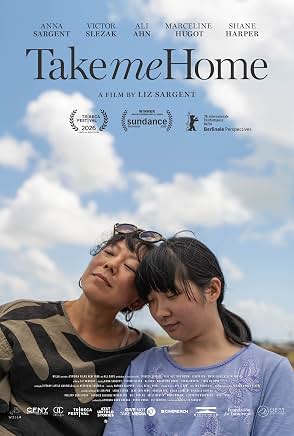

“Take Me Home” (2026) expands writer and director Liz Sargent’s short film (2023) and the the short’s star and filmmaker’s sister, Anna Sargent, reprises the role of Anna, the older, adopted adult daughter of Joan (Marceline Hugot) and Bob (Victor Slezak), who are aging and ailing. As the real-life person and the character, Anna has cognitive and physical disabilities. Joan has mobility issues, and Bob is showing signs of dementia. When the trio combine their strengths, they are functional, but then one of the legs on the stool can no longer provide support. Will Anna be able to hold up their world, and if she cannot, what will happen? Lyrical, realistic and without taking events to their absolute worst-case scenario, the trailer hides that Sargent’s debut feature is an unflinching gut punch that leaves no character unscathed though always loved and understood.
The trailer completely misleads viewers that “Take Me Home” will be a sweet family drama. It is billed as a comedy maybe to reassure the public that it is not maudlin or dismal, which it is not, but it is not funny. It is bleak. The movie opens on a normal day in the life of this family, and like “Lady Parts” (2024), the actors are so convincing as a family that the film often feels like a documentary. The actors perform like an intimate unit with Hugot bathing Anna, and Slezak cuddling with Anna as they watch television. Hugot and Slezak do not seem as if they are playing Anna’s parents. Everyone is relaxed with each other. So relaxed, that once the bumps in the road appear, they never stop.
When Anna does not get her way, she shouts, throws tantrums and disrupts everything and everyone. Joan tries to get her on the right track, but on his good days, Bob would rather go with the flow than threaten to extend the chaos in the hopes that it will naturally wind down, which is emblematic of all their problems. On his bad days, he shouts back because people with dementia can behave exactly like Anna when frustrated. “Take Me Home” has a lot of yelling, so if your nerves cannot handle it, consider yourself warned. On one hand, it is refreshing to see a family behave in a way that people will recognize instead of just inspirational while having disabilities that would not be instinctually affronting to other people. Often in movies, everyone is understanding, and the upsetting moments are limited or framed as quirky. Nope.
There is a younger, adult adopted sister, Emily (Ali Ahn), who pitches in to help, and if you watched “Take Me Home” to see how she is going to step up, adjust your expectations. Joan wants more contact with her, and Bob sees Emily’s independence and distance as a success of their parenting. In one wonderfully nuanced scene, Bob verbalizes his approval to Emily, and Ahn’s muted reaction shows that his pride is more gutting and condemning than if he expressed harsh disapproval. Ahn is terrific in this, and Sargent successfully navigates the tight rope of depicting a woman who cares about her family but has a demanding and unrelenting life of her own to balance. After you finish the movie, you may be tempted to judge her as oblivious, but Sargent nails the dialogue and situation to make her reactions understandable, not negligent. When she sees her dad, he just seems like a cheap skate, not lacking in judgment. All things considered, she handles Joan’s decline well.
The sisters’ dynamic is the brief shining light in “Take Me Home.” They are sisters, but now Emily functions in a maternal capacity to her older sister. She alternates between being a gentle guiding force to reveling in the chaos and going along with the mischief. The trailer features the stealing popsicles scene that ends with them having a stress-free day together that borrows the rhythms of leisure that their parents had with Anna. Upon further contemplation, of course Emily would know those rhythms. Their parents probably had the same habits since they were kids.
Eventually, “Take Me Home” gets to brass tacks. Anna and Bob need help, and the options are sparse. Anna and Bob visit a possible residential option for Anna, and it clearly seems inappropriate since most of the residents are not engaging with each other and seem isolated in their own bodies. An employee, Geraldine (April Matthis), gives them two options: pay $10,000 or abandon Anna at an emergency room, but Anna would be separated from her family forever, which is an unrealistic option. Later, Bob starts yelling at Anna mistaking her for someone else who suggests that he needs help too. The next-door neighbor, James (Shane Harper), offers a brief respite for Anna, but considering the stats on how women with disabilities are more vulnerable to abuse, every time that they hang out, it may induce anxiety. Nothing happens.
“Take Me Home” has a deliberate pace with lots of montages showing close ups of various aspects of the neighborhood or showing the varieties of reactions. The rhythm of the place contrasts with the family’s quiet reverence or noisy protests. The last act is shocking juxtaposed to these moments and will leave your mouth agape at the implications. Sargent envisions a realistic utopian, lively and diverse community where Anna fits in. To understand what is happening, pay close attention to the dialogue in the first act. It offers a huge clue. If you get it, you will realize that the ending was earned, but devastating.
It is unfortunate that “Take Me Home” never came to theaters because it is easier to notice those details on a big screen in a theater that makes you focus on what is in front of you. The night interior scenes are harder to see on the silver screen or a computer, but if “Game of Thrones” screwed up the lighting for a pivotal episode with more money and resources, it is not a big deal and does not last long. Do not watch this movie if you are depressed and do not take anything in the trailer at face value. There is a precipitous drop that no one is prepared for.
S
P
O
I
L
E
R
Never exploitative, “Take Me Home” is a realistic drama version of a “Final Destination” entry except of completely avoidable deaths in the contemporary dystopian US while everyone whistles and pretends everything is fine. It is so understated that as a character dies, it is often a blink and miss it moment. Side note: a completely different scenario, but a former coworker had a car roll over him, and he is fine, which is astonishing, but true. This movie has a higher death count than psychological horror films! Joan died of heat stroke. Bob did the Florida equivalent of drifting on an ice floe to die. Anna died in a fire and wakes up in a secular heaven. She only fits in when she dies! No one rescues any of them! It not only could happen but has. For example, Gene Hackman and his wife. I was unprepared. Ouch.