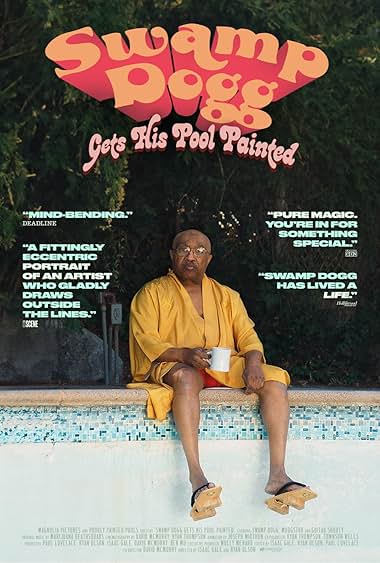

“Swamp Dogg Gets His Pool Painted” (2024) is an unconventional documentary about Jerry Williams, stage name Swamp Dogg, an alter ego that he created in 1970 after formerly being known as Little Jerry Williams, who has been recording music since 1954. As he prepares for his eightieth birthday party at his house in San Fernando Valley, “the Valley,” Swamp Dogg entertains friends at a card table as Jesse Willenbring, a LA and NY based visual artist, paints his pool, and we are invited for a virtual house tour. Their conversation and exclusive interviews lead to stories about their lives, which happens to include a lot of music history.
If you are looking for a comprehensive, chronological documentary about Swamp Dogg, then “Swamp Dogg Gets His Pool Painted” is not for you, but if you want to know what he is like to hang out with, then it is a must-see movie. Swamp Dogg is depicted as the house owner showing hospitality to his long- and short-term guests, a poet in front of a colorful background wearing a three piece suit to deliver a poetic reading, give exclusive interviews in his armchair with his dog, Lowe, in his lap, and appear in creative skits as if he is hosting a cooking show on television. The style of the documentary is reminiscent of those Seventies era variety shows that are part talk show, part skits and part reality television. There are a plethora of montages consisting of photographs, archival video and film of performances, talk shows and other television appearances, and home videos chronicling Swamp Dogg’s life story. The documentary feels like a Nineties underground club kid made it.
Swamp Dogg’s daughter, Dr. Jeri Williams, appears in her office and describes her dad’s living arrangement as a “bachelor pad for aging musicians,” which should not be confused with wild partying and is probably the most surprising element of “Swamp Dogg Gets His Pool Painted.” It is a lot of shooting the breeze and hanging out with musical and dance breaks. The Narrator, Gregg Grease, a hip-hop/rap musician and fan of the titular artist, offers the occasional audio connective tissue between the tales, but this documentary is for the deep cut fans or people solely interested in the vibes. Because Swamp Dogg’s life is not told in chronological order, it is hard to get a sense of the overall trajectory of his story. It does highlight his move from New York to Miami then Macon, Georgia ultimately landing in Muscle Shoals, Alabama, which is synonymous with session musicians churning out some of the greatest music that the twentieth century had to offer without the soulless sameness typical of commercial music.
Two friends live with Swamp Dogg: Moogstar and Guitar Shorty. Each of them gets the Swamp Dogg treatment, a documentary within the documentary, about their respective lives except Moogstar gets animated recreations drawn in the style of Iwao Takamoto, an animator at Hanna-Barbera Productions who originally designed Scooby Doo. Guitar Shorty, government name David Kearney, a contemporary of Swamp Dogg, died during the production of this film with his last living onscreen appearance showing him opening a door as if he is commuting to Heaven by foot. Moogstar, government name Larry Clemons, the youngest resident, never explains how he started living in the Valley with the artist. Because he fills the house with his artistic vision and is often shown giving impromptu solo concerts poolside, the living arrangement seems like a natural fit. Moogstar gives the impression of an undiagnosed neurodivergent person with his quirky, playful aesthetic (compliment). If it is an act to get attention, he has been doing it for fifty years and is so committed that he has earned it. Unlike Swamp Dogg, there are no details about what happened to the wife and four kids.
“Swamp Dogg Gets His Pool Painted” also features other people and frames them as if they just happened to drop in to chat at the card table next to the pool. Most of these participants are famous, but a viewer would not know that from just watching the documentary. Naeem Juwan, formerly of Spank Rock and now commonly known as Naeem, collaborated with Swamp Dogg on their track “Simulation,” which appears on Naeem’s 2020 album “Startisha” and was an homage to Swamp Dogg’s 1970 album “Total Destruction To Your Mind.” This context is not offered in the documentary, but instead Naeem is shown angling for a spot in the house and sporting socks with a sexual demand printed on them. Andre Jackson admiringly poses questions about Swamp Dogg’s ability to wear different hats in the music industry. Alonzo Williams credits Swamp Dogg with establishing the West Coast rap scene through his music label, which Yvonne, Swamp Dogg’s deceased wife, established among other business enterprises that enabled Swamp Dogg’s lifestyle to this day. The documentary does not explicitly explain that Williams developed the World Class Wreckin’ Cru, a hop-hop group that included Dr. Dre as a member.
Alleged neighbor Tom Kenny, the voice of SpongeBob SquarePants, drops in to elicit talk of how Swamp Dogg got the FBI’s attention as a subversive. Mike Judge also appears to validate Moogstar’s wild story about a white owl appearing, which they consider a fortuitous sign; thus, proving that they are oblivious to indigenous folklore, but nothing bad has happened, so maybe they get a pass. Judge is an animator, voice actor, writer, director and producer best known for “Beavis and Butt-Head,” “King of the Hill,” “Office Space” (1999), “Idiocracy” (2006), “Extract” (2009), “Silicon Valley,” and may have featured Swamp Dogg on “Mike Judge Presents: Tales from the Tour Bus,” a clip of which was shown on many of the numerous televisions perched throughout the home. Johnny Knoxville of “Jackass” fame also drops in to razz the pool painter, Willenbring. Two of the three first time feature codirectors, Isaac Gale and Ryan Olson, commissioned Willenbring, but Willenbring’s history and how he is hired does not appear in “Swamp Dogg Gets His Pool Painted.” All the big names just ask like ordinary people. Emphasis on act since there is a camera right there to capture the alleged spontaneity.
“Swamp Dogg Gets His Pool Painted” becomes more diffuse as it approaches the end. It touches on Swamp Dogg’s musical collaboration with John Prine, American folk-country singer. Swamp Dogg covered Prine’s song, “Sam Stone,” on “Cuffed, Collared & Tagged,” and Prane later sang on Swamp Dogg’s album, “Sorry You Couldn’t Make It,” one of his last performances before Prine died. Even though their relationship was possibly the longest collaboration featured in the film, the documentary does not devote a lot of time to it, and a viewer would not know of how long they worked together. There is a recording studio session with Swamp Dogg working on Jenny Lewis, an American songwriter, musician and actor who also lives in the Valley. Fans of the singers can only expect a brief glimpse of her too, but it is good to get a sense of Swamp Dogg’s work style and not just hearing about it.
Though delightful, “Swamp Dogg Gets His Pool Painted” requires a bit too much brainpower if you want to get more from the film than just a feel for the onscreen personas. While the documentary is probably best suited to match Swamp Dogg’s style, it could be exhausting for someone trying to keep the timeline straight and more left-brained.